Modern Data Stack: A Decision-Maker's Practical Roadmap
Modern Data Stack: A Decision-Maker’s Practical Roadmap The modern data stack is a cloud-native, ELT/SQL-first data infrastructure that moves raw data from source systems into a governed, analysis-ready state, and it is currently the most practical foundation for both fast ana...
The modern data stack is a cloud-native, ELT/SQL-first data infrastructure that moves raw data from source systems into a governed, analysis-ready state, and it is currently the most practical foundation for both fast analytics and AI readiness. If your team is still running on-premises ETL pipelines, waiting days for reports, or wondering why your ML models keep producing unreliable outputs, this architecture is the direct answer. The core primitives are ELT (load raw first, transform inside the warehouse using SQL), separation of storage and compute, and modular tooling, and together they reduce operational burden while preserving the data history your future AI workloads will need.
Table of Contents
-
How does a modern stack differ from a traditional data platform?
-
What governance and observability controls should you build from day one?
-
What strategic bets should you make over the next 12–36 months?
-
Environmental and sustainability considerations of cloud-native data stacks
-
Ridiculous Engineering builds modern data stacks that actually ship
What is a modern data stack, and what makes it “modern”?
The term gets used loosely, so a precise definition matters. A modern data stack replaces the legacy ETL monolith with a set of cloud-managed services, each responsible for one layer of the data pipeline, connected by SQL as the shared interface. “Modern” refers to four specific architectural decisions, not a brand or a vendor.
Core principles:
-
Cloud-native managed services. No servers to provision, no warehouse clusters to size in advance. Compute scales elastically and you pay for what you run.
-
ELT, not ETL. Load raw data into the warehouse first, then transform it in place using SQL. Cloud warehouse storage is inexpensive; compute is elastic and billed per query. Loading everything raw preserves optionality: when requirements change in six months (they will), the source data is still there.
-
SQL as the lingua franca. Analysts, analytics engineers, and data engineers all work in the same language. Cognitive handoffs between Python preprocessing and SQL reporting largely disappear.
-
Separation of storage and compute. Reporting workloads no longer compete with ad-hoc queries for the same CPU. ML training reads the same tables BI reads without copying them. Capacity planning, the bottleneck of the on-premises era, mostly evaporates.
-
Modularity with practical consolidation. Each layer is replaceable in theory. In practice, the 2026 direction is fewer tools doing more, not more tools doing less.
These principles connect directly to business outcomes. Time-to-insight drops because analysts can self-serve against modeled tables rather than waiting for IT to build reports. Cost becomes more predictable when you run a small, disciplined tool set. And AI readiness follows naturally: clean, governed, accessible data is the prerequisite for any ML model or AI agent to deliver reliable value.
Cost signal: A company using the standard stack typically spends a modest monthly budget, scaling with team size and usage, with warehouse compute as the primary cost driver. The variance is almost entirely warehouse compute, which scales with query volume and how disciplined the team is about incremental versus full-refresh runs. For typical teams, monthly spend ranges from $500–$2,000 for a 50-person company, and $5,000–$20,000 for mid-market teams of 50–200 employees.
The core components: what each layer does and who owns it
Think of the analytics stack as a pipeline with distinct responsibilities at each stage. Conflating layers is where most architecture mistakes originate.
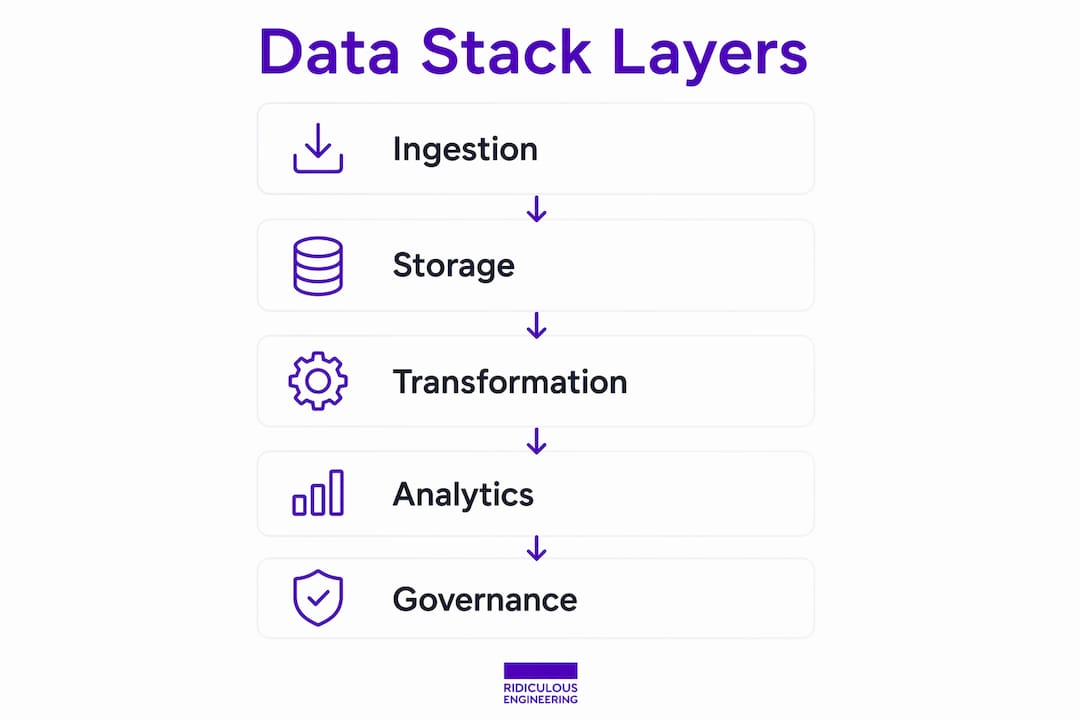
| Layer | Responsibility | Key signals / constraints | Typical owner |
|---|---|---|---|
| Ingestion | Move raw data from sources into the warehouse; handle schema detection, incremental loads, CDC | Connector availability, PII handling, sync frequency | Data engineer / platform team |
| Storage / Warehouse | Store raw and modeled data; serve SQL queries; scale compute independently | Query cost model, concurrency, ML workload support | Platform team |
| Transformation | Convert raw tables into modeled, tested, documented assets using SQL | Model run time, incremental strategy, test coverage | Analytics engineer |
| Orchestration | Schedule DAGs, retry failures, alert on breakage, block downstream on upstream failure | Pipeline complexity, team Python fluency, managed vs. self-hosted | Data engineer |
| Data quality / Observability | Monitor freshness, schema drift, null rates, test pass rates; alert before stakeholders notice | SLA sensitivity, data contract requirements | Analytics engineer + platform team |
| Metrics / Semantic layer | Define business metrics once; expose consistent numbers to every BI tool | Metric governance, multi-tool BI environments | Analytics lead + business owners |
| BI / Analytics | Serve dashboards, ad-hoc queries, and self-service exploration | Audience technical level, embedding needs | Analytics team + business owners |
| Reverse ETL / Activation | Push modeled data back into operational tools (CRM, marketing platforms) | Sync frequency, PII compliance, API rate limits | Data engineer + marketing/sales ops |
| Streaming (when required) | Handle low-latency event processing where batch cadence is insufficient | Latency SLA, event rate, engineering capacity | Platform / data engineering |
A few ownership notes worth stating plainly. Business owners typically define what metrics mean and sign off on semantic layer definitions. Platform teams own infrastructure, access controls, and cost monitoring. Analytics engineers sit at the intersection of data engineering and analysis, and that role is where most modern stacks live or die. Cross-team SLAs are required at the ingestion-to-warehouse boundary (who is responsible when a source connector breaks?) and at the transformation-to-BI boundary (who owns a broken dashboard metric?).
Where teams commonly go wrong:
-
Skipping the semantic layer and letting every BI report define its own metric logic, producing conflicting numbers across teams.
-
Treating orchestration as optional until pipelines exceed ten models, then scrambling to retrofit it.
-
Assigning observability to “whoever notices,” which means nobody until a stakeholder does.
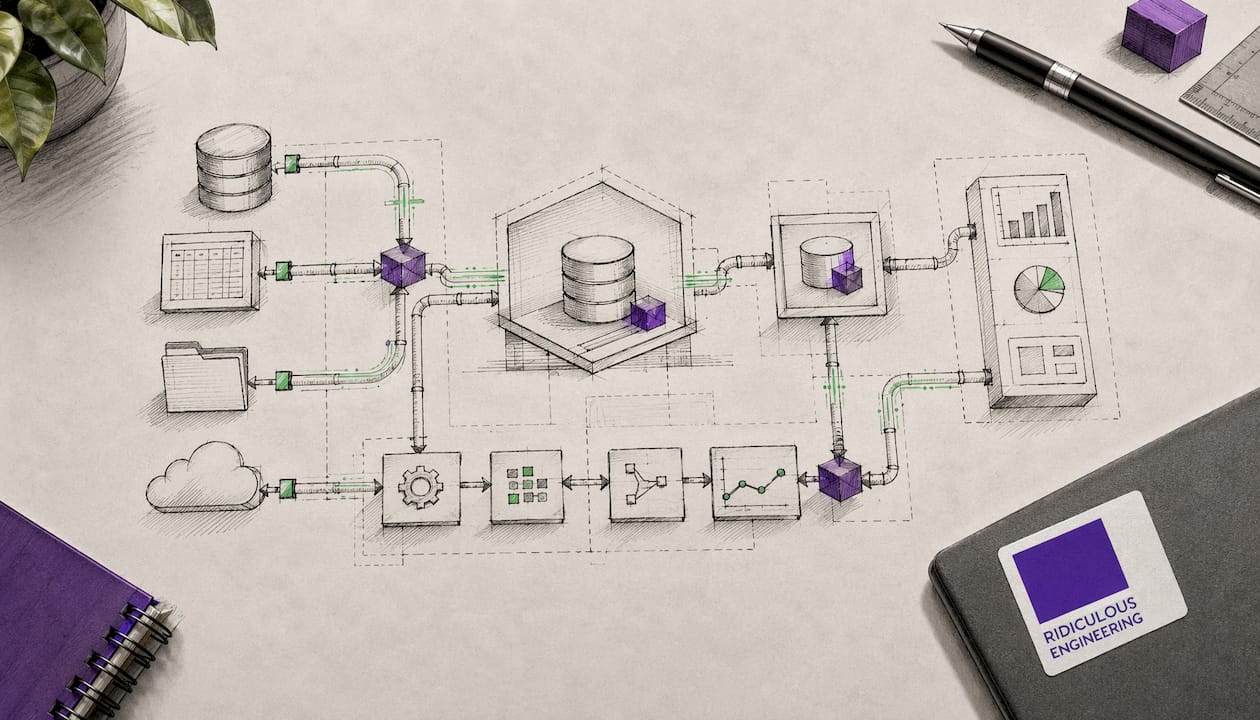
Which architecture pattern fits your situation?
Warehouse-centric
The default for most teams. A cloud warehouse (Snowflake, BigQuery, or Databricks SQL) serves as the hub. Raw data lands there via connectors, dbt transforms it, and BI tools query it directly. Simple to operate, well-documented, and sufficient for the majority of analytics workloads.
Lakehouse
Open table formats like Apache Iceberg and Delta Lake sit on object storage (S3, GCS, ADLS) and support both SQL analytics and ML training from the same physical data. Lakehouse patterns reduce vendor lock-in on storage formats and are the right choice when ML workloads are a first-class citizen alongside BI. Databricks is the most common entry point; Snowflake’s Iceberg support has narrowed the gap considerably.
Hybrid
A warehouse handles governed analytics; a lakehouse or data lake handles ML experimentation and large-scale raw storage. More operational complexity, but appropriate for organizations where the ML and analytics teams have genuinely different needs and enough engineering capacity to maintain both.
Streaming adjuncts
The modern stack is batch-first. Streaming architectures (Kafka plus Flink, or Spark Streaming) typically run alongside the warehouse rather than replacing it. The “unified batch and streaming” pitch has been perpetually touted for years; in practice, real-time systems coexist with the warehouse and rarely share code with it. Introduce streaming only when a latency SLA genuinely requires it, not because it sounds impressive. For a deeper look at when real-time patterns pay off, real-time data patterns are worth reviewing before committing to the infrastructure cost.
Pro Tip: Start with the warehouse-centric pattern. Add a lakehouse layer only when ML workloads are production-grade and the team has a dedicated platform engineer to maintain the open table format. Add streaming only when a business process has a documented latency SLA under five minutes that batch cannot meet.
How does a modern stack differ from a traditional data platform?
The contrast is sharper than most migration proposals acknowledge.
Key differences:
-
Deployment model. Legacy platforms run on-premises or in self-managed VMs. Modern stacks use fully managed cloud services with no infrastructure to provision.
-
ETL vs. ELT. Legacy ETL transforms data before it reaches the warehouse, often in proprietary tools with limited version control. ELT loads raw first and transforms inside the warehouse using SQL in Git.
-
Monolith vs. modular. Legacy platforms bundle ingestion, transformation, and serving in one product. Modern stacks separate them, which enables independent scaling and team ownership.
-
Scaling model. On-premises systems require capacity planning and hardware procurement. Cloud warehouses scale compute in seconds.
-
Self-service vs. IT-controlled reporting. Legacy systems typically require IT to build every report. Modern stacks expose modeled tables directly to analysts and business users.
The architectural shifts that made this possible arrived in sequence: cloud object storage made raw data retention cheap, cloud warehouses separated compute from storage, and dbt put transformation logic into Git. Those three changes, arriving between roughly 2016 and 2020, made the modern stack viable for teams without large infrastructure budgets.
Migration anti-patterns to avoid: Lift-and-shift without refactoring (you get cloud costs with on-premises architecture), uncontrolled incremental loads that silently duplicate records, and skipping governance setup on the assumption you will add it later. You won’t, until an incident forces you to.
Legacy platforms carry real operational risk: schema changes break downstream reports with no lineage to trace the impact, capacity constraints create reporting queues, and stored procedures accumulate technical debt that nobody wants to touch. The cloud computing advantages of the modern approach are not theoretical; they show up in reduced on-call burden and faster iteration cycles.
Which tools should you actually use?
ELT with SQL-in-warehouse has standardized the transformation layer, and dbt is the default tool for managing SQL models. The rest of the stack has more options, but the selection heuristic is consistent: pick one tool per layer, prefer managed over self-hosted when team capacity is limited, and plan FinOps controls from day one.
| Layer | Representative tools | Best for / notes |
|---|---|---|
| Ingestion | Fivetran, Airbyte, AWS Glue, Azure Data Factory | Fivetran: managed, many connectors, minimal ops; Airbyte: open-source option; Glue/ADF: AWS/Azure-native shops |
| Warehouse | Snowflake, Google BigQuery, Databricks | Snowflake: analytics-heavy, strong governance; BigQuery: cost-at-scale, serverless; Databricks: ML-heavy workloads |
| Transformation | dbt (Cloud or Core), SQLMesh | dbt is the default; SQLMesh is the emerging alternative for state-aware runs |
| Orchestration | Apache Airflow, Dagster, Prefect | Airflow leads by deployment count; Dagster gaining traction for asset-based workflows; Prefect for Python-first teams |
| Data quality / Observability | dbt tests, Monte Carlo, Soda | dbt tests cover most needs early; Monte Carlo and Soda for production SLA monitoring |
| Metrics / Semantic layer | dbt Semantic Layer, Cube | Define metrics once; expose to multiple BI tools |
| BI / Analytics | Looker, Tableau, Power BI, Metabase | Looker for metrics governance; Metabase for broad self-service; Tableau/Power BI for executive reporting |
| Reverse ETL / Activation | Census, Hightouch | Push modeled data to CRM, ad platforms, and operational tools |
| Streaming | Apache Kafka, Apache Flink, RisingWave | Parallel to the warehouse; introduce only when latency SLA requires it |
Selection heuristics for US organizations:
-
If your team has fewer than three data engineers, choose managed ingestion (Fivetran) and dbt Cloud over self-hosted alternatives. The operational savings outweigh the licensing cost.
-
Snowflake and BigQuery are both strong defaults; the decision usually comes down to existing cloud relationships and whether ML workloads are primary.
-
Tool sprawl with eight or more SaaS tools creates significant operational and cost friction. Many teams reduce to four primary components in practice: warehouse, dbt, one orchestrator, one BI tool.
-
Apache Airflow is conceptually important to understand, but running it on Kubernetes requires dedicated platform engineering. Managed Airflow (Cloud Composer, MWAA, Astronomer) is the practical choice for most teams.
What governance and observability controls should you build from day one?

Governance retrofitted after an incident is always more expensive than governance built in from the start. The same is true for observability. Treat both as product features with their own SLAs, not as compliance checkboxes.
Core governance pillars:
-
Least-privilege access control. Role-based access at the warehouse level, with separate roles for raw data, modeled data, and PII-tagged columns. No analyst should have write access to raw schemas.
-
Data lineage and cataloging. dbt’s built-in lineage covers the transformation layer. Extend it upstream (source systems) and downstream (BI reports) with a catalog tool or warehouse-native metadata features.
-
PII discovery and masking. Tag PII columns at ingestion time. Apply dynamic masking policies in the warehouse so downstream models never expose raw PII to unauthorized roles.
-
Audit logging. Every query, every schema change, every role grant should be logged. Most cloud warehouses provide this natively; enable it before you go live.
-
Metrics governance. Define business metrics in the semantic layer, not in individual BI reports. When “revenue” means the same thing everywhere, you stop having the meeting where two teams argue about whose number is right.
For observability, the key metrics to monitor are freshness (when did this table last update?), schema drift (did a source column disappear?), null rates (is a critical field suddenly empty?), and dbt test pass rates. Alert on these before stakeholders notice. Data quality directly correlates with AI model reliability, so observability is not just an operational concern; it is an AI readiness investment.
Sample policy guardrails worth adopting early: only platform engineers can run full-refresh dbt models in production; schema changes in source systems require a 48-hour notice period and a downstream impact review; PII columns require a data owner approval before any new model references them.
Pro Tip: Integrate FinOps monitoring into your observability stack from day one. A single unwatched dbt full-refresh or a connector resync on schema change can spike your warehouse bill tenfold in a week. Set query cost alerts and warehouse credit budgets before you onboard your first production pipeline. Cloud governance frameworks provide a useful policy template for this.
For AI-enabled stacks, security considerations extend beyond data access. Agentic AI security risks are an emerging governance concern that data platform teams should understand before exposing governed data to AI agents.
How do you plan and build a modern data stack?
Phase roadmap
Phase 1: Discover (weeks 1–4). Audit existing data sources, identify the three to five business questions the stack must answer on day one, and document current data flows. Deliverable: a source inventory and a prioritized use-case list.
Phase 2: Pilot MVP (weeks 5–12). Stand up one warehouse, one ingestion connector for the highest-priority source, one dbt project with five to ten models, and one BI dashboard. Deliverable: a working, tested pipeline that answers one business question end-to-end.
Phase 3: Expand (months 4–9). Add connectors for remaining priority sources, build out the dbt model layer, introduce orchestration when pipelines exceed ten models, and add observability monitoring. Deliverable: a production-grade stack covering the top ten use cases.
Phase 4: Operationalize (months 10–18). Formalize governance policies, implement the semantic layer, establish FinOps controls, and document SLAs. Deliverable: a stack the team can maintain and extend without heroics.
Roles and team sizing
| Role | Responsibility | Small team (1–5 data people) | Mid-market (5) | Enterprise (large) |
|---|---|---|---|---|
| Analytics engineer | dbt models, data quality, semantic layer | 1 (shared with analyst duties) | 2–4 | 4–8 |
| Data engineer | Ingestion, orchestration, platform ops | 1 (shared) | 2–4 | 4–10 |
| Platform / data infra | Warehouse admin, security, FinOps | Shared with data engineer | 1–2 dedicated | 2–5 dedicated |
| Analytics / BI | Dashboard development, stakeholder support | 1 (shared) | 2–4 | 4–10 |
| Data governance / security | Policy, access control, compliance | Shared with platform | 1 part-time | 1–2 dedicated |
For staffing guidance on building AI-ready data teams, talent strategy for AI-ready organizations covers the skill gaps most teams underestimate.
Implementation checklist
-
Select and contract your warehouse (Snowflake, BigQuery, or Databricks) and establish billing alerts before any data lands.
-
Procure managed ingestion (Fivetran or equivalent) and document connector SLAs with source system owners.
-
Set up a dbt Cloud account and a Git repository; establish branch protection and CI checks on dbt models.
-
Define role-based access control in the warehouse before any PII-adjacent data is loaded.
-
Configure query cost monitoring and set a monthly budget threshold that triggers an alert at 80% utilization.
-
Document go-live acceptance criteria: minimum test pass rate, freshness SLA for each table, and stakeholder sign-off on at least one end-to-end dashboard.
-
Schedule a 30-day post-launch review to assess pipeline reliability, cost actuals versus estimates, and team capacity.
Cost estimation drivers: Warehouse compute is the dominant variable, scaling with query volume and model run frequency. Connector costs scale with the number of sources and sync frequency. Data retention policies affect storage costs modestly. A disciplined incremental dbt strategy versus full-refresh runs can reduce warehouse compute costs substantially on large tables.
What strategic bets should you make over the next 12–36 months?
Consolidation toward warehouse-native capabilities
The market is correcting toward fewer, more capable platforms. Snowflake added Snowpark and Streamlit. Databricks added Delta Live Tables and an orchestrator. Microsoft Fabric bundles ingestion, transformation, and BI under one billing relationship. The procurement calculus is shifting: integration overhead and eight separate SaaS billing relationships are their own kind of operational pain. For most teams, the right 2026 stack is smaller than the canonical version: one warehouse, dbt, one orchestrator, one BI tool.
The counter-argument is that best-of-breed tools still outperform warehouse-native equivalents at individual layers. That is often true. The question is whether the performance delta justifies the integration tax. For teams with limited platform engineering capacity, it usually does not. For data sharing and consolidation patterns, the operational benefits of fewer integration points are well-documented.
AI readiness as a first-class design goal
AI readiness is not a feature you add to a data stack; it is a consequence of building the stack correctly from the start. The prerequisites are data quality (tested, monitored, reliable), lineage (traceable from source to model to output), and a small, well-governed core dataset that AI agents can trust. Vector stores and feature stores are relevant for specific ML use cases, but they sit on top of a well-governed warehouse, not in place of one. Generative AI operational readiness depends on the same data foundation.
Pro Tip: Before investing in a vector database or a feature store, audit your existing dbt model test coverage. If your test pass rate is below 90% on critical models, AI outputs built on that data will be unreliable regardless of how sophisticated the model is. Fix the foundation first.
When to hire versus when to engage a consultant
Hire a dedicated platform engineer when your pipeline count exceeds 20 and your data engineer is spending more than 30% of their time on infrastructure rather than data work. Engage an external partner like Ridiculous Engineering when you need to compress the discovery-to-MVP timeline, when you lack internal architecture experience for the initial design, or when a governance or AI-readiness audit requires an outside perspective. The SaaS consolidation trade-offs between managed services and self-hosted options are worth understanding before making long-term vendor commitments.
Environmental and sustainability considerations of cloud-native data stacks
Cloud-native data stacks carry a real environmental footprint, and it is worth understanding before committing to a warehouse and compute configuration. The major cloud providers (AWS, Google Cloud, Microsoft Azure) have published carbon-neutral or net-zero commitments, and their hyperscale data centers typically operate at higher energy efficiency than on-premises alternatives. That efficiency advantage is real, but it does not make cloud compute carbon-free.
The primary levers for reducing a data stack’s environmental impact are compute efficiency and data retention discipline. Poorly written dbt models that run full-refreshes on large tables waste compute; incremental models that process only new records use a fraction of the resources. Unused dashboards that trigger scheduled queries, connectors syncing at five-minute intervals when daily would suffice, and warehouses left running without auto-suspend all contribute to unnecessary energy consumption. FinOps controls that reduce cost also reduce carbon output, which makes the business case and the sustainability case point in the same direction.
Data retention policies matter too. Storing every raw event indefinitely in a warehouse is expensive and energy-intensive. Tiered storage (hot in the warehouse, cold in object storage) reduces both cost and compute overhead for historical data that is rarely queried. Teams that treat data retention as a governance decision rather than a default setting tend to run leaner, cheaper, and lower-impact stacks.
Key Takeaways
A modern data stack built on ELT, SQL-first transformation, and cloud-native managed services is the most practical foundation for fast analytics and AI readiness in 2026.
| Point | Details |
|---|---|
| Start small and stay disciplined | A 4-tool stack (warehouse + dbt + 1 orchestrator + 1 BI tool) outperforms an 8-tool assembly for most teams. |
| Budget for compute variance | For most teams, monthly spend is $500–$2,000 for 50-person companies, and $5,000–$20,000 for mid-market (50–200 employees); warehouse compute is the primary cost driver. |
| Governance from day one | Least-privilege access, PII masking, and FinOps alerts must be configured before production data lands, not after an incident. |
| AI readiness requires data quality first | Test coverage, lineage, and freshness monitoring on dbt models are prerequisites for reliable AI outputs. |
| Ridiculous Engineering accelerates adoption | Ridiculous Engineering provides discovery audits, MVP design, platform engineering, and governance setup to compress time-to-production. |
Ridiculous Engineering builds modern data stacks that actually ship
Most teams that struggle with data infrastructure are not short on ambition. They are short on time, architecture experience, or both. Ridiculous Engineering is a Colorado-based software engineering consultancy that designs, builds, and operationalizes data and analytics systems for organizations that need a production-grade stack without a six-month runway to get there. The engagement model is practical: a focused discovery audit to map your sources and use cases, an MVP design that gets you to a working pipeline in weeks, and platform engineering support to carry it through governance, FinOps setup, and AI-readiness review. If your team has the talent but needs architecture guidance, a short consulting engagement is often enough to avoid the most expensive mistakes. Contact Ridiculous Engineering to scope a discovery engagement.
Useful sources
-
The Modern Data Stack, Honestly Assessed — The most direct practitioner assessment of the 5-layer architecture, its trade-offs, and the 2026 consolidation direction. Primary source for cost bands, tool defaults, and streaming limitations cited in this article.
-
How to Build a Modern Data Stack in 2026 — Practitioner guide covering ELT/SQL dominance, dbt as the transformation default, and orchestration options. Useful for implementation sequencing.
-
Modern Data Stack 2026: Complete Guide to Tools and Architecture — Architecture patterns including lakehouse and open table formats; orchestration tool landscape with Airflow, Dagster, and Prefect.
-
What Is a Modern Data Stack and Why It Matters — ThoughtSpot’s overview connecting data quality and observability to AI readiness. Useful for governance and AI-readiness sections.
-
Modern Data Platform Architecture: Building a Data Stack That Scales — Technical depth on storage-compute separation and SQL as the shared interface.
-
AWS Glue — Primary vendor documentation for serverless data integration on AWS; reference for AWS-native ingestion and ELT pipeline options.
-
Azure Data Factory — Microsoft’s managed data integration service documentation; reference for Azure-native ingestion and ELT/ETL pipeline configuration.
-
Apache Software Foundation — Primary source for Apache Airflow, Apache Kafka, Apache Flink, Apache Iceberg, and Apache Hudi documentation.
-
Ridiculous Engineering: Cloud Computing for Business Growth — Architecture and cloud strategy guidance for technology leaders designing a modern data infrastructure.
-
Ridiculous Engineering: Understanding AI and Data Quality — Explains the link between data quality, observability, and AI model trust.
FAQ
What is a modern data stack?
A modern data stack is a cloud-native, ELT/SQL-first data infrastructure that ingests raw data from source systems, stores it in a cloud warehouse or lakehouse, transforms it using SQL (typically with dbt), and serves it to BI tools and AI workloads. The defining characteristics are managed cloud services, separation of storage and compute, and version-controlled transformation logic.
Is the modern data stack still a useful idea?
Yes, the core principles are settled and still the right approach: cloud-native services, ELT, SQL-first transformation, and storage-compute separation. What is changing is the tool composition. The 8-tool best-of-breed assembly is giving way to warehouse-native consolidation, so the modern stack in 2026 is typically four tools, not eight.
What is the difference between a traditional and a modern data stack?
Traditional platforms use ETL (transform before loading), run on-premises or self-managed infrastructure, and require IT to build every report. Modern stacks use ELT (load raw, transform in the warehouse with SQL), run on managed cloud services, and expose modeled data directly to analysts for self-service. The operational and cost model is fundamentally different.
Which data stack tools are trending in 2026?
The defaults are Snowflake or Google BigQuery for the warehouse, dbt for transformation, Apache Airflow (or Dagster for new builds) for orchestration, and Fivetran for managed ingestion. The broader trend is consolidation: warehouse-native features are reducing the need for separate best-of-breed tools at every layer.
How much does a modern data stack cost per month?
A company using the standard stack typically spends $500–$2,000 per month for a 50-person team and $5,000–$20,000 for mid-market (50–200 employees), driven primarily by warehouse compute costs that scale with team size and usage.
Recommended
-
Transformative Growth with Cloud Computing | Ridiculous Engineering | Ridiculous Engineering
-
Composable Architecture Strategy 2026 | Ridiculous Engineering
-
Building the Modern Web: Headless CMS Technology | Ridiculous Engineering
-
Seven Lessons COVID-19 Has Taught Us About Data Strategy | Ridiculous Engineering