Data Quality Management: A Practical Guide for 2026
Data Quality Management: A Practical Guide for 2026 Data quality management (DQM) is the set of practices, rules, and operational controls that keep your data accurate, complete, consistent, and fit for analytics and AI.
Data quality management (DQM) is the set of practices, rules, and operational controls that keep your data accurate, complete, consistent, and fit for analytics and AI. It is not a one-time cleanup project. It is an ongoing operational program, and organizations that treat it as anything less tend to discover the gap when a model misfires or an executive dashboard contradicts itself in a board meeting.
The single most useful thing you can do in a short term is to profile your most critical datasets and implement several automated rules covering format, completeness, and uniqueness. This narrow scope is achievable within about a month and generates the evidence you need to fund a broader program.
What to do right now:
-
Identify the datasets your analytics and AI pipelines depend on most (start with customer, product, or transaction data).
-
Run a profiling pass to establish baseline completeness and duplicate rates.
-
Implement three automated rules: a format/regex check, a null/blank check, and a uniqueness check on primary keys.
-
Assign a named data owner for each dataset before you write a single rule.
Pro Tip: Start with the dataset that feeds your most-used report or your highest-stakes model. Fixing quality there produces visible business impact fast, which is exactly what you need to secure budget for the rest of the program.
Key Takeaways
Effective data quality management is an operational program, not a project. It requires named ownership, automated rules, and KPIs tied to business outcomes to sustain results over time.
| Point | Details |
|---|---|
| Start with profiling | Profile your top five datasets first to establish completeness, uniqueness, and validity baselines before writing rules. |
| Automate three rules immediately | Implement format, null/blank, and uniqueness checks in your existing pipeline within 30 days for fast, visible impact. |
| Assign ownership before rules | Every dataset needs a named data owner; a rule with no owner is an alert with no one to answer it. |
| Tie metrics to business outcomes | Track certified-dataset adoption, MTTD, and MTTR alongside completeness scores to sustain executive support. |
| Ridiculous Engineering | Ridiculous Engineering delivers scoped DQM pilots in 30–90 days, from profiling and rule design through certified dataset handoff. |
Table of Contents
What data quality management actually covers
DQM spans the full data lifecycle: from the moment data enters your systems at ingest, through transformation and enrichment, into master data and analytics layers, and on to archival or deletion. It combines profiling (measuring what you have), rules (defining what “good” looks like), remediation (fixing what fails), and monitoring (detecting drift over time). The goal is fitness for purpose, not perfection in the abstract.
Where teams often get confused is in the overlap with adjacent disciplines. The table below clarifies the distinctions.
| Discipline | Primary focus | Key outputs | Typical owner |
|---|---|---|---|
| Data quality management | Accuracy, completeness, consistency, and fitness of data values | Rules, profiles, remediation workflows, certified datasets | Data stewards, data engineers |
| Data governance | Policy, ownership, accountability, and compliance across data assets | Policies, roles, data catalog, lineage documentation | Chief Data Officer, governance council |
| Master data management | Single authoritative record for core entities (customer, product, location) | Golden records, entity resolution, MDM hub | MDM platform team, data owners |
| Ad-hoc data cleansing | One-time correction of a specific dataset | Cleaned file or table | Analyst or engineer on request |
DQM is the operational layer that makes governance policy real. Governance tells you what the rules should be; DQM is the machinery that enforces them, measures compliance, and routes exceptions to the right people. Master data management depends on DQM to keep golden records trustworthy over time.
For analytics and AI specifically, DQM adds two concerns that traditional data management often ignores: auditable lineage (so you can trace a model’s training data back to its source) and drift detection (so you catch when production data diverges from the distribution the model was trained on). TechTarget’s guidance frames governance integration as the mechanism that ties roles, metadata, lineage, and quality metrics into a coherent system rather than a collection of disconnected tools.
Ownership typically distributes across four roles: data owners (accountable for a domain), data stewards (responsible for day-to-day quality decisions), data engineers (who build and maintain the pipelines and rule infrastructure), and QA or analytics engineers (who validate outputs before they reach consumers).
The canonical dimensions you need to measure
Every DQM program maps to a set of dimensions. These are not theoretical categories; each one corresponds to a class of failures that causes real business harm.
| Dimension | Business impact if violated | Simple check or metric |
|---|---|---|
| Accuracy | Wrong decisions, regulatory exposure | Sample audit: % of records matching authoritative source |
| Completeness | Missing fields break models and reports | Completeness % = (non-null values / total expected values) × 100 |
| Consistency | Conflicting values across systems erode trust | Cross-system match rate on shared keys |
| Timeliness / currency | Stale data produces outdated insights | Age of record vs. SLA threshold (e.g., updated within 24 hours) |
| Uniqueness | Duplicate records inflate counts and distort analytics | Duplicate rate = (duplicate rows / total rows) × 100 |
| Validity / conformity | Invalid formats fail downstream processing | % of values matching defined format or enumeration |
| Integrity / lineage | Broken relationships corrupt joins and aggregations | Referential integrity check: orphaned foreign keys / total FKs |
| Relevance | Irrelevant data increases storage cost and noise | % of fields actively used by downstream consumers |
Accuracy and completeness tend to matter most for structured analytics.
For AI and ML workloads, the AISI Data Quality Management Guidebook recommends treating annotation quality, bias detection, version control, and drift monitoring as separate checks layered on top of the canonical dimensions rather than folded into them. Annotation quality is its own failure mode: a label that is technically “complete” can still be systematically wrong. Drift monitoring belongs at the model serving layer, not just at ingest. These are worth adding to your dimension inventory if you are building or maintaining ML models. For more on the connection between data quality and AI reliability, the Ridiculous Engineering post on AI and data quality covers the practical implications in depth.
Core capabilities your DQM program must have
A DQM program is only as strong as the operational machinery behind it. The following capabilities are the minimum viable set for a production-grade program.
Profiling is the foundation. Before you write a rule, you need to know what your data actually looks like: null rates, value distributions, cardinality, and format patterns. Profiling tools generate this baseline automatically and surface anomalies you would not find by eyeballing a sample.
A rule engine is where policy becomes enforcement. Microsoft Purview’s documentation describes a practical three-part model for custom rules: a row expression (the core check), a filter expression (which rows the rule applies to), and a null expression (how to handle missing values). That structure handles the edge cases that simple regex checks miss. Rule types you need at minimum: regex/format match, data type validation, null/blank detection, uniqueness checks, table-lookup validation against reference data, and custom row expressions for business logic.
Matching and deduplication resolves the uniqueness dimension at scale. Exact-match deduplication handles simple cases; probabilistic matching (fuzzy name, address normalization) is required for customer and supplier data where records arrive from multiple sources with inconsistent formatting.
Remediation workflows close the loop. Three patterns cover most situations: automated correction (safe for deterministic fixes like date format normalization), staged quarantine (hold the record, flag it, prevent it from reaching downstream consumers until reviewed), and ticketed steward workflows (route the exception to a named owner with context and a deadline). Automated correction is fast but risky if the correction logic is wrong. Quarantine is the safest default for ambiguous cases.

Lineage and observability let you answer the question every auditor and model engineer eventually asks: where did this data come from, and what happened to it? Without lineage, you cannot certify a dataset for model training or regulatory reporting.
Pro Tip: Prioritize rules by downstream impact, not by ease of implementation. Map each proposed rule to the pipeline or report it protects, then rank by business criticality.
How to build an effective DQM program
Building a DQM capability is a phased effort. Trying to govern everything at once is the most common way to govern nothing at all.
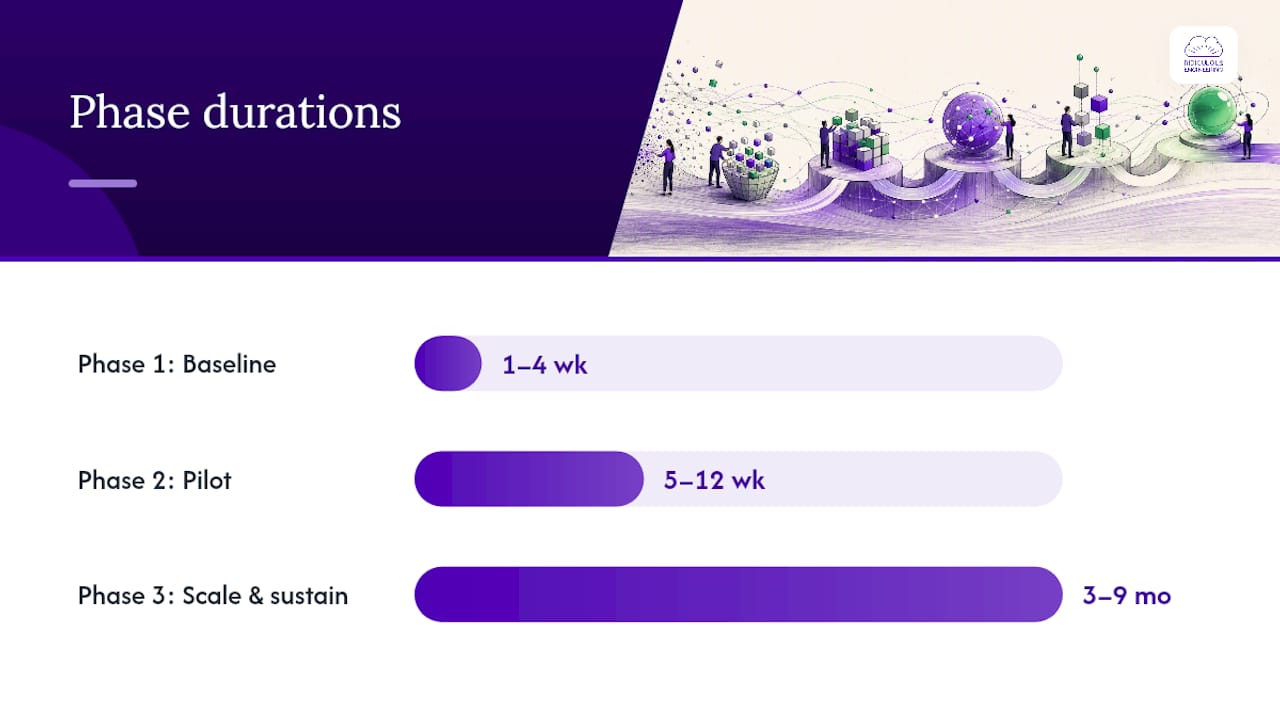
Phase 1: Baseline and scoping (weeks 1–4)
-
Conduct a maturity assessment: document current profiling coverage, existing rules, ownership gaps, and known quality incidents.
-
Identify critical data elements (CDEs) — the fields and datasets that directly affect revenue, compliance, or model performance.
-
Profile CDEs to establish baseline metrics for completeness, uniqueness, and validity.
-
Define SLAs: what “good enough” looks like for each dimension on each dataset.
Phase 2: Pilot (weeks 5–12)
-
Design and implement a rule set for one high-priority domain (customer data is a common starting point).
-
Stand up remediation workflows: at minimum, a quarantine queue and a steward notification process.
-
Automate the rule execution in your ETL or data platform.
-
Publish a simple KPI dashboard showing baseline vs. current quality scores.
Phase 3: Scale and sustain (months 3–9)
-
Expand rule coverage to additional domains based on CDE priority.
-
Integrate quality checks into CI/CD pipelines for data assets.
-
Establish a certified dataset catalogue: a governed list of datasets that have passed defined quality thresholds and are approved for analytics and model use.
-
Run quarterly management reviews against quality KPIs, as recommended by the DAMA-NL DQMS framework.
Roles and responsibilities:
-
Executive sponsor: approves scope, budget, and escalation path; reviews KPIs quarterly.
-
Data owners: accountable for quality outcomes in their domain; approve rule changes.
-
Data stewards: resolve exceptions, maintain reference data, and own remediation queues.
-
Data engineers: build and maintain rule infrastructure, pipelines, and monitoring.
-
QA / analytics engineers: validate outputs before promotion to certified status.
The three pitfalls that derail most programs: over-governing (writing hundreds of rules before any are enforced), missing ownership (rules with no named steward become orphaned alerts), and ignoring downstream consumers (building rules that satisfy the data team but not the analysts or model engineers who actually use the data). Gartner recommends combining profiling, monitoring, stewardship, and governance while tying quality improvements to measurable business outcomes — the last part is what keeps the program funded past the first quarter.
Pro Tip: Run your pilot on the dataset that feeds the report the most senior stakeholder looks at every week. When quality scores improve and the report stops conflicting with itself, you have a story that funds the next phase without a lengthy business case.
Where to apply checks across the data lifecycle
Quality checks belong at multiple points in the data lifecycle, not just at the end. The further downstream a bad record travels, the more expensive it is to fix.
| Lifecycle stage | Recommended checks | Prevention or detection |
|---|---|---|
| Design / collection | Schema definition, enumeration constraints, required-field enforcement at source | Prevention |
| Ingest (API, file, stream) | Schema validation, format checks, null detection, referential integrity | Prevention |
| Transformation (ETL/ELT) | Completeness, uniqueness, cross-table consistency, business-rule validation | Detection |
| Master data / MDM layer | Deduplication, entity resolution, golden-record certification | Prevention + detection |
| Analytics / model training | Label consistency, bias checks, distribution drift, version control | Detection |
| Serving / consumption | SLA timeliness checks, certified-dataset flag validation | Detection |
| Archival | Completeness audit, lineage snapshot | Detection |
Prevention checks at source are cheaper per defect caught but require coordination with upstream system owners, which is often the harder organizational problem. Detection checks post-ingest are easier to implement unilaterally but allow bad data to travel further before it is caught.
A practical pipeline example: for an API ingest feeding a customer analytics model, apply schema and format checks at the API gateway (prevention), completeness and uniqueness checks in the ETL layer (detection), and label consistency and drift checks in the model training pipeline (detection). The AISI guidebook specifically recommends version control and drift monitoring as checks that belong in the model training stage, not just at ingest. The Ridiculous Engineering post on operational data pipelines covers how these patterns apply in production environments.
Which metrics and KPIs actually prove DQM value
Quality metrics only sustain executive support when they connect to outcomes the business already tracks.
Primary metrics to track:
-
Completeness score: (non-null values / total expected values) × 100, per dataset and per CDE.
-
Duplicate rate: (duplicate rows / total rows) × 100; target varies by domain but sub-1% is a reasonable starting SLA for customer master data.
-
Accuracy rate: % of sampled records matching an authoritative source; sampling 200–500 records per dataset per quarter is sufficient for most programs.
-
Timeliness SLA compliance: % of records updated within the defined freshness window.
-
Certified-dataset adoption: % of analytics and model workloads consuming data from the certified catalogue vs. uncertified sources.
-
Mean time to detect (MTTD): average time from a quality issue occurring to it being flagged by monitoring.
-
Mean time to remediate (MTTR): average time from detection to resolution; a steward workflow with clear ownership typically cuts MTTR by more than automation alone.
Practical programs measure adoption and outcomes rather than activity counts, according to InfiniSynapse’s governance playbook. Metrics like certified-dataset usage, reduction in report conflicts, and time-to-audit are the ones that resonate with finance and operations leaders.
A simple KPI dashboard row looks like this: metric name, current value, target/SLA, trend (up/down/stable), and owner. Publishing that dashboard to stakeholders monthly is more effective than a quarterly deep-dive, because it keeps quality visible as an operational concern rather than a periodic audit.
How to evaluate the technology landscape
Tool selection should follow strategy, not precede it. Clarify your domains, workflows, and success metrics before you evaluate platforms.
Tool categories to consider:
-
Data profiling and observability: automated baseline measurement, anomaly detection, and drift alerting. These tools generate the evidence that justifies rule investment.
-
Data catalogs and lineage: metadata management, dataset documentation, and end-to-end lineage tracking. Critical for certified-dataset programmes and audit readiness.
-
Rule engines and validators: the enforcement layer. Look for support for the rule types documented in Microsoft Purview’s rule authoring guide: regex, data type, null/blank, uniqueness, table lookup, and custom row expressions with null handling.
-
Matching and deduplication engines: probabilistic and deterministic matching for entity resolution.
-
MDM platforms: golden-record management for core entities.
-
Orchestration and monitoring: pipeline scheduling, alerting, and SLA tracking.
Buy vs. build: buy an integrated platform when you need lineage, catalog, and certification in a single system with audit logs and role-based access. Build (or assemble best-of-breed) when your use case is narrow, your existing stack already covers most capabilities, or you need deep integration with a specific data platform. The risk with best-of-breed is integration gaps: metadata does not flow between tools automatically, and you end up maintaining a custom orchestration layer that becomes its own maintenance burden.
Non-functional requirements checklist: scalability to your data volume, auditable logs for compliance, role-based access control, API-first integration for pipeline embedding, and AI-readiness (the ability to certify datasets for model use and track dataset versions). For teams building AI-adjacent data products, a structured data audit can surface schema conformity gaps that affect LLM readiness before they reach the model training stage.
Standards and frameworks worth adopting
You do not need to implement every clause of every standard. The value of standards is that they give you an audit-ready vocabulary and a checklist of controls you might otherwise miss.
-
ISO/IEC 5259-3:2024 is the most directly relevant standard for analytics and ML-focused DQM. It defines requirements for managing data quality across the analytics and machine learning lifecycle, with an emphasis on auditable controls and trustworthy outcomes. Use it to validate your lifecycle coverage and to frame requirements for regulated or high-stakes AI applications.
-
DAMA-NL DQMS framework translates technical DQM controls into a management-system structure: policy, critical data elements, improvement actions, rules, monitoring, and certification. It is particularly useful when preparing internal audit documentation or when a compliance function wants evidence that quality is managed systematically rather than ad hoc.
-
AISI Data Quality Management Guidebook provides practical AI-specific guidance on annotation quality, bias detection, version control, and drift monitoring. Treat it as a supplement to ISO/IEC 5259-3 for ML-heavy programs.
-
Gartner and TechTarget analyst guidance offer program design and governance integration perspectives that are useful for framing executive conversations and vendor evaluations.
How to use these standards practically: pick the clauses most relevant to your current maturity level, map them to your existing controls, and treat the gaps as a prioritized backlog. A full ISO implementation is a multi-year effort; using the standard as an audit checklist for a 90-day pilot is immediately useful and costs nothing.
How Ridiculous Engineering approaches DQM engagements
The engagements that go well share a common pattern: a tight discovery phase, a pilot scoped to one domain, and a handoff that leaves the client’s team able to operate the program without ongoing dependency on external help.
Discovery and scoping (weeks 1–2): We inventory data assets, map CDEs to business processes, and identify the three to five datasets with the highest quality risk and business impact. The output is a prioritized dataset inventory and a scoping document that defines pilot boundaries, success metrics, and roles.
Profiling and baseline (weeks 2–4): Automated profiling across the priority datasets establishes completeness, uniqueness, validity, and timeliness baselines. We document findings in a profile report that becomes the before-state for KPI tracking.
Pilot rule development and automation (weeks 4–8): We design a rule set for the highest-priority domain, implement it in the client’s existing data platform or pipeline tooling, and wire up a quarantine and steward notification workflow. Deliverables: a rule library, a remediation runbook, and a working automated pipeline.
Scale and handoff (weeks 8–16): We expand coverage to additional domains, stand up a certified dataset catalogue, publish a KPI dashboard, and run onboarding sessions with data owners and stewards. The final deliverable is a documented program that the client’s team can operate and extend independently.
Common pitfalls we see and how we address them:
-
Scope creep: We fix the pilot domain boundary in the scoping document and require a formal change request to expand it. This sounds bureaucratic until the third week when someone wants to add six more datasets.
-
Missing ownership: We require a named data owner for every dataset before we write a rule. A rule with no owner is an alert with no one to answer it.
-
Under-investing in remediation automation: Teams often spend 80% of their effort on rule authoring and 20% on remediation. The ratio should be closer to 50/50. An unfixed defect that gets detected repeatedly is worse for morale than a defect that never gets detected.
Vendor evaluation checklist: when assessing a consultancy or internal plan, ask for a sample profile report from a prior engagement, a rule library with at least 10 documented rules and their business justification, a remediation runbook with escalation paths, and a KPI dashboard template. If a vendor cannot produce these artifacts, they are selling governance theater, not a working program.
What to prioritize this quarter
Three to five focused actions deliver more value than a broad initiative that stalls at the planning stage.
For executive sponsors:
-
Assign a named data owner for your top five datasets this week. Without ownership, every other investment in quality is fragile.
-
Approve a 30-day profiling sprint with a defined output: baseline completeness, uniqueness, and validity scores for CDEs.
-
Commit to a quarterly KPI review cadence before the program starts, not after.
For engineering and data teams:
-
Profile the five datasets that feed your most critical reports or models. Document null rates, duplicate rates, and format violations.
-
Implement three automated rules in your existing pipeline: a format/regex check, a null/blank check, and a uniqueness check on primary keys.
-
Stand up a quarantine queue and a steward notification for rule failures. Even a simple email alert to a named owner is better than silent failure.
-
Build a certified dataset list: a simple registry of datasets that have passed defined quality thresholds and are approved for downstream use.
The data sharing and governance post from Ridiculous Engineering covers the stakeholder coordination side of this work, which is often the harder problem than the technical implementation.
Ridiculous Engineering builds DQM programs that actually run in production
Most organizations already have the data platforms and pipeline tooling they need to run a solid DQM program. What they are missing is the architecture, rule design, and operational structure to make it work reliably at scale. That is the gap Ridiculous Engineering fills.
We work with mid-market and enterprise teams to design and implement data quality and analytics systems that connect directly to business outcomes: fewer reconciliation cycles, faster time-to-insight, and model training data you can actually certify. Our engagements are scoped to deliver a working pilot in 30–90 days, with a clear handoff so your team owns the program long-term.
If you are ready to move from profiling to production-grade controls, talk to the Ridiculous Engineering team about a scoped DQM engagement.
Sources
-
Data Quality Management System Framework — DAMA-NL (2024 v12)
-
How to develop a data governance strategy: 7 key steps — TechTarget
FAQ
What is data quality management?
Data quality management is the set of practices, rules, and operational controls that keep organizational data accurate, complete, consistent, and fit for its intended use in analytics, AI, and business decisions. It covers the full data lifecycle from ingest through archival.
What are the four C’s of data quality?
Definitions vary across frameworks, but a common version covers correctness (accuracy), completeness, consistency, and currency (timeliness). These four dimensions appear across most DQM frameworks as the core measures of whether data is reliable for decision-making.
What are the five key measures of data quality?
The most widely cited measures are accuracy, completeness, consistency, timeliness, and uniqueness. Many programs also add validity (conformity to defined formats or enumerations) and integrity (referential relationships between datasets) as the program matures.
What are the core principles of data quality?
The four principles most governance frameworks align on are fitness for purpose (data meets the needs of its consumers), accountability (named owners for every dataset), measurability (quality is tracked with defined metrics and SLAs), and continuous improvement (quality is monitored and remediated as an ongoing operational activity, not a one-time fix).