LLM Governance: A Practical Framework for Business Leaders
LLM Governance: A Practical Framework for Business Leaders LLM governance is the set of policies, roles, and runtime controls that manage how large language models are deployed, monitored, and held accountable in production.
LLM governance is the set of policies, roles, and runtime controls that manage how large language models are deployed, monitored, and held accountable in production. Unlike traditional AI governance, which mostly checks a model before launch and moves on, LLM governance treats deployment as the start of the risk window, not the end of it.
If you lead technology or risk at your organization, here are the five moves to make first:
- Risk-tier every use case based on business impact and autonomy, not just data sensitivity.
- Assign an owner for each deployed model or agent, not just an owner for “AI” broadly.
- Stand up runtime observability so you can see prompts, responses, and drift as they happen.
- Gate traffic at the API layer so bad outputs get filtered before they reach customers.
- Build an audit plan covering governance, model, and application layers, not a single pre-launch checklist.
That’s the whole game in outline form. The rest of this guide unpacks how to build it.
Key Takeaways
Effective LLM governance depends on shifting the center of gravity from one-time pre-deployment validation to continuous runtime observability paired with coordinated three-layer audits.
| Point | Details |
|---|---|
| Scope goes beyond the model | Governance must cover prompts, RAG pipelines, agentic behavior, vendors, and data flows, not just model weights. |
| Runtime monitoring is the primary control | Continuous observability of prompts, outputs, and KRIs catches drift that pre-launch testing misses. |
| Audit in three coordinated layers | Governance, model, and application audits should feed evidence into each other, not run in isolation. |
| Assign named ownership | Every high-risk use case needs a specific risk owner, not a shared team inbox. |
| Get engineering help early | Ridiculousengineering builds the traffic gating, logging, and monitoring infrastructure governance policies depend on. |
Table of Contents
- What Does LLM Governance Actually Cover?
- What Principles Should Anchor Your LLM Governance Policy?
- What Components Make Up an LLM Governance Framework?
- How Should You Audit an LLM System?
- What Runtime Controls Actually Prevent LLM Incidents?
- How Do You Operationalize LLM Governance Day to Day?
- What Mistakes Should You Avoid in LLM Governance?
- What Should Your First 90 Days of LLM Governance Look Like?
- Building the Governance Infrastructure Yourself
- Sources
- FAQ
What Does LLM Governance Actually Cover?
LLM governance in LLMs extends well past the model file itself. It covers the model, the prompt surface, retrieval pipelines, agentic workflows, third-party integrations, vendor contracts, and the data flowing through all of it. If you’re only governing the model weights, you’re governing maybe a third of your actual risk surface.
Here’s the distinction that trips up most teams: traditional ML governance assumes a model produces consistent, deterministic outputs for a given input, and you validate it once against a test set. LLMs don’t work that way. The same prompt can produce different outputs across runs. Small prompt changes can produce wildly different behavior. And once you add retrieval-augmented generation (RAG) or agentic tool use, you introduce emergent behaviors that no static test suite catches. Research on multi-agent LLM systems found that individually “safe” agents can still produce unsafe systems once they interact, through cascading failures and conformity bias between agents.
That risk touches more of the business than most leaders assume. In-scope systems typically include:
- Customer service bots and support automation
- Internal knowledge management and search tools
- Analytics copilots summarizing sensitive data
- Workflow automation with write access to production systems
- Any agent that can take action (send an email, issue a refund, modify a record)
Pro Tip: Treat a use case as “high materiality” the moment it can take an autonomous action, touch regulated data, or reach an external customer without a human review step. Materiality, not model size, should drive how much governance scrutiny a use case gets.
What Principles Should Anchor Your LLM Governance Policy?
Every LLM governance policy needs a small set of principles that translate into actual controls, not aspirational language for a slide deck. Six do most of the work:
- Transparency: Users and internal stakeholders should know when they’re interacting with an LLM and roughly how it reached an output.
- Accountability: A named person or team owns each deployed model’s behavior, end to end.
- Safety and reliability: The system degrades gracefully and has a fallback when confidence is low.
- Data protection: Inputs and outputs respect data residency, retention, and privacy commitments.
- Fairness: Outputs are checked for disparate impact across user groups, not just aggregate accuracy.
- Auditability: Every material decision leaves a trace that a third party could review later.
Each principle maps to a different stakeholder, which is exactly why governance fails when it’s treated as one team’s job. Legal cares most about transparency and data protection. Security owns reliability and access control. Product owns fairness and user experience. The board mostly wants accountability, meaning a clear answer to “who signed off on this and who do we call when it breaks.”
Operationally, these principles aren’t just values, they’re artifacts. Transparency becomes a disclosure notice and a model card. Accountability becomes a sign-off log. Auditability becomes a retained trace of prompts, retrieved context, and outputs. If a principle doesn’t produce a document, a dashboard, or a gate somewhere in your pipeline, it’s not governance yet, it’s a mission statement.
What Components Make Up an LLM Governance Framework?
An LLM governance framework is only as good as the artifacts behind it. Principles don’t stop a bad deployment; a missing model card or an unassigned risk owner does. Here’s what actually needs to exist:
Required artifacts:
- Risk-tiering rubric that scores use cases by autonomy, data sensitivity, and blast radius
- Model inventory listing every LLM, fine-tune, and vendor API in production
- Model cards documenting training data provenance, known limitations, and intended use
- Access and token controls scoping which systems and users can call which models
- Data lineage tracking what data enters prompts and where outputs get stored
- Approval gates requiring sign-off before a model or prompt change ships
- Runbooks for incident response when a model misbehaves in production
- Monitoring dashboards surfacing key risk indicators (KRIs) in near real time
Policy and process elements:
- Lifecycle sign-offs at each stage: development, staging, production, and retirement
- Third-party model vetting before procurement, including a security and bias review
- Contract clauses covering data handling, model update notifications, and liability
- Service-level agreements defining acceptable latency, uptime, and escalation windows
None of this needs to launch simultaneously. Assign each artifact to an owner and a deadline: security owns access controls and token scoping, engineering owns model cards and monitoring dashboards, legal owns vendor contracts and data lineage documentation, and product owns the risk-tiering rubric with input from every other function. The MindForge AI Risk Management Handbook lays out a similar operating model for financial institutions, and its risk-tiering logic transfers cleanly to almost any regulated or customer-facing deployment.
How Should You Audit an LLM System?
Auditing an LLM system requires three separate layers, and treating any one of them as sufficient on its own is how governance programs fail quietly. Research on auditing large language models frames these as governance audits, model audits, and application audits, coordinated so evidence from each layer informs the others.
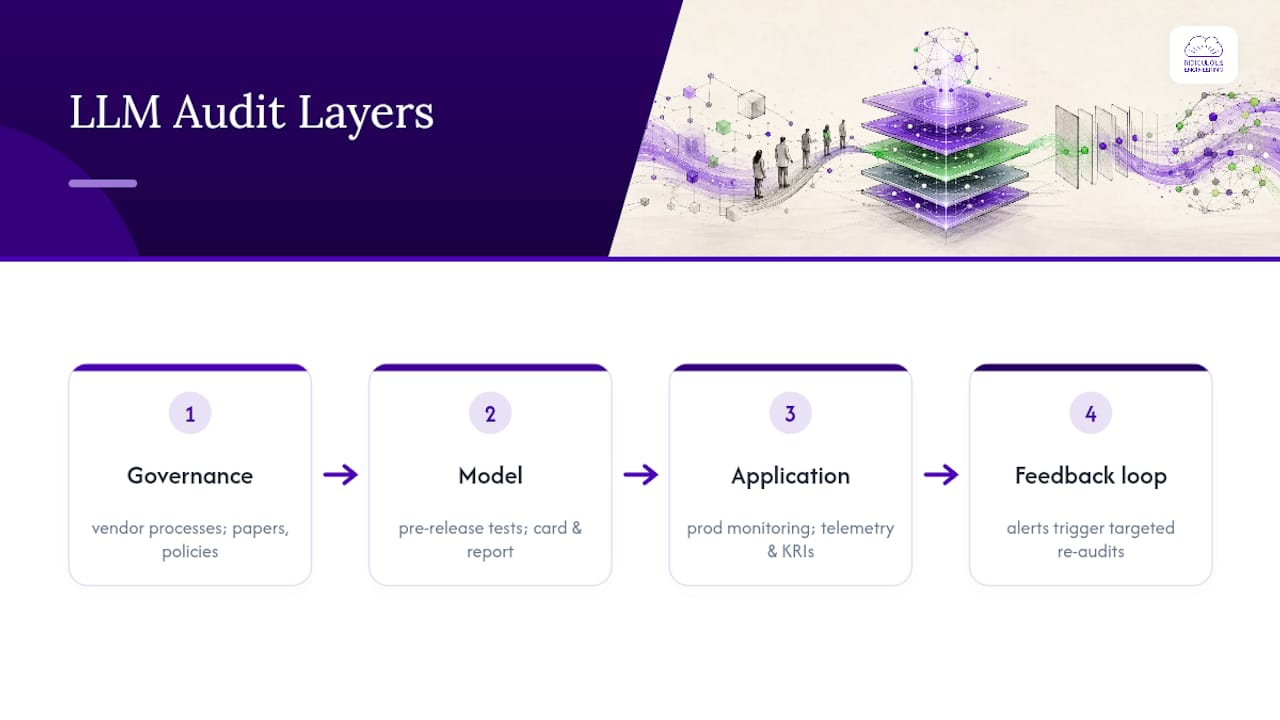
Governance audits examine the vendor and internal processes producing the model: training data sourcing, quality management practices, and documented development standards. The evidence here is mostly paper trails, vendor attestations, and policy documents. It tells you whether the process that built the model was sound, but it says nothing about how the model behaves once it’s live.
Model audits happen after pre-training and before release. This is where red-teaming and adversarial testing earn their keep: probing for jailbreaks, bias, hallucination rates, and edge-case failures before the model touches a customer. The output should be a model card and a testing methodology report with pass/fail thresholds. The limit is obvious once you see it: a model audit is a snapshot, and LLM behavior shifts as prompts, retrieval sources, and user populations change.
Application audits are the layer most organizations skip, and it’s the one that matters most in practice. These are continuous, production-facing checks that watch real prompts and real outputs, track KRIs like hallucination rate and refusal rate, and flag drift as it happens. A review of generative AI model risk management makes the case plainly: static pre-deployment validation alone is not enough for GenAI systems, and continuous monitoring paired with AI-augmented compliance review does the heavier lifting.
The three layers should feed each other. A notable change in risk indicators from application monitoring should trigger a targeted model audit. A vendor’s changed training data disclosure should trigger a governance audit refresh.
Pro Tip: Build a single evidence pipeline that archives audit reports, streams runtime telemetry, and logs corrective actions in one place. When a regulator or board member asks “prove it,” you want one system to query, not three teams to chase down.
What Runtime Controls Actually Prevent LLM Incidents?
Runtime controls, not pre-launch checklists, catch most LLM incidents before they reach a customer. This is where governance stops being a policy document and starts being code.
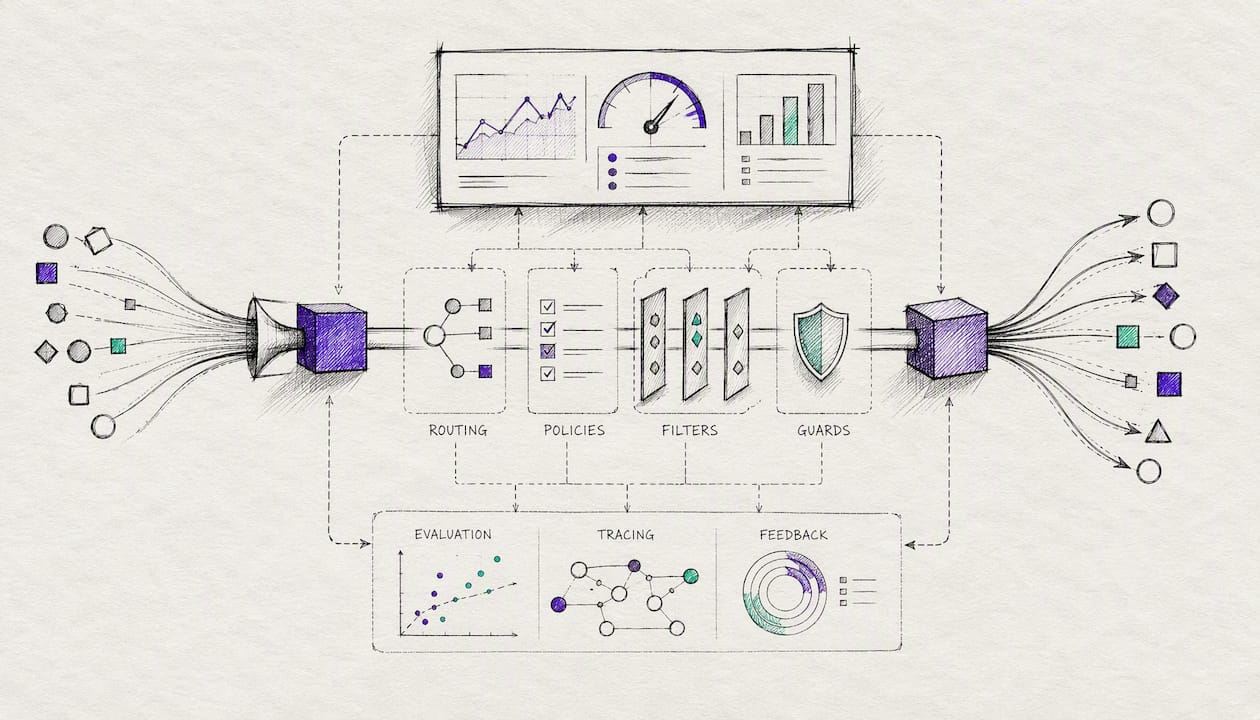
Traffic governance sits at the API gateway. Gateway-level filtering can block prompts matching known injection patterns, scope tokens so a given integration can only call approved model endpoints, and rate-limit calls per use case to contain blast radius if something goes wrong. Routing high-risk use cases to a smaller, more tightly evaluated model pool, rather than a general-purpose frontier model, cuts exposure further. Partner platforms built for API-level governance, like Jundago’s approach to testing and governing APIs, show how this pattern extends naturally to REST and GraphQL layers beyond just LLM traffic.
RAG and retrieval controls matter just as much. Track provenance on every retrieved chunk so you know what source informed an answer. Redact sensitive fields before they enter a prompt. Set recall guards on retrieval so the system doesn’t silently pull from stale or unauthorized indexes. Lock down embedding store access with the same rigor you’d apply to a production database, because that’s effectively what it is.
Observability is the connective tissue. Log prompts and responses (with appropriate redaction), capture debug traces for failed calls, and instrument cost, latency, and KRI dashboards side by side. The SANS guidance on risk-based AI controls recommends monitoring specifically for hallucination rate, jailbreak attempts, and prompt drift as ongoing metrics, not one-time tests.
One pattern worth adopting directly: route outputs through a panel of smaller, specialized judge models scoring for privacy, safety, and regulatory compliance, then aggregate into a single compliance score. This “profile-as-a-jury” approach, described in recent runtime compliance monitoring research, avoids the monoculture risk of relying on one model’s self-assessment of its own output.
Engineering checklist:
- Define a logging schema covering prompts, responses, retrieved context, and model version
- Set retention policies aligned with your data protection commitments
- Build escalation hooks that page a human when KRIs cross a threshold
- Wire judge-panel or compliance-gate scoring into the deployment pipeline itself
How Do You Operationalize LLM Governance Day to Day?
Operationalizing LLM governance starts with a lightweight structure, not a new department. Most organizations need three things: a central governance board that sets policy and risk thresholds, risk owners embedded in each business line who know their use cases best, and engineering guardrails baked into the deployment pipeline itself.
The three-lines-of-defense model adapts cleanly to LLMs:
- First line: The team building or deploying the model owns day-to-day risk management, including model cards and initial testing.
- Second line: Risk, legal, and security review deployments against policy, run independent red-teaming, and maintain the compliance gates.
- Third line: Internal audit periodically checks that the first two lines are actually doing what they claim, using the three-layer audit evidence as source material.
A workable cadence looks like this:
- Intake: New use case gets risk-tiered before any development starts
- Sign-off: Risk owner and second-line reviewer approve the tier and required controls
- Deployment checklist: Engineering confirms logging, gating, and fallback are live before launch
- Monitoring review: Weekly or biweekly check of KRI dashboards for the highest-tier use cases
- Quarterly audit: Coordinated governance, model, and application audit for material systems
Track a small set of KPIs and KRIs consistently: hallucination rate, compliance gate pass rate, false-positive and false-negative rates on content filters, and mean time to mitigate once an issue is flagged. These numbers matter more to a board than a narrative description of your process, because they show trend lines.
Initial rollout checklist:
- Inventory every LLM and agent currently in production or pilot
- Pick observability tooling before picking policy tooling; you can’t govern what you can’t see
- Adopt policy-as-code where possible so gates enforce automatically rather than relying on manual review
- Set audit logging retention before your first quarterly audit, not after
What Mistakes Should You Avoid in LLM Governance?
The costliest LLM governance mistakes are structural, not technical. A few show up again and again.
Treating governance as an IT problem alone leaves legal, product, and the board out of decisions they should be making. Fix it by assigning named risk owners in the business, not just a ticket queue in engineering.
Over-relying on pre-deployment validation gives you false confidence. A model that passed red-teaming in January can drift in behavior by June as prompts, users, and retrieval sources change. Runtime monitoring is what catches that, not a one-time report.
Monoculture risk shows up when a single model (or a single model family’s self-assessment) evaluates its own compliance. Multi-model judge panels reduce that blind spot.
Ignoring prompt and usage drift means nobody notices when your production prompts have quietly diverged from what was tested. Version and log prompts like you’d version code.
Weak third-party contracts leave you exposed when a vendor changes a model without notice. Require update notifications and audit rights in every vendor agreement.
If you take one warning to your executive team, make it this: a passed pre-launch audit tells you almost nothing about next quarter’s risk.
What Should Your First 90 Days of LLM Governance Look Like?
Standing up LLM governance in 90 days is realistic if you sequence it correctly. Trying to do everything in month one is how programs stall.
Days 1 to 30:
- Complete a full model and use-case inventory
- Risk-tier every use case using a simple high/medium/low rubric
- Assign named owners for each high-tier use case
- Stand up baseline logging for prompts, responses, and model version
- Define an emergency fallback (human handoff or feature disable) for high-risk flows
Days 31 to 60:
- Deploy API gateway traffic gating for the highest-risk flows
- Publish model cards for every production model
- Automate at least three KRIs (hallucination rate, refusal rate, latency)
- Define your audit cadence and who sits on each of the three lines of defense
Days 61 to 90:
- Run a red-team exercise against your highest-materiality use case
- Complete a first coordinated audit spanning governance, model, and application layers
- Draft a board report summarizing risk tiers, KRIs, and open remediation items
Sample targets worth setting include ensuring that all high-risk flows have a documented runbook within two months, that escalation of risk indicator breaches occurs promptly, and that compliance gate pass rates are tracked frequently rather than infrequently.
Building the Governance Infrastructure Yourself
Most of what this guide describes, the logging schema, the traffic gateway, the compliance gates, the model card pipeline, isn’t policy work. It’s software engineering. And that’s usually where governance programs stall: legal and risk teams can write the policy, but somebody still has to build the gateway that enforces token scoping, the dashboard that surfaces KRIs in real time, and the audit trail that survives a regulator’s questions.
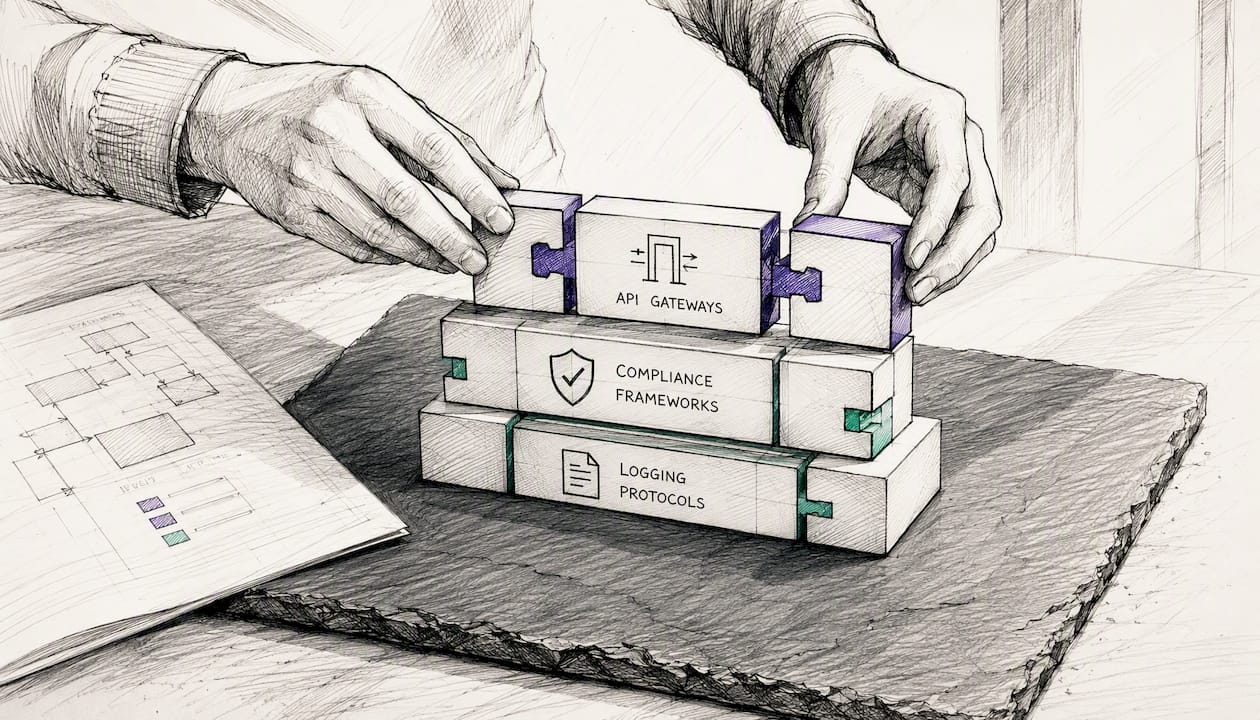
That’s the gap Ridiculousengineering fills. We build the runtime infrastructure, API gateways, observability pipelines, RAG hardening, and monitoring dashboards, that turns an LLM governance policy from a document into something that actually runs in production. If you’re modernizing legacy systems to add AI features safely, or you need custom software development to stand up the traffic gating and logging layer your governance plan calls for, that’s exactly the kind of engagement we take on. Reach out and we’ll scope what your first 90 days of technical implementation actually looks like.
For teams that want these controls without building everything from scratch, our Cognitus product packages governance-ready infrastructure out of the box.
Sources
A handful of sources are worth bookmarking if you’re building this program out further. The NIST AI Risk Management Framework remains the most portable standard for mapping, measuring, and managing AI risk across any sector. The three-layered auditing paper is the clearest breakdown of governance, model, and application audits available. For runtime compliance specifically, the governance-from-metrics framework details judge-panel scoring and compliance gating in practical terms. The MindForge handbook offers a regulated-industry operating model that transfers well outside finance. The models-to-metrics framework is useful for translating principles into measurable artifacts. And the generative AI model risk management review makes the strongest case for continuous monitoring over static validation.
- Auditing large language models: a three-layered approach
- Effective generative AI model risk management (finance/insurance review)
- MindForge AI Risk Management Executive Handbook (MAS consortium)
LLM Governance Framework
Want this framework as a downloadable checklist?
Get the 90-day LLM governance plan from this guide in a format your team can actually work through.
FAQ
What Does LLM Stand For?
LLM stands for large language model, a type of AI system trained on large text datasets to generate and understand natural language, including tools like ChatGPT and Claude.
What Are the Four Models of Governance?
Governance frameworks vary by field, but corporate and IT governance commonly reference four broad models: shareholder-driven, stakeholder-driven, hierarchical/regulatory, and network or collaborative models; LLM governance typically borrows most heavily from stakeholder-driven and regulatory approaches given the mix of legal, security, and product interests involved.
Is ChatGPT an LLM or Generative AI?
ChatGPT is both: it’s built on a large language model (an LLM) and it belongs to the broader category of generative AI, which includes any system that creates new content such as text, images, or code.
What Is an LLM Degree Salary?
This question typically refers to a Master of Laws (LL.M.) degree, a legal specialization degree, not a large language model; salaries for LL.M. graduates vary widely by specialization, country, and firm, and this article does not cover legal education outcomes.
How Do You Get Started With LLM Governance if You Have No Program Today?
Start with a full model and use-case inventory, risk-tier each use case, assign named owners, and stand up baseline logging before adding formal policy documents; the infrastructure and observability work often needs a dedicated engineering effort, which is where a partner like Ridiculous Engineering can accelerate the timeline.