Cloud Cost Governance for Technology and Finance Leaders
Cloud Cost Governance for Technology and Finance Leaders Cloud cost governance is the practice of aligning cloud spending to business value through defined roles, policies, and controls — and the immediate next step for most organizations is to run a 7-day visibility scan that...
Cloud cost governance is the practice of aligning cloud spending to business value through defined roles, policies, and controls — and the immediate next step for most organizations is to run a 7-day visibility scan that maps every cloud invoice line to a product, team, or cost center.
TL;DR — what you’ll find in this guide:
A clear definition that separates governance from cost optimization and FinOps
The six governance pillars and the minimum artifact each one requires
How major cloud pricing models work and which levers actually move the needle
A roles-and-policies framework with an enforcement spectrum
Daily and weekly operational controls to prevent spend drift
A tool-selection decision tree (cloud-native vs CCM platforms)
KPIs for engineering teams and for CFO/FP&A audiences
The cultural traps that kill governance programs before they scale
A week-by-week 90-day rollout with effort and cost estimate bands
Table of Contents
How cloud pricing models work and which levers move the needle
Building the governance framework: roles, policies, and enforcement
Daily and weekly operational controls that prevent spend drift
Where governance programs fail — and how FinOps fixes the culture
The 90-day rollout: week-by-week milestones and effort bands
What cloud cost governance actually is (and what it isn’t)
Cloud cost governance is the organizational layer that sits above cost optimization. It defines who is accountable for cloud spend, what policies constrain it, and how those policies are enforced continuously. Optimization is a one-off savings action — rightsizing a VM, deleting an orphaned bucket. Management is the reporting and allocation layer — dashboards, invoices, showback reports. Governance is the structure that makes both of those activities repeatable and owned.
The FinOps Framework defines this well: FinOps is an operational framework that maximizes business value from cloud spending through collaboration between engineering, finance, and business teams, with the principle that business value drives technology decisions. Governance is the mechanism that operationalizes that principle.
For U.S. organizations, the practical scope of governance covers three governed outcomes: budget enforcement (spending does not exceed approved limits without a deliberate decision), product-level cost visibility (every dollar maps to a business construct), and procurement rules (commitment purchases follow an approval workflow). What governance must not become is an engineering policing function. The moment engineers experience governance as a blocker rather than an enabler, the program loses the distributed ownership it depends on.
Pro Tip: Pick one FinOps Scope — a single product, environment, or cost center — for your initial pilot. Trying to govern all cloud spend on day one is how programs stall. A focused pilot produces evidence that earns organizational buy-in for the broader rollout.
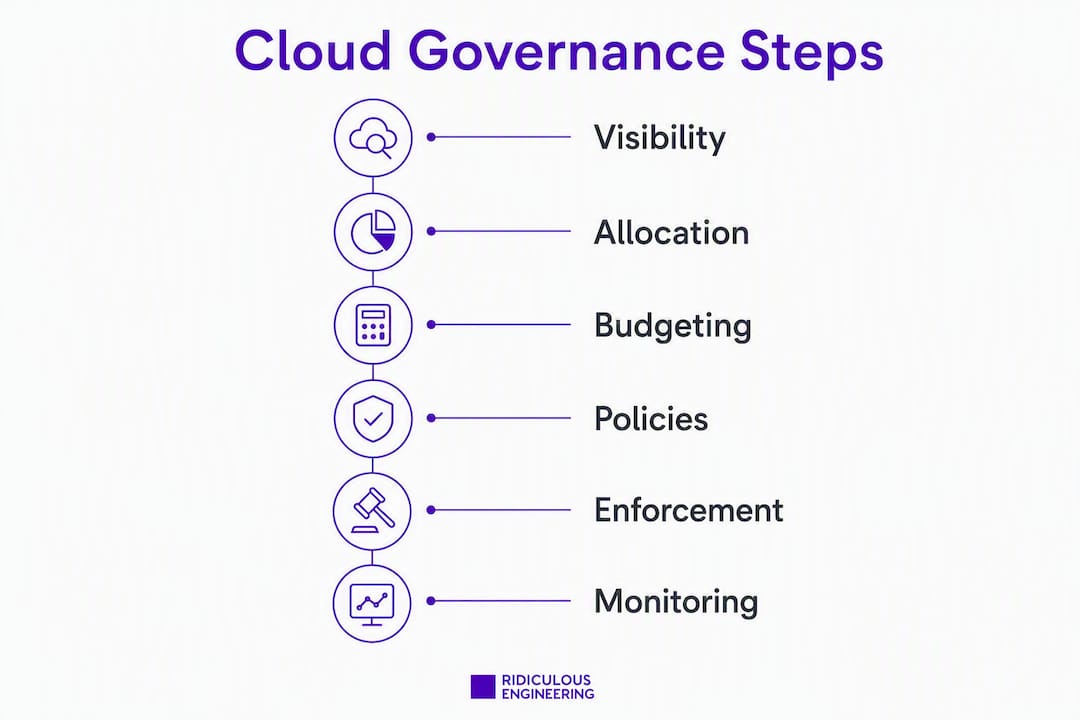
The six pillars every governance program needs
Governance programs that stick are built on six pillars. Each one has a minimum artifact — the thing that proves the pillar is actually operating, not just documented.
Pillar | Owner | Cadence | Minimum Output |
|---|---|---|---|
Visibility & tagging | Platform engineering | Daily | Tagged-spend dashboard with <5% untagged |
Allocation / chargeback | FinOps / Finance | Monthly | Showback report by product and cost center |
Budgeting & forecasting | FP&A + FinOps | Monthly / quarterly | Budget objects with variance alerts |
Policy & enforcement | FinOps + Engineering leads | Quarterly review | Written policy doc + enforcement log |
Optimization & architecture reviews | Engineering / architects | Monthly | Rightsizing and waste report |
Procurement & discounts | Procurement + FinOps | Quarterly | Commitment purchase log and utilization rate |

Visibility and tagging is the foundation. Without it, every other pillar is guesswork. The GSA/ITVMO FinOps best practices guidance recommends using organizational resource hierarchies — AWS Organizations, Azure Management Groups, GCP folders — as the hard cost boundary, with tags reserved for metadata-driven reporting. Tags break. Hierarchies don’t.
Allocation and chargeback convert raw billing data into business language. A showback report tells a product team what they spent; a chargeback report moves that cost to their budget. Start with showback — it builds trust before you ask teams to own a number.
Budgeting and forecasting closes the loop between finance and engineering. Budget objects in your cloud provider’s billing console, combined with variance alerts at 80% and 100% of budget, give FP&A the signal they need without requiring a monthly manual reconciliation. Connecting this to agile financial modeling practices makes forecasting more responsive to actual usage patterns.
Pro Tip: If your organization is early in cloud maturity, prioritize visibility and allocation first. Procurement optimization (reserved instances, savings plans) delivers the largest dollar savings, but only after you understand your baseline usage patterns well enough to commit confidently.
How cloud pricing models work and which levers move the needle
One industry survey found that 66% of executives reported that cloud migration did not lower total cost of ownership, with one-third citing cost unpredictability and 31% citing pricing complexity as primary impediments. The variable billing model is genuinely hard to manage without a framework. Understanding the pricing shapes is the prerequisite.
Pricing Model | Typical Cost Lever | Business Trade-off |
|---|---|---|
Pay-as-you-go (on-demand) | Rightsizing, autoscaling policies | Full flexibility; highest unit cost |
Reserved instances / savings plans | 1- or 3-year commitments | 30% savings vs. on-demand; requires usage confidence |
Spot / preemptible instances | Fault-tolerant batch workloads | Lowest cost; interruption risk |
Data egress | Region co-location, CDN offload | Significant savings; architectural change required |
Managed services | Right-tier selection, lifecycle policies | Convenience premium; often over-provisioned |
The most reliable levers, in order of effort-to-savings ratio, are: rightsizing and autoscaling (low effort, immediate), reserved instance and savings plan purchases (medium effort, large savings), spot workloads for batch and CI/CD jobs (medium effort, high savings for the right workloads), and data egress optimization (higher effort, but egress costs are frequently the hidden line item that surprises teams).
Region selection matters more than most teams realize. Running workloads in a region with lower compute pricing — while keeping data residency requirements in scope — can reduce unit costs without any architectural change. For AI and GPU workloads specifically, this tradeoff is worth modeling explicitly, as discussed in the context of balancing cost and speed in AI workloads.

Pro Tip: Centralize commitment purchasing (reserved instances, savings plans, committed use discounts) in a single FinOps or procurement function. Decentralized commitment buying leads to overlapping purchases and underutilization. Let product teams own on-demand spend decisions; let the central team own rate optimization.
Building the governance framework: roles, policies, and enforcement
A governance framework without named owners is a document, not a program. The table below maps the five core roles to their primary responsibilities.
Role | Primary Responsibility |
|---|---|
Central FinOps / Cloud Finance | Rate optimization, commitment purchasing, policy authoring, reporting |
Engineering / Product owners | Day-to-day spend decisions, tagging compliance, anomaly response |
Procurement | Vendor contracts, commitment approval workflows |
Platform engineering | IaC policy-as-code, account hierarchy, tooling |
FP&A | Budget objects, variance analysis, forecast integration |
The FinOps principles are explicit on this structure: a central FinOps function enables best practices while engineers own day-to-day cost decisions. Centralizing everything creates a bottleneck; decentralizing everything creates chaos. The split is rate optimization (central) versus usage decisions (distributed).
Policy types your program needs on day one:
Tagging policy — mandatory tags (product, environment, team, cost-center) with enforcement via IaC linting or cloud policy engines
Account hierarchy policy — which accounts/subscriptions map to which business constructs
Budget and budget-violation handling — who is notified at 80%, who approves overrun at 100%
CI/CD cost guardrails — cost estimation in pull requests for infrastructure changes
Procurement rules — approval workflow for any commitment purchase above a defined threshold
Approval workflows — who can provision production-tier resources without a change request
Enforcement spectrum: Alerts are the default for production. Approvals apply to new resource provisioning above a cost threshold. Soft guardrails (budget caps that notify but do not terminate) apply to dev/test. Hard stops — automated termination — are appropriate only for non-production resources that exceed a defined idle threshold, and only after human acknowledgement is built into the workflow. The Usage.ai governance guidance is clear: alerting that requires acknowledgement before any automated action on critical services prevents the business disruption that hard stops routinely cause.
Pro Tip: Write your first tagging policy as a pull request to your IaC repository, not as a wiki page. A policy that lives in code gets reviewed, versioned, and enforced. A policy that lives in a wiki gets ignored.
Daily and weekly operational controls that prevent spend drift
Governance policy is the blueprint. Operational controls are what actually keep costs in line week to week. The controls below are the minimum viable rhythm for a team that has completed the pilot phase.
Daily controls:
Automated anomaly alerts configured to fire when spend exceeds a defined threshold above the 7-day rolling average, routed to Slack or a webhook channel
Orphaned resource sweep — automated identification of unattached volumes, unused load balancers, and idle reserved IPs
Tag compliance report — percentage of spend covered by mandatory tags, with a daily delta
Weekly controls:
Rightsizing review: pull the cloud provider’s rightsizing recommendations and triage with the relevant engineering team
Reserved instance utilization review: confirm commitment utilization stays above the target threshold (typically 80%+)
Storage lifecycle audit: identify buckets or blobs without a lifecycle policy applied
CI/CD pipeline cost check: review infrastructure cost estimates from the previous week’s deployments
Anomaly response playbook:
Alert fires in Slack/webhook channel
On-call engineer acknowledges within a defined SLA (e.g., 2 hours during business hours)
Triage: identify the resource, team, and root cause
Mitigation: scale down, terminate, or escalate to the resource owner
Postmortem: document root cause and update policy or IaC to prevent recurrence
The operational guidance from practitioners frames this well: automated anomaly detection reduces mean time to remediation from months to hours when it is integrated as a live signal into CI/CD and operational workflows, rather than surfaced in a monthly billing report.
Pro Tip: Soft limits with human acknowledgement outperform hard stops for production systems. Automate safe actions — terminating idle dev instances, archiving cold storage — and require human sign-off for anything that could affect a customer-facing service.
Which tools should you use for cloud cost management?
The right tooling answer depends on your cloud footprint, spend volume, and internal engineering capacity. The decision is not which vendor to pick — it is which capability tier you actually need.
Capability | Cloud-native billing tools | Platform automation (IaC/policy-as-code) | CCM platforms |
|---|---|---|---|
Spend visibility | Basic (single cloud) | None | Multi-cloud, unified |
Anomaly detection | Limited | None | Advanced, ML-based |
Reservation planning | Provider-specific | None | Cross-cloud optimization |
Tagging enforcement | Manual or policy engine | Strong (OPA, Sentinel) | Reporting only |
Showback / chargeback | Basic | None | Full |
Automation actions | Limited | Strong | Varies by platform |
Cloud-native tools — AWS Cost Explorer, Azure Cost Management, GCP Billing — are the right starting point for single-cloud organizations with straightforward billing. They are free, accurate, and sufficient for the pilot phase. The limitation is that they do not aggregate across clouds and their anomaly detection is basic.
Platform automation via Infrastructure as Code policy engines (Open Policy Agent, HashiCorp Sentinel, AWS Service Control Policies) handles tagging enforcement and provisioning guardrails. This is where engineering-led governance lives. It requires IaC discipline but produces durable, version-controlled policy.
CCM platforms add multi-cloud aggregation, ML-based anomaly detection, reservation optimization recommendations, and showback/chargeback automation. They make sense when you are operating across two or more clouds, when your monthly cloud spend justifies the subscription cost, or when your internal team lacks the capacity to build custom reporting. The build vs. buy decision framework applies directly here: if the capability is not a differentiator and a platform delivers it reliably, buy it.
Pro Tip: Instrument anomaly detection as your first automation investment, before dashboards and before chargeback. A Slack alert that fires within minutes of a cost spike is worth more than a beautiful monthly report. Wire it to a webhook, require acknowledgement, and you have a fast feedback loop that changes engineer behavior within weeks.
What metrics to present to engineering vs. executives
The mistake most teams make is building one dashboard and presenting it to everyone. Engineering needs granular, near-real-time signals. Executives need business-language summaries on a monthly cadence. The metrics are different, and the dashboards should be too.
Engineering and product owner metrics:
Cost per resource (VM, container, database) by day
Cost per deployment (infrastructure delta from CI/CD runs)
Anomaly rate (number of alerts fired vs. resolved per week)
Untagged spend percentage (target: <5%)
Reservation utilization rate (target: 80%+)
Executive and FP&A metrics:
Total cloud spend by product, month over month
Forecast vs. budget variance (current month and rolling 90-day)
Committed vs. on-demand spend mix
Unit economics: cost per customer, cost per transaction, cost per API call
Waste as a percentage of total spend
The FinOps Framework emphasizes that data must be timely, accurate, and accessible to enable quick decision-making. A dashboard that updates weekly is not timely enough for engineering. A dashboard that shows per-resource costs is not useful for a CFO. Connecting real-time data pipelines to your billing export is what makes the engineering dashboard genuinely operational rather than retrospective.
Improving the quality of financial reporting for cloud spend — structuring it so it answers the questions finance teams actually ask — is a discipline in its own right, and frameworks for financial reporting improvement offer useful structure for the FP&A-facing layer of your governance program.
Pro Tip: Marry usage metrics to cost metrics to produce unit economics. Cost per customer = total cloud spend / active customers. Track it monthly. When it rises, you have a conversation starter. When it falls, you have a win to share with the business.
Where governance programs fail — and how FinOps fixes the culture
Most cloud cost governance failures are not technical. They are organizational. The patterns repeat predictably.
Common pitfalls:
Treating governance as policing. When engineers experience cost governance as a compliance audit rather than an enabling service, they route around it. Policies get ignored, tags get faked, and the program loses credibility.
Relying solely on tags for allocation. Tags are fragile. Engineers forget them, rename them, or apply them inconsistently. Without account/subscription hierarchy as the hard boundary, allocation reports become unreliable.
One-off cleanups instead of continuous processes. A quarterly “cloud cleanup sprint” is not governance. It is evidence that governance does not exist. Continuous operational controls replace the need for cleanup sprints.
Hard stops in production. Automated termination of production resources based on cost thresholds causes incidents. The cost of the incident exceeds the cost of the overspend.
Ignoring governance feedback loops. Policies written once and never reviewed go stale. A tagging policy written for a three-tier web app does not cover Kubernetes workloads or serverless functions without revision.
The FinOps cultural model addresses these directly. The FinOps principles push accountability to the edge: engineers own usage decisions, the central FinOps function owns rate optimization and enablement. This is not a finance-only function, and it is not an engineering-only function. The GSA/ITVMO pilot guidance recommends a small, cross-functional steering group that iterates policy where it matters most, rather than a top-down mandate. Building engineering team autonomy into the governance model is what makes distributed ownership work in practice.
Pro Tip: Launch governance as an enabling service, not a control function. The first thing the FinOps team should do is give engineering teams better visibility into their own costs — no policies, no enforcement, just data. Teams that can see their costs almost always want to reduce them.
The 90-day rollout: week-by-week milestones and effort bands
The GSA/ITVMO guidance validates the iterative approach: government and industry pilots that used incremental FinOps rollouts — starting with visibility, then allocation, then optimization — outperformed big-bang implementations on both adoption and sustained savings. The 90-day plan below follows that pattern.
Phase | Weeks | Milestones | Owner | Acceptance Criteria |
|---|---|---|---|---|
Discovery | 1–2 | Cloud billing export configured; account hierarchy mapped; stakeholder interviews complete | Platform eng + FinOps | 100% of spend visible in a single pane |
Visibility pilot | 3–4 | Tagging policy drafted and in IaC; anomaly alerts live; first showback report | Platform eng + FinOps | low untagged spend; first alert acknowledged |
Allocation | 5–8 | Showback reports for top 3 products; budget objects created; FP&A integrated | FinOps + FP&A | Budget variance alerts functioning and FP&A involvement confirmed |
Optimization | — | Rightsizing recommendations triaged; first reservation purchases approved | FinOps + Procurement | Reservation utilization above the target threshold indicating effective utilization |
Embed operations | — | Operational cadence documented; runbooks published; tagging compliance >95% | All owners | Weekly review cadence running without prompting |
Days 1–30 checklist:
Configure billing export to a central data store (BigQuery, S3, or Azure Storage)
Map account/subscription hierarchy to business constructs
Draft tagging policy as an IaC pull request
Stand up anomaly alerting with Slack/webhook routing
Produce the first showback report for the highest-spend product
Days 31–60 checklist:
Extend showback to the top three products
Create budget objects with 80% and 100% alerts
Integrate cloud spend data with FP&A forecasting
Triage the cloud provider’s rightsizing recommendations
Run the first reservation utilization review
Days 61–90 checklist:
Execute first centralized reservation or savings plan purchase
Publish operational runbooks for anomaly response
Achieve tagging compliance above 95%
Deliver the first executive cost report in business language
Schedule quarterly policy review
Effort and cost estimate bands:
Internal FTE hours: 80–160 hours across platform engineering, FinOps, and FP&A for the 90-day pilot
Cloud-native tooling: $0 (included with cloud provider accounts)
CCM platform subscription: $500–$5,000/month depending on spend volume and platform tier
Optional consultancy engagement: varies by scope; a focused discovery and pilot engagement typically runs 4–8 weeks
Pro Tip: The pilot is ready to scale when three conditions are met: tagging compliance exceeds 95%, at least one product team is reviewing their own showback report without being asked, and the anomaly alert has fired and been resolved at least once. Those three signals indicate the program has organizational traction, not just technical infrastructure.
What to do in the next 30, 90, and 180 days
Governance programs stall when leaders leave a planning session without a specific next action. The list below is prioritized by impact and sequenced to build on each phase.
Immediate (next 7–30 days):
Run a 7-day visibility scan: configure billing export and identify the top five cost drivers by product or team. Success metric: 100% of spend mapped to a business construct.
Draft the tagging policy as an IaC PR. Owner: platform engineering lead.
Stand up anomaly alerting. Owner: platform engineering. Success metric: first alert acknowledged within 2 hours.
Near-term (30–90 days):
Deliver showback reports for the top three products. Owner: FinOps/Finance. Success metric: product owners reviewing their own reports monthly.
Reduce untagged spend to below 5%. Owner: platform engineering + FinOps. Success metric: daily tag compliance dashboard showing <5%.
Create budget objects and integrate with FP&A. Owner: FP&A + FinOps. Success metric: variance alerts firing before month-end surprises.
Medium-term (90–180 days):
Execute the first centralized reservation purchase. Owner: procurement + FinOps. Success metric: reservation utilization above 80%.
Publish unit economics (cost per customer or cost per transaction) for the top two products. Owner: FinOps + engineering. Success metric: metric tracked monthly and reviewed in product planning.
Conduct the first quarterly policy review. Owner: FinOps steering group. Success metric: at least one policy updated based on operational feedback.
When the program reaches the 90-day mark and the operational cadence is running without prompting, that is the right moment to evaluate whether external help can accelerate the optimization and unit economics phases. A focused engagement at that stage delivers faster savings than one at the start, because the data and organizational context already exist.
Key Takeaways
Effective cloud cost governance requires visibility, distributed ownership, and continuous operational controls — not a one-time cleanup or a finance-only policing function.
Point | Details |
|---|---|
Governance vs. optimization | Governance is the structure (roles, policies, controls) that makes cost optimization repeatable and owned. |
Hierarchy over tags | Use account/subscription hierarchies as hard cost boundaries; reserve tags for metadata and reporting. |
Iterative rollout | Start with visibility and allocation, then optimize procurement — big-bang implementations consistently underperform. |
Soft controls first | Alert and require human acknowledgement for production systems; automate hard stops only for non-production idle resources. |
Ridiculous Engineering | Ridiculous Engineering offers 90-day pilot engagements that deliver a cost dashboard, tagging policy, and prioritized optimization playbook as concrete deliverables. |
Ridiculous Engineering can help you build this
Cloud cost governance is an engineering and organizational problem, not just a finance problem. Ridiculous Engineering works with technology and finance leaders to design and implement governance programs that produce measurable outcomes: product-level cost visibility, tagging compliance above 95%, and unit economics that connect cloud spend to business value.
The two most common engagement shapes are a 90-day pilot (discovery through operational embed, with a cost dashboard and prioritized playbook as deliverables) and a shorter discovery and assessment (2–4 weeks, producing a current-state analysis, a governance gap report, and a prioritized roadmap). Both engagements include transparent scoping, fixed deliverables, and a clear handoff so your team owns the program after the engagement ends.
If you are a technology or finance leader who needs a practical governance framework rather than a vendor pitch, start a conversation with Ridiculous Engineering. The first call is a working session, not a sales call.
Useful sources
FinOps Foundation Framework overview — The primary reference for FinOps principles, scopes, and the cultural model of distributed accountability. Start here for the conceptual foundation.
FinOps Foundation Principles — The specific principles governing central enablement and distributed ownership; essential for designing the roles model.
GSA / ITVMO FinOps Best Practices — Government-validated guidance on iterative FinOps pilots, tagging governance, and organizational hierarchy. Directly applicable to U.S. federal and enterprise programs.
Microsoft Cloud Adoption Framework: Manage Cloud Costs — Azure-specific guidance on mapping governance scope to business constructs and running periodic reviews.
BizTech Magazine: How to Control Cloud Spending — Industry survey data on cost unpredictability and pricing complexity as the top barriers to cloud TCO realization.
Ridiculous Engineering: Kubernetes Cost Optimization Guide — Platform-specific cost tactics for containerized workloads; recommended reading for teams running Kubernetes.
Ridiculous Engineering: Cloud Migration Strategy Guide — Planning guidance for migration phases and cost forecasting; relevant to the discovery phase of the 90-day rollout.
FAQ
What is cloud cost governance?
Cloud cost governance is the set of roles, policies, and controls that align cloud spending to business value on a continuous basis. It differs from cost optimization (one-off savings actions) and cost management (reporting and allocation) by providing the organizational structure that makes both repeatable.
What is cost management in the cloud?
Cloud cost management covers the reporting, allocation, and monitoring of cloud spending — dashboards, showback reports, budget alerts, and invoice reconciliation. Governance is the layer above it that defines who is accountable and what policies constrain spending decisions.
What is cloud computing governance?
Cloud computing governance is the broader framework of policies, controls, and accountability structures that cover security, compliance, cost, and operational standards for cloud environments. Cloud cost governance is a specific domain within that broader framework, focused on financial accountability and spend alignment.
What is the best cloud strategy for cost optimization?
The most effective approach combines an iterative FinOps rollout — starting with visibility and allocation, then moving to procurement optimization — with distributed ownership, where engineers own usage decisions and a central FinOps function owns rate and commitment optimization. Committing to reserved instances or savings plans after establishing a usage baseline typically delivers the largest sustained savings.