Application Modernization Strategy: Your 2026 Roadmap
Application Modernization Strategy: Your 2026 Roadmap An application modernization strategy is a structured plan for upgrading legacy software to meet current business demands, using approaches such as reposting, refactoring, and rebuilding to reduce maintenance costs and impr...
An application modernization strategy is a structured plan for upgrading legacy software to meet current business demands, using approaches such as reposting, refactoring, and rebuilding to reduce maintenance costs and improve agility. The industry term for this discipline is application portfolio modernization, and it sits at the intersection of technology planning and business transformation. Around 70% of modernization initiatives fail due to poor planning and weak links to measurable business outcomes. That failure rate is not a technology problem. It is a strategy problem. Organizations that treat modernization as a technical refresh, rather than a business change program, consistently underdeliver. This guide gives business leaders and IT decision-makers a clear framework for building a modernization plan that works. For the hands-on execution side, see our practical guide to legacy system modernization.
What makes an application modernization strategy effective?
An effective application modernization strategy starts with a complete picture of your current application portfolio. You cannot make sound decisions about what to modernize without first understanding what you have, what it costs, and what business value each system delivers. Skipping the assessment phase is the primary driver behind failed initiatives, because unidentified dependencies and unclear ownership create cascading problems downstream.
The standard framework for selecting modernization approaches is the 6 Rs (sometimes extended to 7 Rs): Retire, Retain, Rehost, Replatform, Refactor, and Rebuild or Replace. Each option maps to a different level of business value, risk, and technical complexity.

| Approach | What it means | Best for |
|---|---|---|
| Retire | Decommission the application entirely | Redundant or unused systems |
| Retain | Keep as-is, defer modernization | Stable systems with low business impact |
| Rehost | Move to cloud with no code changes (“lift and shift”) | Quick wins, cost reduction |
| Replatform | Minor adjustments to take advantage of cloud services | Moderate improvement with low risk |
| Refactor | Restructure code to improve architecture | Revenue-generating, high-value applications |
| Rebuild/Replace | Rewrite from scratch or adopt a new product | Outdated systems with no viable upgrade path |
The 7 Rs framework treats modernization as a business decision, not a technical one. The key question is whether an application drives revenue or serves a utility function. Revenue-generating systems justify the higher cost and risk of refactoring or rebuilding. Utility systems are better candidates for rehosting or replacement with off-the-shelf products.
- Assess technical health, business criticality, and integration complexity for every application.
- Classify each application using the 6 Rs before committing to any modernization path.
- Prioritize differentiated applications for deeper investment and utility applications for faster, lower-cost approaches.
Pro Tip: Map each application to a business outcome before assigning it a modernization approach. If you cannot name the outcome, the application is a candidate for retirement.
How to build a realistic modernization roadmap
Structured, phased roadmaps with 90-day sprints increase modernization success rates by 2.5x compared to unsequenced initiatives. That gap exists because phased execution forces teams to validate assumptions early, catch integration problems before they scale, and demonstrate value to executives before the program loses momentum.
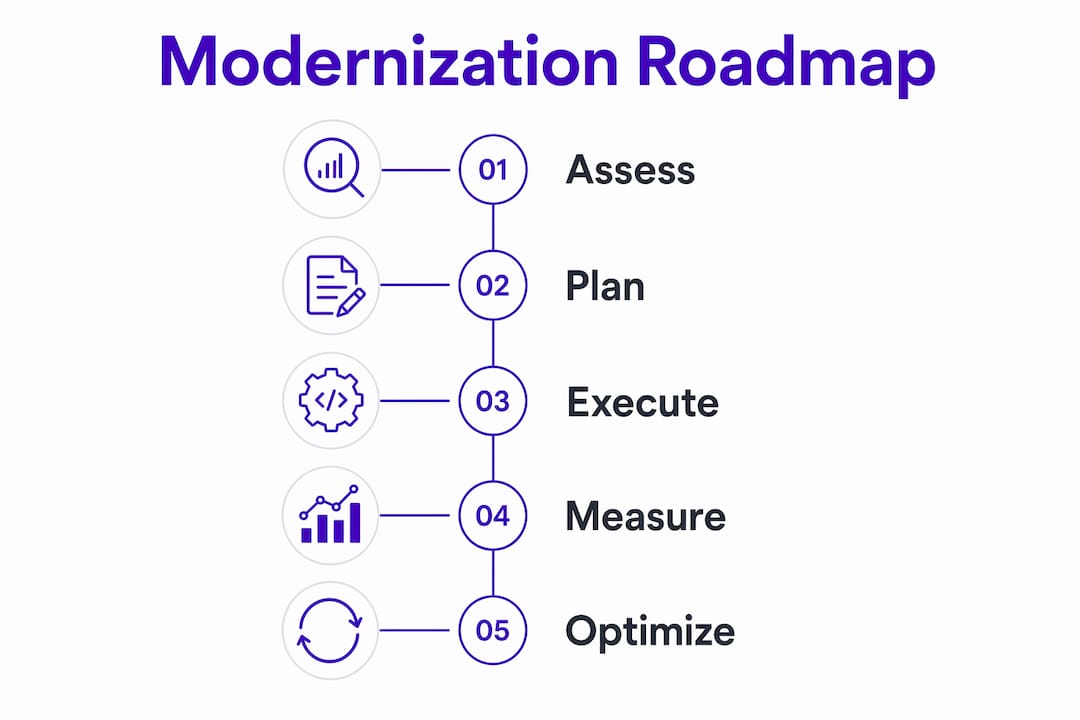
A practical application modernization roadmap follows this sequence:
- Complete the portfolio assessment. Document every application’s technical debt, business value, owner, and integration dependencies. This step takes time, but organizations that skip it spend the rest of the program correcting the consequences.
- Retire first. Eliminating redundant or unused applications before modernizing anything else reduces complexity and frees up budget. Most portfolios contain 15–25% of applications that can be retired immediately.
- Establish a cloud landing zone. A phased cloud foundation builds secure governance and networking before any critical application migrates. This reduces operational risk significantly.
- Run 90-day sprints for each modernization wave. Group applications by dependency and risk profile. Migrate or refactor the lowest-risk systems first to build team confidence and refine your process.
- Validate outcomes at each sprint boundary. Measure against predefined KPIs before moving to the next wave. If a sprint misses its targets, diagnose the cause before proceeding.
Executive sponsorship is not optional. Programs without a named executive sponsor consistently stall when cross-functional conflicts arise over budget, priorities, or resource allocation. A steering committee with representatives from IT, finance, operations, and the business units affected by each application keeps decisions grounded in business reality.
Pro Tip: Sequence your first sprint around a system with clear business impact and low migration risk. An early, visible win builds organizational confidence and secures continued investment.
Aligning your modernization roadmap with business goals from the start prevents the common drift where technical teams optimize for architecture while business leaders wait for outcomes that never materialize.
What tools and technologies support modernization in 2026?
Cloud platforms and managed services form the foundation of any modern software modernization effort. They eliminate the need to manage physical infrastructure, reduce time to provision environments, and provide built-in services for security, monitoring, and scaling. The right cloud platform choice depends on your existing technology stack, your team’s skills, and your vendor relationship preferences.
AI-assisted modernization tooling has changed the economics of legacy system upgrades. AI-driven tools are reducing modernization timelines by 40–50% and costs by 40%, with projections suggesting 70% cost reduction by 2027. These tools automate code analysis, dependency mapping, and code translation between languages, which previously required months of manual effort.
Key technology categories to evaluate for your digital transformation plan:
- Code analysis and migration tools: Automate discovery of technical debt, dead code, and integration points in legacy codebases.
- Container and orchestration platforms: Kubernetes and Docker enable consistent deployment across cloud and on-premises environments.
- API management platforms: Critical for connecting modernized applications to legacy systems during phased migration.
- CI/CD pipelines: Automate testing and deployment to reduce release risk and accelerate delivery cycles.
Evaluating tools against function, integration, cost, complexity, and stability before committing to a platform prevents vendor lock-in and integration failures. The biggest technology risk in modernization is not choosing the wrong tool. It is choosing a tool before you understand your architecture requirements. Aligning your cloud computing approach with your broader architecture design prevents costly rework later.
Mixed-portfolio approaches that balance speed and long-term value consistently outperform single-method strategies. Rehosting a batch of utility applications while simultaneously refactoring a core revenue system lets you show cost savings quickly while investing deeply where it matters most.
How to manage change, governance, and measurement
Governance and change management determine whether modernization delivers lasting value or reverts to technical debt within two years. Post-migration governance and continuous optimization are critical to prevent drift back into legacy practices after the initial program closes.
Most organizations underfund change management, allocating 0–5% of their modernization budget to it. The recommended allocation is 20–30% of total investment. That number surprises many IT leaders, but it reflects the real cost of adoption: training, process redesign, communication, and the productivity dip that follows any significant system change.
Effective governance for a modernization program includes:
- Decision rights documentation: Define who approves architecture changes, vendor selections, and scope adjustments before the program starts.
- Cross-functional steering committee: Meet bi-weekly to review sprint outcomes, resolve blockers, and realign priorities as business conditions change.
- Outcome-focused KPIs: Measure application uptime, deployment frequency, mean time to recovery, and cost per transaction, not just migration completion percentages.
- Continuous optimization cadence: Schedule quarterly reviews to assess whether modernized systems are delivering expected business value and identify new technical debt before it accumulates.
“Organizations that skip vision clarity and readiness assessment spend the rest of their programs correcting those consequences, reducing ROI and increasing risk. Governance is not bureaucracy. It is the mechanism that keeps modernization aligned with the business outcomes that justified the investment.”
Connecting modernization outcomes to business intelligence and revenue metrics gives executives the visibility they need to sustain investment across multi-year programs.
Key Takeaways
A successful application modernization strategy requires linking every technical decision to a measurable business outcome, sequencing initiatives in phased sprints, and funding change management at 20–30% of total investment.
| Point | Details |
|---|---|
| Assess before you act | Map every application’s business value, technical debt, and dependencies before selecting a modernization approach. |
| Use the 6 Rs framework | Match each application to the right approach based on whether it drives revenue or serves a utility function. |
| Phase your roadmap in 90-day sprints | Phased execution increases success rates by 2.5x compared to unsequenced programs. |
| Fund change management properly | Allocate 20–30% of your modernization budget to training, process redesign, and adoption support. |
| Govern continuously post-migration | Quarterly optimization reviews prevent drift back into technical debt after the initial program ends. |
What I’ve learned from modernization programs that actually work
The most common mistake I see is treating modernization as a one-time IT project with a finish line. Organizations that succeed treat it as an ongoing business capability. The technology changes, but the discipline of assessing, sequencing, and measuring never stops.
The second mistake is letting the technology team drive the entire program. When IT owns modernization without strong business sponsorship, the program optimizes for architecture elegance instead of business outcomes. The result is technically impressive work that fails to move the metrics executives care about. The application modernization market is projected to reach $67.91 billion by 2031, growing at nearly 20% annually. That growth reflects genuine business demand, not just technology enthusiasm.
What I find most valuable in practice is the mixed-portfolio approach. Not every application deserves the same level of investment. Rehosting your payroll system while rebuilding your customer-facing platform is not a compromise. It is a deliberate allocation of resources to where they create the most value. Teams that internalize this distinction make faster decisions and waste far less budget on over-engineering utility systems.
The integration of emerging technologies with legacy systems is where many programs stall. The technical complexity is real, but the bigger challenge is organizational. People built those legacy systems. They understand them deeply. Bringing those people into the modernization process, rather than working around them, consistently produces better outcomes and faster adoption.
How Ridiculousengineering supports your modernization program
Ridiculousengineering works with business leaders and IT teams to turn complex modernization challenges into production-ready outcomes. From portfolio assessment and roadmap design through technical execution and post-migration support, the team brings software engineering, solution architecture, and business analysis together under one engagement.
Whether you need to retire technical debt, migrate to cloud infrastructure, or rebuild a core business platform, Ridiculousengineering’s custom software development services are built for exactly this kind of work. The team has deep experience with phased modernization programs, API integration, DevOps, and AI-assisted development. If your organization is ready to move from planning to execution, Ridiculousengineering is the partner that makes hard problems practical.
FAQ
What is an application modernization strategy?
An application modernization strategy is a structured plan for upgrading legacy software systems to meet current business and technology requirements. It defines which applications to retire, rehost, refactor, or rebuild, and sequences those decisions to maximize business value and minimize risk.
Why do most modernization initiatives fail?
Around 70% of modernization initiatives fail due to poor planning and a lack of connection to measurable business outcomes. The most common root causes are skipping the portfolio assessment phase and underfunding change management.
What is the 6 Rs framework?
The 6 Rs framework categorizes modernization approaches as Retire, Retain, Rehost, Replatform, Refactor, and Rebuild or Replace. Each option maps to a different level of investment, risk, and expected business return.
How long does application modernization take?
Modernization timelines vary by portfolio size and complexity, but phased programs using 90-day sprints consistently outperform big-bang approaches. AI-assisted tooling is reducing timelines by 40–50% compared to traditional manual methods.
How much should organizations budget for change management?
Organizations should allocate 20–30% of their total modernization investment to change management, including training, process redesign, and adoption support. Most programs that fail allocate only 0–5%, which is the primary reason adoption stalls after migration completes.
Recommended
- Transformative Growth with Cloud Computing | Ridiculous Engineering | Ridiculous Engineering
- Composable Architecture Strategy 2026 | Ridiculous Engineering
- Top Design Trends for 2024: Enhancing User Experience and Web Design | Ridiculous Engineering
- Managing Tech Surprises: How to Stay Ahead of the Game | Ridiculous Engineering