Legacy System Modernization: A Practical Guide for Leaders
Legacy System Modernization: A Practical Guide for Leaders Legacy system modernization is the process of transforming outdated IT systems to meet current business needs, reduce security exposure, and cut the technical debt that slows every team down.
Legacy system modernization is the process of transforming outdated IT systems to meet current business needs, reduce security exposure, and cut the technical debt that slows every team down. The industry also calls this application modernization, and the two terms are interchangeable. Modernization ranges from a simple lift-and-shift to a full architectural rebuild, depending on each system’s business value and technical health. The AWS Prescriptive Guidance framework known as the 7 Rs gives teams a structured menu of options. This guide walks business leaders through assessment, prioritization, strategy selection, phased execution, and measurement so every dollar spent on upgrading legacy systems connects to a measurable outcome.
What is legacy system modernization, and why does it matter now?
Legacy system modernization is not just a technology project. It is a business continuity decision. Outdated systems accumulate maintenance costs, create security gaps, and block the integrations your teams need to move fast. Modernization differs from migration: migration moves a workload with minimal changes, while modernization updates architecture and code for improved agility. Many programs blend both. Teams migrate first to stabilize the environment, then modernize to unlock real business value.
The misconception worth addressing early: modernization is not a single event. Large portfolio efforts typically span 2–5 years, with individual applications taking anywhere from weeks for a rehost to months for a refactor or rebuild. That timeline is not a reason to delay. It is a reason to start with a clear plan.
How do you assess and inventory your legacy system portfolio?
A complete, current inventory is the prerequisite for every decision that follows. Without it, you are guessing at costs, dependencies, and risk. Outdated CMDBs and spreadsheets routinely fail here. Automated discovery tools and cross-team knowledge sessions are the reliable alternative.
Build your inventory by capturing these data points for every system:
- Service and business function: What does this system do, and which business processes depend on it?
- Owner: Who is accountable for this system today? Who holds the institutional knowledge?
- Runtime environment: Where does it run? On-premises hardware, a private data center, or a cloud account?
- Dependencies: What does this system call, and what calls it? API contracts, data feeds, batch jobs.
- Annual cost: Total cost of ownership including licensing, infrastructure, support labor, and incident response.
- Security posture: Known vulnerabilities, patch currency, and compliance obligations.
Pro Tip: Involve cross-functional teams early. Finance, operations, and compliance staff often hold tribal knowledge that engineering teams never documented. A two-hour working session with the right people surfaces more than weeks of automated scanning.
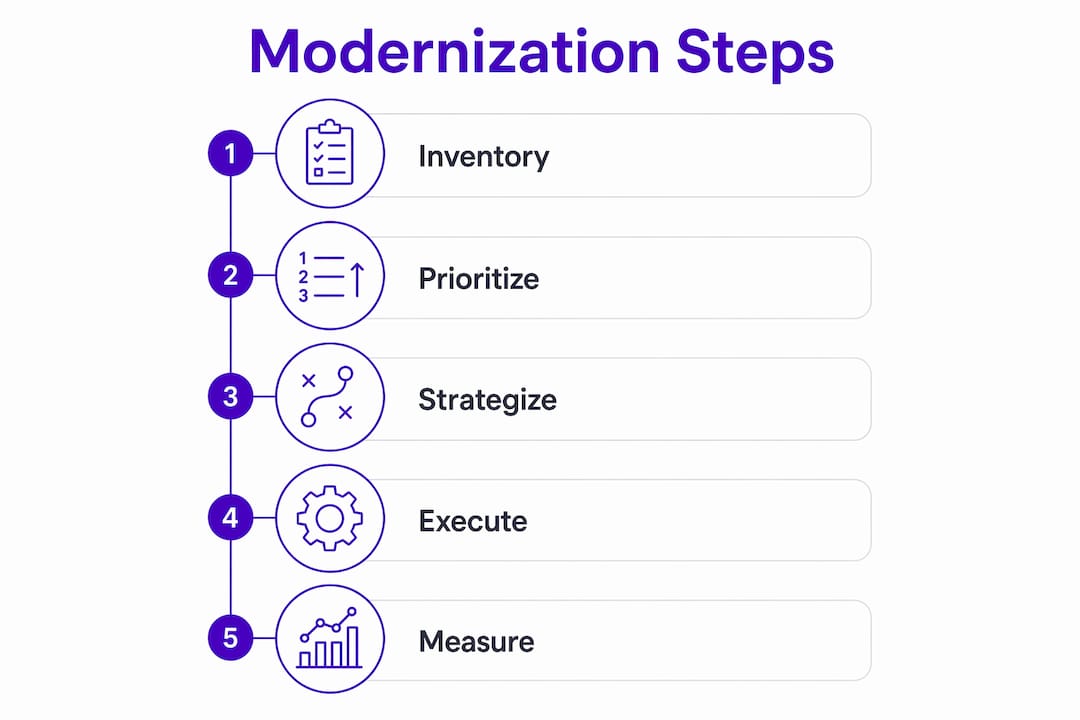
The goal is a single source of truth your leadership team can review. That inventory becomes the input to prioritization, and prioritization is where most programs either gain traction or stall.
How do you prioritize which legacy systems to modernize first?
Prioritization is the step that separates disciplined programs from expensive ones. The method is a two-axis scoring model: business value and technical health, with weights agreed on by executives before scoring begins.
Score each system on these dimensions:
- Revenue impact: Does this system directly generate or protect revenue? A billing platform scores higher than an internal reporting tool.
- Regulatory weight: Does a compliance failure here create legal exposure? Systems under SOC 2, HIPAA, or PCI DSS scope score higher.
- Strategic dependency: Is this system a blocker for a product launch, a merger integration, or a cloud migration initiative?
- Maintenance cost: What does it cost to keep this system running per year, including unplanned incidents?
- Security posture: Does this system carry known vulnerabilities or run on an unsupported runtime? Legacy systems increase security vulnerabilities as vendors stop issuing patches.
- Scalability ceiling: Can this system handle projected load growth, or does it require manual intervention to scale?
Once scored, sort your portfolio into three buckets: retain, modernize, and retire. Not every legacy system needs modernization. A stable, low-maintenance application with no integration pressure is a candidate for retention. Retiring unused systems saves cost and eliminates risk without a single line of new code.
Get executive sign-off on the scoring weights before you run the numbers. That step converts a technical exercise into a business decision, and it prevents the political debates that derail programs six months in.
What are the 7 Rs, and which strategy fits your system?
The 7 Rs framework, popularized by AWS Prescriptive Guidance, gives teams a structured vocabulary for modernization decisions. No single strategy fits every system. A well-run program uses a portfolio mix.
| Strategy | What it means | Best fit |
|---|---|---|
| Retain | Keep the system as-is | Stable, low-cost apps with no integration pressure |
| Retire | Decommission the system | Unused or fully redundant applications |
| Rehost | Move to new infrastructure with no code changes | Systems where cost reduction is the primary goal |
| Replatform | Move with minor optimizations (e.g., managed database) | Systems that benefit from cloud services without a full rewrite |
| Repurchase | Replace with a SaaS product | Commodity functions like HR, CRM, or email |
| Refactor | Restructure code without changing external behavior | Systems with high maintenance cost but sound business logic |
| Rearchitect/Rebuild | Redesign from the ground up | Systems where the existing architecture cannot meet future needs |
The cost and risk increase as you move down that list. Rehosting is fast and low-risk but delivers limited long-term value. Rearchitecting delivers the most value but requires the most time, budget, and skilled staff. Most portfolios land the majority of systems in the rehost, replatform, and refactor categories, with a handful of high-value systems warranting a full rebuild.
Pro Tip: Resist the urge to rearchitect everything. The instinct to start fresh is understandable, but big-bang rewrites fail at a high rate. Reserve rebuild for systems where the existing architecture is genuinely incompatible with your future state, not just unfamiliar to your current team.
For teams managing cloud migration for legacy systems, the rehost and replatform strategies often serve as the first wave, stabilizing workloads before deeper refactoring begins.
How do you execute modernization safely using waves and the strangler fig pattern?
Phased execution is the mechanism that keeps modernization programs from collapsing under their own weight. Dependency mapping is the first step: you cannot plan waves without knowing which systems share data, APIs, or batch processes.
Once dependencies are mapped, structure your work into waves with clear entry and exit criteria:
- Wave 1: Target systems with high business value, low technical complexity, and few dependencies. These are your early wins.
- Wave 2: Address systems with moderate complexity that depend on Wave 1 completions.
- Wave 3 and beyond: Tackle the most complex refactors and rearchitects after the team has built operational maturity.
The strangler fig pattern is the execution technique that makes incremental modernization practical. You build new functionality alongside the legacy system, route traffic to the new components gradually, and retire old components once traffic has fully moved. The result is reversible, incremental change rather than a high-stakes cutover that usually fails.
Blue-green deployments and feature flags complement the strangler fig approach. Blue-green deployments let you run two production environments simultaneously and switch traffic instantly if something breaks. Feature flags let you release new functionality to a subset of users before full rollout.
Pro Tip: Front-load early wins deliberately. A Wave 1 that retires three redundant systems and replatforms two others generates visible cost savings within the first quarter. That evidence keeps executive sponsors engaged and budget intact for the harder work ahead.
Teams dealing with integrating emerging technologies alongside legacy systems will find the strangler fig pattern especially useful, since it avoids forcing a hard cutover before the new system is proven.
How do you measure whether your modernization program is working?
Measurement is what separates a modernization program from a modernization theater. Business-aligned metrics give executive sponsors the evidence they need to sustain investment across multi-year programs.
Track these metrics from the first wave:
- Deployment frequency: How often does the team ship changes to production? Higher frequency signals improved engineering health.
- Lead time for changes: How long from code commit to production? Shorter lead times mean faster response to business needs.
- Change failure rate: What percentage of deployments cause incidents? A declining rate confirms quality is improving.
- Mean time to restore (MTTR): How quickly does the team recover from failures? Lower MTTR reduces business disruption.
- Operational cost per feature: What does it cost to run and maintain each capability? This metric ties engineering work directly to financial outcomes.
These are the DORA metrics, a research-backed framework for measuring software delivery performance. Report them to executive sponsors at the end of every wave. Sponsors who see deployment frequency double and MTTR cut in half will fund the next wave. Sponsors who receive only technical status updates will eventually question the investment.
Watch for modernization churn: teams that refactor the same components repeatedly without measurable improvement are a warning sign. Churn usually indicates unclear exit criteria or scope creep. Tighten the wave definition and recheck the dependency map.
Key Takeaways
Legacy system modernization succeeds when business leaders treat it as a portfolio-level program with scored priorities, a defined strategy per system, phased execution, and metrics that report directly to business outcomes.
| Point | Details |
|---|---|
| Inventory before everything | Capture owner, runtime, dependencies, and cost for every system before making any modernization decision. |
| Score on two axes | Rate each system on business value and technical health, with executive-approved weights, to drive objective prioritization. |
| Match strategy to system | Use the 7 Rs framework to assign the right approach; most portfolios need a mix, not a single strategy. |
| Execute in waves | Front-load early wins, map dependencies, and use the strangler fig pattern to reduce cutover risk. |
| Measure with DORA metrics | Track deployment frequency, lead time, change failure rate, and MTTR to validate ROI at every wave. |
Why I think most modernization programs fail before they start
The programs I have seen struggle share a common trait: they skip the inventory and jump straight to architecture decisions. The team spends months designing a target state for systems they do not fully understand, and the first wave hits dependencies nobody mapped. Budget overruns follow, and executive confidence evaporates.
The other failure mode is the big-bang rewrite. It sounds appealing in a boardroom. One clean break, one modern platform, done. The reality is that COBOL modernization projects and similar large-scale rewrites routinely cost three times the original estimate. The business logic embedded in legacy systems is often more complex than anyone remembers, and rebuilding it from scratch while keeping the old system running is genuinely hard.
What actually works is ruthless portfolio curation. Retire what you can. Retain what is stable. Rehost what just needs a cheaper home. Save the refactoring and rebuilding budget for the systems that genuinely block your business goals. That discipline is harder to sell than a grand vision, but it delivers results that keep programs funded.
My advice to business leaders: demand measurable outcomes at every wave review. Not slide decks about architecture. Actual numbers. Deployment frequency, MTTR, cost per transaction. If your technology team cannot connect their work to those numbers, the program needs a tighter definition of success before the next wave begins.
— Paul
Ridiculousengineering’s approach to application modernization
Ridiculousengineering works with organizations that have real legacy estates and real business pressure to modernize them. The team brings custom software development expertise to every engagement, from initial inventory and scoring through wave planning, execution, and post-modernization support. The approach is direct: understand the business goals first, then select the right strategy per system rather than applying a one-size-fits-all method. Ridiculousengineering has helped enterprises, nonprofits, and government organizations replace inefficient systems with production-ready platforms that deliver measurable improvements in cost, speed, and reliability. If your organization is ready to move from assessment to execution, the team is worth a conversation.
FAQ
What is the difference between legacy system modernization and migration?
Migration moves a workload to new infrastructure with minimal code changes. Modernization updates architecture and code to improve business agility. Many programs combine both: migrate first to stabilize, then modernize.
How long does a legacy system modernization program take?
Individual applications take weeks for a rehost and months for a refactor or rebuild. Large portfolio programs typically run 2–5 years, with each wave delivering incremental business value.
What are the 7 Rs in legacy modernization?
The 7 Rs are Retain, Retire, Rehost, Replatform, Repurchase, Refactor, and Rearchitect/Rebuild. Each represents a different level of change, cost, and risk.
How do you decide which legacy systems to modernize first?
Score each system on business value (revenue impact, regulatory weight, strategic dependency) and technical health (maintenance cost, security posture, scalability). Systems with high scores on both axes are the first modernization candidates.
What metrics prove a modernization program is succeeding?
Track DORA metrics: deployment frequency, lead time for changes, change failure rate, and MTTR. Add operational cost per feature to connect engineering performance directly to financial outcomes.
Recommended
- Transformative Growth with Cloud Computing | Ridiculous Engineering | Ridiculous Engineering
- COBOL Modernization: Why Projects Cost More Than Expected | Ridiculous Engineering
- Modernizing Digital Infrastructure for a Pacific Northwest Credit Union | Ridiculous Engineering
- Bridging the Gap: Integrating Emerging Technologies with Legacy Systems | Ridiculous Engineering