Government Software Procurement: A Practical Officer's Guide
Government Software Procurement: A Practical Officer’s Guide Use an RFP only when you must evaluate factors beyond price. For everything else, an RFQ or a GSA schedule vehicle gets you to contract faster with less protest exposure.
Use an RFP only when you must evaluate factors beyond price. For everything else, an RFQ or a GSA schedule vehicle gets you to contract faster with less protest exposure. Three safeguards apply to every public sector software acquisition regardless of route: FAR compliance, a documented security posture (FedRAMP, FISMA, or NIST SP 800-53 alignment), and defensible, pre-established evaluation criteria.
Your immediate next steps:
-
Conduct market research to confirm whether commercial solutions exist before writing custom requirements.
-
Run a security baseline check against your agency’s FISMA categorization and FedRAMP authorization requirements.
-
Engage your contracting officer or an assisted acquisition team early if requirements are complex or timelines are tight.
Table of Contents
-
Which solicitation type fits your government software procurement?
-
What does the software procurement lifecycle actually look like?
-
How do you write requirements and build a defensible scoring matrix?
-
What security and compliance requirements apply to government software?
-
What do realistic timelines and total cost of ownership look like?
-
Ridiculous Engineering supports procurement teams that need a technical partner
Which solicitation type fits your government software procurement?
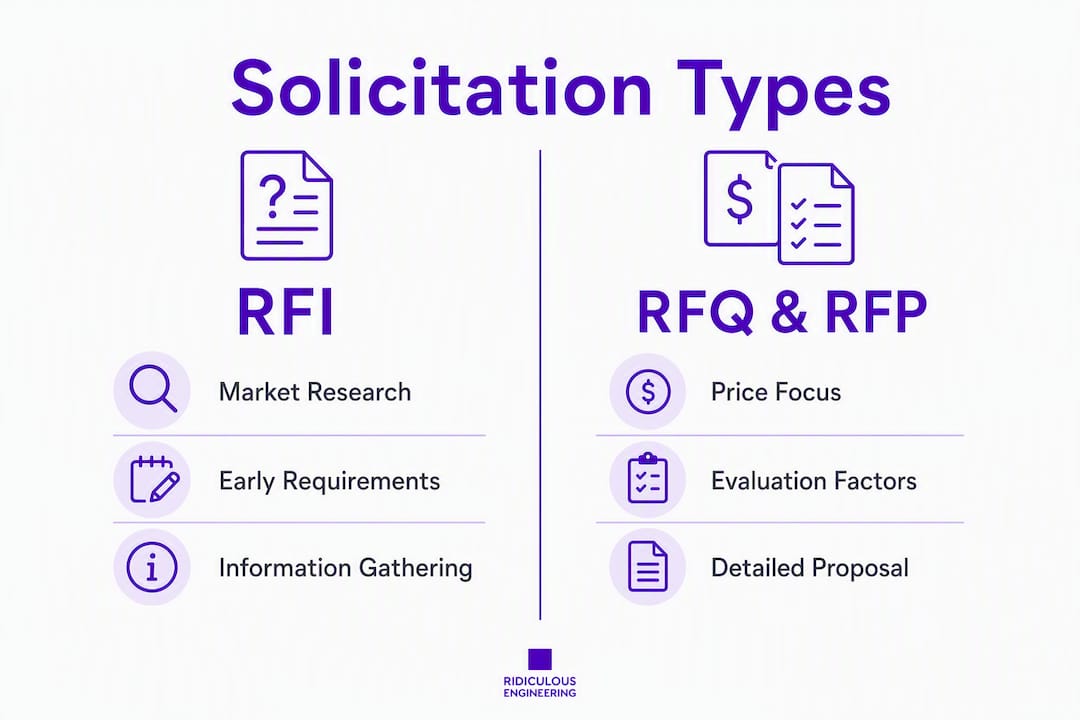
The choice between RFI, RFQ, and RFP is the first decision that shapes everything downstream. Get it wrong and you either over-engineer a simple buy or under-specify a complex one.
| Route | Best for | When to use |
|---|---|---|
| RFI | Market research only | Before requirements are final; no award results |
| RFQ | Price-focused, well-defined scope | COTS/SaaS with known specs, micro-purchases |
| RFP | Multi-factor evaluation | Technical approach, past performance, or service delivery matter |
| GSA MAS / OneGov | Pre-negotiated IT buys | Faster award, consistent security terms, volume pricing |
| Cooperative / piggyback | Speed, existing contract | Scope and pricing must align; due diligence required |
GSA purchasing programs consolidate common IT spend under pre-negotiated, compliance-ready vehicles. For many software buys, a GSA Multiple Award Schedule (MAS) order is faster and lower-risk than a standalone solicitation.
Piggybacking on another agency’s contract can cut weeks off procurement lead time, but it requires confirming that the original contract’s scope covers your use case, that pricing is still competitive, and that the vendor’s security certifications remain current. Skipping that check is where piggybacking goes wrong.
Pro Tip: Use RFPs only when you must evaluate non-price factors. Defaulting to an RFP for every software buy adds months and increases protest risk without improving outcomes.
What does the software procurement lifecycle actually look like?
Each phase produces a specific artifact. Skipping one usually means revisiting it later at higher cost.

| Phase | Key artifact | Primary owner |
|---|---|---|
| Requirements & market research | Market research report, requirements doc | Program/technical lead |
| Solicitation | RFQ, RFP, or order request | Contracting officer |
| Evaluation | Scored proposals, consensus memo | Evaluation panel + CO |
| Award | Contract / task order | Contracting officer |
| Implementation | Acceptance test plan, deployment records | Technical lead + vendor |
| Contract management | Performance reports, modification log | CO + program office |
Timeline ranges vary considerably. A straightforward SaaS order off a GSA schedule can close within a few weeks. A competitive RFP for a custom platform typically takes several months from requirements through award, with implementation adding additional months depending on scope. Most delays occur during requirements definition and evaluation, not solicitation.
The single most expensive mistake in public sector software acquisition is starting the solicitation before requirements are stable. Agencies that invest two to four weeks in structured market research consistently shorten their overall procurement cycle.
How do you write requirements and build a defensible scoring matrix?
Outcome-focused requirements describe what the system must accomplish, not how it must be built. “The system shall process 10,000 permit applications per month with 99.5% uptime” is testable. “The system shall be modern and user-friendly” is not.
Separate mandatory pass/fail criteria from scored elements. Mandatory criteria eliminate non-compliant offers before scoring begins. Scored elements differentiate among compliant offers.
| Evaluation factor | Weight | Scoring notes |
|---|---|---|
| Technical approach | — | Methodology, architecture, integration plan |
| Past performance | — | References, similar scope, recency |
| Security posture | — | FedRAMP status, NIST controls, incident response |
| Price / total cost | — | Licensing, implementation, ongoing maintenance |
A compliance scorecard applied consistently across all offerors reduces protest exposure and makes the award decision easier to document.
Key practices for audit-ready evaluations:
-
Lock evaluation criteria and weights in the solicitation before receiving proposals.
-
Use a consensus-based scoring process with individual scores documented before panel discussion.
-
Maintain version control on all solicitation amendments and evaluation worksheets.
Pro Tip: Document every scoring decision with a rationale sentence. “Offeror A scored 4/5 on technical approach because…” is the sentence that wins a protest defense.
SaaS/COTS vs. custom development: how do you choose?
The honest answer is that most agencies default to COTS when custom is warranted, and occasionally commission custom builds when a commercial product would have worked fine. The tradeoffs between open-source and proprietary software follow a similar pattern.
| Dimension | SaaS / COTS | Custom development |
|---|---|---|
| Best for | Common workflows, proven use cases | Unique processes, legacy integration, mission-specific needs |
| Total cost of ownership | Lower upfront; subscription costs compound | Higher upfront; lower long-term if well-maintained |
| Time to deploy | Weeks to months | Months to years (modular approach shortens this) |
| Vendor lock-in risk | High; data portability must be negotiated | Low if you own the IP and source code |
| Security posture | FedRAMP authorization available for major platforms | Must be built in; requires NIST SP 800-53 alignment |
| Maintenance model | Vendor-managed updates | Agency or contractor-managed |
| Licensing flexibility | Standard EULA; limited modification rights | Full rights negotiable via contract |
FAR Part 39 recommends modular contracting for large IT projects, breaking work into smaller increments to reduce schedule and technical risk. That guidance applies equally to custom builds and phased COTS implementations.
Pro Tip: When accepting a commercial license, review the EULA for indemnification clauses before signing. FAR Part 12 cautions against accepting terms that create obligations inconsistent with federal law, including the Anti-Deficiency Act.
What security and compliance requirements apply to government software?
Security is not a post-award concern. It belongs in the solicitation, the evaluation criteria, and the contract.
Minimum expectations by system type:
-
Cloud SaaS: FedRAMP authorization at the impact level matching your data (Low, Moderate, or High). Verify current authorization status on the FedRAMP Marketplace before award.
-
On-premise or hybrid: FISMA compliance documentation and a current Authority to Operate (ATO) or plan to obtain one.
-
All software: Mapping to relevant NIST SP 800-53 control families, particularly access control (AC), incident response (IR), and configuration management (CM).
Contract clauses to require:
-
Data rights and ownership (government retains rights to its data at all times).
-
Patching and vulnerability response timelines (critical patches within 30 days is a common standard).
-
Incident notification requirements (72-hour notification is a common threshold).
-
Limitation of liability language reviewed against federal law.
Security posture is an evaluation factor, not a checkbox. A vendor with a FedRAMP Moderate authorization and a documented incident response plan is materially lower risk than one with a self-attestation and a vague security policy.
Commercial EULAs frequently contain indemnification or warranty terms that conflict with federal purchasing rules. FAR Part 12 directs contracting officers to acquire commercial software under standard public licenses when those licenses are consistent with law, and to flag terms that are not. Legal review before execution is not optional for high-value or sensitive-data contracts. For zero-trust and federal contractor security requirements, the bar has risen considerably in recent years.
When should you use assisted acquisition services?
Assisted acquisition means engaging a third-party contracting organization, such as a GSA Center of Excellence or another agency’s contracting shop, to run the procurement on your behalf. Your agency retains technical ownership and requirements authority; the assisted acquisition team handles solicitation, evaluation support, and award administration.
GSA’s assisted acquisition services reduce administrative burden and bring pre-negotiated vehicles and compliance expertise to complex buys. They are particularly useful when your agency lacks contracting capacity, when the requirement involves specialized IT expertise, or when a tight timeline makes a full in-house solicitation impractical.
Assisted acquisition is not a shortcut around oversight. It is a way to redirect your team’s energy toward what only your agency can do: defining requirements, setting acceptance criteria, and managing vendor performance after award.
Pro Tip: Retain a technical lead from your program office throughout any assisted acquisition. The contracting team handles process; your team owns the outcome.
Vendor due diligence checklist and red flags
Due diligence happens before award, not after a problem surfaces.
Checklist:
-
Verify past performance references for contracts of similar scope and complexity.
-
Confirm FedRAMP authorization status or FISMA documentation is current.
-
Review SOC 2 Type II reports for SaaS vendors handling sensitive data.
-
Check financial stability indicators (years in business, government contract history).
-
Confirm patching and incident response SLAs are documented and enforceable.
| Contract term | Minimum standard |
|---|---|
| SLA uptime | 99.5% or higher for mission-critical systems |
| Critical patch response | 30 days from disclosure |
| Data return at termination | 30 days, machine-readable format |
| Incident notification | 72 hours from discovery |
| Acceptance criteria | Defined, measurable, and tied to payment milestones |
Red flags: opaque or non-negotiable EULA terms, indemnification clauses that shift unlimited liability to the government, a product roadmap that has not been updated in over a year, and SLA commitments with no financial remedy for breach. Piggybacking on an existing contract can be fast, but these checks still apply.
What do realistic timelines and total cost of ownership look like?
| Procurement type | Procurement lead time | Implementation | Stabilization |
|---|---|---|---|
| SaaS via GSA schedule | Several weeks | A few months | Several weeks to a few months |
| Competitive RFP, COTS | Several months | Several months | Several months |
| Custom development (modular) | Several months | Several months to over a year | Several months |
Hidden cost drivers that budgets routinely miss: data migration, integration with legacy systems, security remediation before ATO, end-user training, and ongoing maintenance after the initial contract period. A three-year total cost of ownership analysis, including licensing escalation and support costs, almost always produces a different ranking than a first-year price comparison.
Pro Tip: Structure custom development contracts as modular increments per FAR Part 39. Each increment has its own acceptance criteria and funding authorization, which limits exposure if requirements change mid-project.
How Ridiculous Engineering supports government buyers
Ridiculous Engineering works with government and public sector organizations at the requirements, delivery, and long-term support stages of a procurement.
Services that map directly to procurement needs:
-
Requirements definition and technical specification writing.
-
Modular architecture design aligned to FAR Part 39 contracting structures.
-
Secure custom software development with NIST SP 800-53 control alignment.
-
Legacy system integration and API development.
-
DevOps, CI/CD pipeline setup, and cloud architecture.
-
Post-award implementation, testing, and long-term maintenance support.
Procurement teams can engage Ridiculous Engineering through a statement of work under an existing vehicle, as a subcontractor post-award, or through assisted acquisition cooperation per agency rules. The goal is always the same: help you define what you actually need, build it correctly, and keep it running.
Key Takeaways
Effective government software procurement requires the right solicitation type, a documented security posture, and defensible evaluation criteria established before proposals arrive.
| Point | Details |
|---|---|
| Match solicitation to complexity | Use RFQ for price-focused buys; reserve RFP for multi-factor evaluations to save time and reduce protest risk. |
| Security is an evaluation factor | Require FedRAMP authorization, NIST SP 800-53 alignment, and enforceable patching SLAs in every software contract. |
| Score before you receive proposals | Lock evaluation criteria and weights in the solicitation; document every scoring rationale for audit readiness. |
| Use modular contracting for large builds | FAR Part 39 recommends breaking large IT work into increments to limit schedule risk and preserve funding flexibility. |
| Ridiculous Engineering as a technical partner | Ridiculous Engineering supports government buyers from requirements definition through post-award implementation and long-term maintenance. |
Ridiculous Engineering supports procurement teams that need a technical partner
Government procurement officers often know exactly what outcome they need and have no shortage of process guidance. What they frequently lack is a technical partner who can translate mission requirements into a buildable, secure, maintainable system, and who understands how government contracting actually works.
Ridiculous Engineering offers custom software development scoped to fit procurement vehicles, from statement-of-work engagements to post-award delivery contracts. The team covers requirements definition, secure architecture, integration with existing agency systems, and long-term support, without the overhead of a large systems integrator or the risk of a vendor who disappears after go-live.
To discuss how Ridiculous Engineering can support your next software acquisition, reach out directly through the custom software development services page.
Authoritative sources and further reading
-
FAR Part 12: Acquisition of Commercial Products and Commercial Services — governs commercial software license handling and EULA review requirements.
-
FAR Part 39: Acquisition of Information Technology — covers modular contracting policy and IT procurement procedures.
-
FAR 15.203: Requests for Proposals — defines RFP structure and minimum content requirements for competitive acquisitions.
-
GSA Purchasing Programs — assisted acquisition services and pre-negotiated IT vehicles.
-
GSA OneGov — centralized software buying for consistent pricing and security terms.
-
FedRAMP Marketplace — authoritative source for verifying cloud product authorization status.
-
DFARS Subpart 227.72 — defense-specific rules for computer software rights and documentation.
-
RFQ vs. RFP in government tenders — practical analysis of when each solicitation type applies.
FAQ
When should you use an RFP instead of an RFQ?
Use an RFP when evaluation factors beyond price, such as technical approach, past performance, or security posture, must be assessed. For well-defined software purchases where price is the primary differentiator, an RFQ is faster and carries less protest risk.
What is FedRAMP and why does it matter for software procurement?
FedRAMP is the federal authorization program for cloud services. Requiring FedRAMP authorization at the appropriate impact level (Low, Moderate, or High) means the vendor’s security controls have been independently assessed, which reduces your agency’s ATO burden and risk exposure.
What does FAR Part 39 say about large IT projects?
FAR Part 39 recommends modular contracting for large IT acquisitions, breaking work into smaller increments with defined acceptance criteria. This limits schedule risk and preserves funding flexibility if requirements change.
How does assisted acquisition reduce procurement risk?
Assisted acquisition shifts contracting administration to a specialist team, such as a GSA center, while your agency retains technical ownership and requirements authority. It is most useful for complex IT buys, constrained timelines, or when in-house contracting capacity is limited.
Can Ridiculous Engineering support a government software procurement?
Yes. Ridiculous Engineering works with government buyers on requirements definition, secure custom development, system integration, and post-award support, structured to fit standard procurement vehicles including statement-of-work and subcontracting arrangements.