Technical Debt Remediation: A Practical 2026 Guide
Technical Debt Remediation: A Practical 2026 Guide Technical debt remediation is the systematic process of identifying, prioritizing, and resolving engineering compromises that accumulate over time and degrade software quality, delivery speed, and business agility.
Technical debt remediation is the systematic process of identifying, prioritizing, and resolving engineering compromises that accumulate over time and degrade software quality, delivery speed, and business agility. Every engineering organization carries some debt. The ones that stay competitive are the ones that manage it deliberately rather than discovering it during a production incident or a failed product launch.
Unmanaged debt slows feature delivery, raises defect rates, and quietly increases the cost of every future change. The Technical Debt Ratio (TDR) gives teams a concrete health signal: under 5% is healthy, 5–10% is a yellow flag, and above 10% means debt is materially slowing your team. Quantitative frameworks like RIVER, RICE, and Weighted Shortest Job First (WSJF) convert subjective engineering frustration into objective, prioritized backlogs that leadership can actually evaluate.
A few facts worth keeping front of mind:
- Effective teams allocate 15–25% of sprint capacity to debt remediation as a protected, recurring investment.
- Continuous remediation outperforms episodic “debt sprints” because it prevents rebound accumulation.
- The goal is never zero debt. It is a manageable portfolio that does not slow your roadmap.
What are the main types of technical debt and why do they matter?
Not all technical debt looks the same, and treating it as a single category leads to poor prioritization decisions. Three broad types drive most of the pain teams experience.
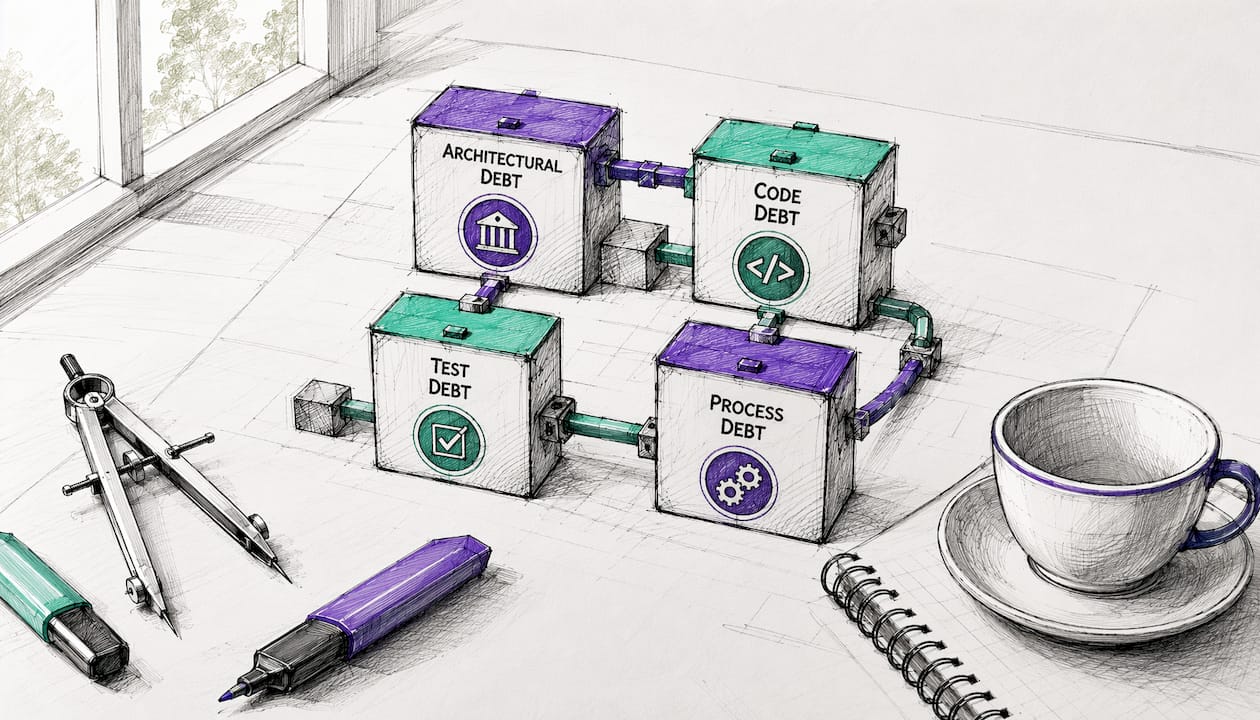
Intentional debt is a conscious tradeoff. A team ships a quick implementation to meet a deadline, knowing it will need rework. Done with eyes open and a logged backlog item, this is reasonable engineering judgment. The problem starts when the backlog item never gets addressed.
Unintentional debt accumulates without anyone deciding to take it on. It shows up as code that was correct when written but has since become a liability through changing requirements, team turnover, or simply the passage of time. This category is the hardest to see because no one made a deliberate choice.
Environmental debt is driven by external forces: a dependency reaching end of life, a cloud provider deprecating an API, or a compliance requirement that invalidates an existing architecture. Teams often underestimate this category until a vendor sunset notice lands in their inbox.
At the code level, debt typically appears as duplicated logic, high cyclomatic complexity, poor test coverage, and tight coupling between modules. Architectural debt runs deeper: a monolithic deployment pipeline that slows every team, a missing observability layer that hides bugs as traffic scales, or a data model that made sense in year one but now blocks every new feature. The healthcare.gov launch failure is a well-documented case of architectural debt under pressure, where compounding system integration problems overwhelmed a high-stakes release.
The business consequences are concrete:
- Slower cycle times in debt-heavy modules, often 3x longer than the team median
- Higher change failure rates in services where debt has crossed from “annoying” to “actively breaking things”
- Delayed revenue when debt blocks a feature tied to a deal or a compliance deadline
- Increased onboarding friction as new engineers struggle to understand poorly documented, tightly coupled systems
Best practices for managing and reducing technical debt effectively
The most common failure mode in debt management is treating remediation as something teams will get to once feature pressure eases. Feature pressure never eases. Debt either gets managed alongside the work, or it eventually becomes the work.
Four patterns consistently work in practice:
- Fixed allocation: Reserve 15–25% of every sprint for debt reduction, not as optional spare time but as a guaranteed slice. Consistency matters more than size. Twenty percent every sprint compounds; fifty percent once a quarter does not.
- Boy Scout Rule, codified: Every pull request that touches a high-debt module must include at least one improvement. Reviewers enforce it. This handles distributed, opportunistic debt that does not justify a dedicated initiative.
- Targeted initiatives: For concentrated work like a database migration or a framework upgrade, run a fixed-time, fixed-team initiative with a clear definition of done, a named owner, and a hard time box. Six weeks works for most; anything over a quarter usually means the scope was wrong.
- Replacement over refactoring: When a system is fundamentally misaligned with where the business is going, refactoring legacy code is often throwing good money after bad. Replacement is frequently cheaper and faster for genuinely misarchitected systems.
Pro Tip: Stop using the word “debt” with product leaders. Frame remediation in business outcomes: feature throughput, incident rate, hiring velocity, contract eligibility. Quantify the cost of delay. Product leaders are not against improving the system; they are against vague engineering asks they cannot evaluate.
Tooling matters too. Static analysis tools like SonarQube and ESLint catch complexity spikes, duplication, and policy violations before they merge. Automated quality gates in your CI/CD pipeline turn quality from a heroic act by the most senior engineer into a routine check that runs on every commit.

How do you measure and prioritize technical debt remediation?
You cannot reduce what you do not measure. The challenge is that debt resists single-number quantification, so effective teams use a small portfolio of metrics that each catch a different signal.
| Metric | What it measures | Healthy threshold |
|---|---|---|
| Technical Debt Ratio (TDR) | Estimated remediation cost vs. total development cost | Under 5% |
| Code churn rate | How often code is rewritten shortly after commit | Low in stable modules |
| PR cycle time by module | Time to merge pull requests per area | Within 1x team median |
| Change failure rate (CFR) | Deployments causing incidents in specific services | Trending down |
Once you can see the debt, the harder question is what to fix first. Prioritization frameworks convert subjective frustration into objective, sortable backlogs. Three lenses drive the most useful decisions:
Cost of delay asks what each debt item costs per month to leave unaddressed. Slower feature delivery, higher incident rates, lost engineering capacity, and real revenue impact when debt blocks a deal all belong in this calculation.
Strategic alignment maps debt against the 12-month product roadmap. Debt in a module powering your next major launch gets a priority bump. Debt in code about to be deprecated drops to the bottom or off the list entirely.
Compounding risk identifies debt that grows over time. A flaky test suite gets flakier as the codebase grows. A monolithic pipeline gets slower with every team added. This debt should be paid down earlier than its current pain suggests because the cost curve is nonlinear.
A practical scoring rubric: rate each debt item 1–5 on cost of delay, strategic alignment, and compounding risk. Multiply the scores. Sort descending. The top of that list is your debt backlog for the next quarter.
| Framework | Best suited for | Key dimensions |
|---|---|---|
| RIVER | Broad debt inventories | Risk, Impact, Value, Effort, Reach |
| RICE | Product-aligned teams | Reach, Impact, Confidence, Effort |
| WSJF | SAFe and agile at scale | Cost of delay divided by job size |
| Impact/Effort matrix | Quick triage sessions | Business impact vs. implementation effort |
Quarterly reviews with scoring rubrics prevent stale prioritization and keep the backlog aligned with changing business and technical contexts. Protect the debt budget in sprint planning the same way you protect feature work. If debt items get bumped every cycle, the allocation is theoretical, not real.
How do you make technical debt remediation part of everyday work?
Treating debt remediation as a special project is what turns it into a crisis. Embedding it as ambient work in CI/CD pipelines and developer workflows is what keeps it from becoming one.
Automated quality gates are the most reliable mechanism. When a build fails on a critical lint violation or a complexity spike, the team addresses it immediately, in context, before it merges. That is far cheaper than scheduling a cleanup sprint six months later. Continuous automated governance is especially important in fast AI-driven development environments, where coding agents can introduce debt at a rate that outpaces manual review.
Automating remediation at scale also reduces governance drift. Declarative code transformations applied consistently across multiple repositories avoid the human inconsistencies that accumulate when engineers fix the same class of problem differently in different codebases. This matters most for large organizations managing dozens of services.
Practices that normalize debt work in daily operations:
- Run static analysis on every merge request to catch duplication, complexity spikes, and obvious regressions early.
- Use pull request templates that prompt engineers to note any debt introduced. A small prompt surfaces shortcuts before they disappear into main.
- Capture debt items in the backlog at the moment a shortcut is taken, while context is fresh.
- Review debt items during sprint retrospectives, not just during quarterly planning.
- Embed DevOps workflows with quality checks that make the clean path easier than the sloppy one.
Pro Tip: Zero technical debt is not the goal and not achievable in any active codebase. The right target is a manageable debt portfolio where debt does not slow your roadmap by more than 20%. Healthy teams typically run a TDR between 3–7%, with concentrations in older modules.
How do you implement a technical debt remediation plan?
A remediation plan without clear ownership and defined steps stays a slide deck. Here is how to move it into execution.
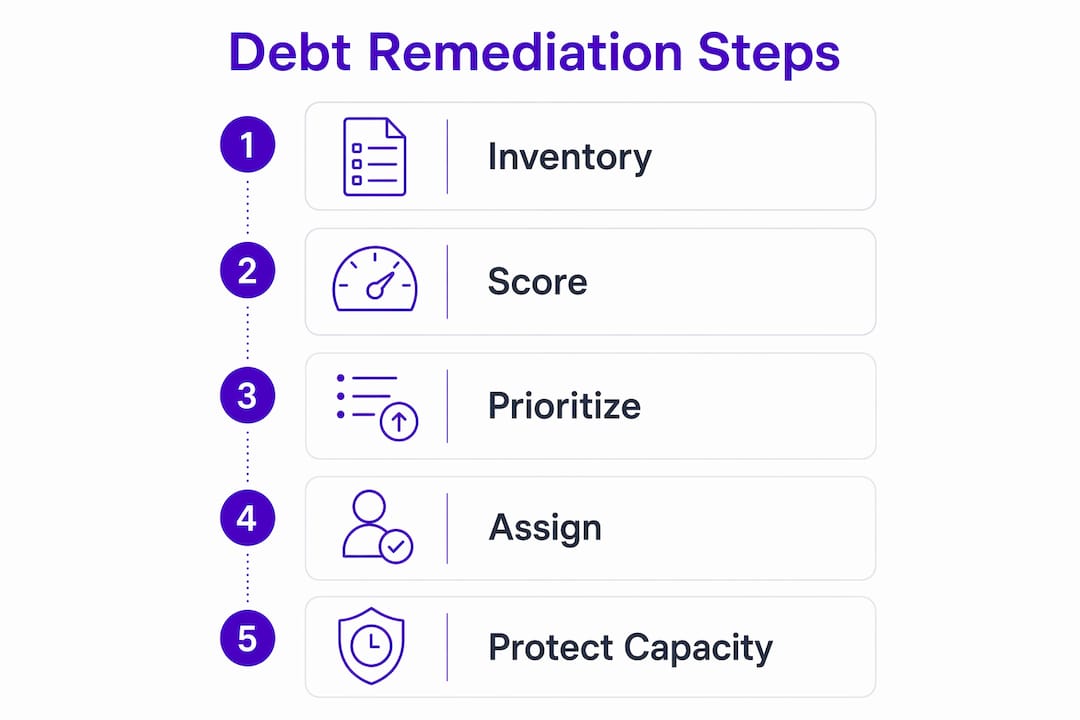
Step 1: Build a debt inventory. Tag debt items in your issue tracker by affected component, symptom, cost of leaving it alone, smallest useful fix, and a trigger for action. The Carnegie Mellon University Software Engineering Institute (CMU SEI) recommends tracking debt items separately from defects and vulnerabilities, and capturing them explicitly during design reviews and release reviews.
Step 2: Score and prioritize. Apply the cost of delay, strategic alignment, and compounding risk lenses. Use a scoring rubric. Sort the backlog. Agree on the top items for the next quarter before sprint planning begins.
Step 3: Assign ownership. Each debt initiative needs a named owner, not just “the team.” That person is accountable for delivery, scope, and the definition of done. Diffuse ownership is how targeted initiatives stall.
Step 4: Protect capacity. Allocate a fixed percentage of every sprint to debt work and defend it in planning. If you need to hire engineers to maintain velocity while running a remediation initiative, that is a legitimate investment decision with a quantifiable return.
Step 5: Measure and adjust. Track whether feature work in refactored areas gets easier, whether bugs recur less often, and whether reviews move faster. Watch for engineers who stop avoiding certain parts of the codebase. Those are the real signals that remediation is working.
Roles that matter:
- Engineering manager: owns the debt budget, protects sprint capacity, escalates blockers.
- Tech lead: maintains the debt inventory, scores items, sets architectural guardrails.
- Individual contributors: apply the Boy Scout Rule, log intentional shortcuts, participate in scoring.
- Product manager: aligns debt priorities with the product roadmap, communicates business impact to stakeholders.
How do you prevent technical debt from accumulating in the first place?
Prevention is cheaper than remediation, and most of it happens at the path to main. CI/CD checks, review rules, and branch protections do not eliminate tradeoffs, but they force teams to make them consciously rather than accidentally.
A baseline prevention setup includes:
- Fail builds on critical lint and formatting violations so review time is not wasted on preventable inconsistency.
- Require automated tests for any changed behavior. Even minimal characterization tests are better than relying on memory.
- Run static analysis on every merge request. Tools like SonarQube and ESLint catch complexity spikes and duplication before they reach production.
- Flag risky dependency changes. Package upgrades and additions often create hidden maintenance work that shows up months later.
- Use pull request templates that ask whether debt is being introduced. A small prompt often surfaces shortcuts before they disappear.
Beyond tooling, the most durable prevention is cultural. When teams treat development and design alignment as a standard practice, fewer architectural shortcuts get made under deadline pressure. When engineers have autonomy and clear standards, they make better tradeoffs without needing a senior engineer to catch every problem in review.
The CMU SEI’s guidance is direct on this point: code quality scans and unit tests before check-in in CI/CD environments are the minimum bar for avoiding unintentional quality issues. Prevention fails when quality checks are optional and debt capture depends on memory alone.
If your team is carrying debt that is actively blocking delivery or you are modernizing a legacy system, Ridiculousengineering works with engineering organizations to assess, prioritize, and systematically reduce technical debt as part of custom software development engagements. We bring the frameworks, the tooling, and the engineering capacity to make debt work a managed line item rather than a recurring crisis.
Key Takeaways
Effective technical debt remediation requires continuous measurement, objective prioritization, and protected sprint capacity, not episodic cleanup sprints.
| Point | Details |
|---|---|
| TDR as a health signal | A Technical Debt Ratio under 5% is healthy; above 10% materially slows your team. |
| Protected sprint capacity | Reserve 15–25% of every sprint for debt reduction as a guaranteed, non-negotiable slice. |
| Prioritize by leverage | Score debt items on cost of delay, strategic alignment, and compounding risk, then sort descending. |
| Embed remediation in workflows | Automated quality gates in CI/CD pipelines normalize debt work and prevent governance drift. |
| Replace, don’t always refactor | When a system is fundamentally misaligned with business needs, replacement is often cheaper than refactoring. |
FAQ
What is technical debt remediation?
Technical debt remediation is the systematic process of identifying, prioritizing, and resolving accumulated engineering compromises that degrade software quality and slow delivery. It includes both incremental improvements during feature work and targeted initiatives for concentrated debt.
What are the 4 types of technical debt?
Debt is commonly categorized as intentional (conscious tradeoffs), unintentional (accumulated without deliberate choice), environmental (driven by external changes like end-of-life dependencies), and architectural (structural design problems that block scaling or change). Different frameworks use slightly different labels, but these four categories cover the most common patterns.
How do you get rid of technical debt?
You reduce it through a combination of fixed sprint capacity allocation (15–25% per sprint), incremental improvements during feature work via the Boy Scout Rule, targeted initiatives for concentrated debt, and replacement of fundamentally misaligned systems. The goal is a manageable portfolio, not zero debt.
What is an example of technical debt?
A team ships a quick database query without indexing to meet a launch deadline, knowing it will degrade under load. That logged shortcut is intentional debt. If the backlog item never gets addressed and query times begin blocking new features six months later, it has become a delivery problem with a measurable cost of delay.
Recommended
- Bridging the Gap: Integrating Emerging Technologies with Legacy Systems | Ridiculous Engineering
- COBOL Modernization: Why Projects Cost More Than Expected | Ridiculous Engineering
- Exploring Tech-Enabled DEI Solutions: A Comprehensive Guide | Ridiculous Engineering
- The Human Side of Tech: Redefining Innovation Beyond Code | Ridiculous Engineering