Human in the Loop: A Practical Guide for Product and Engineering Teams
Human in the Loop: A Practical Guide for Product and Engineering Teams Human-in-the-loop (HITL) is an operating model where humans make or verify decisions that an automated system cannot safely or reliably own on its own.
Human-in-the-loop (HITL) is an operating model where humans make or verify decisions that an automated system cannot safely or reliably own on its own. Stanford HAI frames the stronger version of this not as “humans are present” but as “humans are in charge” — retaining authority over high-stakes decisions rather than rubber-stamping model output. NIST’s AI risk management guidance reinforces that documented human oversight is a core control in high-risk AI deployments. Ridiculous Engineering builds these systems for product teams that need them to actually work in production, not just look good in an architecture diagram.
Use HITL when any of these signals are true:
-
The cost of a wrong automated decision is high (financial, legal, clinical, reputational).
-
Inputs are ambiguous or out-of-distribution often enough that model confidence is unreliable.
-
Regulatory or audit requirements demand a documented human decision point.
The core tradeoff is direct: HITL adds safety, auditability, and a continuous stream of labeled data for model improvement, but it also adds latency, staffing cost, and operational complexity that fully automated pipelines avoid.
Key Takeaways
Human-in-the-loop systems work when human judgment is treated as a planned operating mode with defined routing, clear interfaces, and feedback loops that feed model improvement.
| Point | Details |
|---|---|
| Start with Selective Escalation | Route only low-confidence or high-risk decisions to humans; automate the rest to control cost and latency. |
| Define the automation boundary in writing | A routing rule is more reliable than a vague guideline; document it before go-live and revisit it quarterly. |
| Track five core KPIs | Error rate, reviewer accuracy, mean review latency, escalation rate, and feedback reuse rate cover queue health and model improvement signal. |
| Run inter-rater agreement checks | Agreement below 80% on a shared calibration set signals that decision guidelines need more specificity before training data is trustworthy. |
| Ridiculous Engineering builds production HITL systems | For teams that need a designed, compliant, and measurable human-in-the-loop workflow, Ridiculous Engineering provides the engineering and architecture to get it done. |
Table of Contents
-
What does “human in the loop” actually mean, and how does it differ from related terms?
-
What are the core HITL design patterns, and which one should you start with?
-
What roles, workflows, and UI elements does a production HITL system need?
-
Which KPIs and quality controls should you track in a HITL system?
-
How do you implement HITL in production? A step-by-step checklist
-
What are the most common HITL anti-patterns, and how do you fix them?
-
Ridiculous Engineering builds HITL systems that work in production
What does “human in the loop” actually mean, and how does it differ from related terms?
According to Stanford HAI, HITL refers to AI systems where human feedback or intervention is part of normal operation — humans guide, correct errors, or make final decisions to improve accuracy and reliability. That definition covers a lot of ground, so the field uses three distinct variants to be more precise.
Human-in-the-loop (HITL): The system pauses and waits for a human decision before proceeding. A radiologist reviewing a flagged scan before a diagnosis is recorded is a clean example. The human’s action is part of the transaction.
Human-on-the-loop (HOTL): The system acts autonomously, but a human monitors the output stream and can intervene. A fraud-detection system that blocks transactions automatically while a risk analyst watches the alert queue operates this way. The human can override, but the system doesn’t wait.
Human-out-of-the-loop (HOOTL): No human is involved in individual decisions. A nightly batch job that re-scores a customer segment and updates a recommendation model runs without any human touchpoint per record.
A compact mental model for documentation and diagrams: HITL = pause-and-approve; HOTL = monitor-and-intervene; HOOTL = ghost control. That shorthand tends to land well in design reviews and sprint planning when teams are debating where to draw the automation boundary.
You’ll also see HITL called human-assisted automation or a hybrid human-AI workflow in product and operations contexts. The meaning is the same; the framing shifts depending on whether the speaker is emphasizing the AI side or the human side of the collaboration.
When should you adopt a human-in-the-loop operating model?
The decision isn’t binary. Most production systems sit somewhere on a spectrum, and the right answer depends on a handful of concrete signals. Work through these in order:
-
Does a wrong decision require synchronous correction? If an error discovered after the fact is too costly to remediate, you need a human in the decision path before the action fires.
-
Is auditability required? Regulated industries — insurance, healthcare, financial services, government — often require a documented human decision point. Systematic review research confirms that governance and compliance requirements are a primary driver of HITL adoption in high-risk domains.
-
Is model confidence reliably calibrated? If your model’s uncertainty estimates don’t track actual error rates, you can’t trust confidence thresholds to route safely without human backup.
-
How frequent are edge cases? A model that handles 95% of inputs well but fails badly on the remaining 5% may still justify HITL if that 5% carries disproportionate risk.
-
Are there legal or regulatory constraints on automated decisions? Certain decisions — credit denials, benefits eligibility, clinical recommendations — carry legal requirements for human accountability in the United States.
Three short product examples that map to these signals:
-
Insurance claims triage: High financial stakes, regulatory audit trail required, and edge-case inputs (unusual loss events) are common. HITL on flagged claims is both a product and compliance decision.
-
Medical triage support: Clinical research shows HITL reduces risk in high-stakes domains by pairing model suggestions with human judgment, while the reviewed cases generate labeled data that feeds model improvement over time.
-
Conversational AI escalation: A support chatbot that detects low-confidence responses and routes to a human agent is a lightweight HITL pattern. The stakes per interaction are lower, but volume is high and customer experience is on the line.
The honest tradeoff: every human touchpoint adds latency and cost. A review queue that takes four hours to clear is a four-hour delay in your pipeline. Staffing a review team is a recurring operational expense. The answer to “is HITL worth it?” is almost always “yes, for the right subset of decisions” — which is why confidence thresholds and selective escalation exist. Route only the decisions the model genuinely can’t own, and automate the rest. That’s the preview of the design patterns below.
What are the core HITL design patterns, and which one should you start with?
DistilledPatterns names the canonical patterns and makes a point worth repeating: treat human work as a planned operating mode, not a temporary workaround. The patterns below reflect that framing.
Selective Escalation is the recommended starting pattern for most teams. The model handles high-confidence decisions automatically and routes low-confidence or high-risk cases to a human reviewer. It’s the lowest-cost entry point because it minimizes review volume while protecting the decisions that matter most.
Risk-Aware Autonomy extends selective escalation by scoring decisions on a risk dimension (not just confidence) and applying different routing rules per risk tier. A payment fraud model might auto-approve low-risk transactions, queue medium-risk ones for same-day review, and block high-risk ones immediately pending human clearance.
Data Flywheel treats every human review as a training signal. Reviewed cases flow back into the model’s training pipeline, so the model improves over time and the volume of escalated decisions shrinks. This pattern requires more infrastructure but compounds in value. Databricks notes that confidence thresholds and risk scoring make this kind of selective escalation scalable in practice.
Stage-Gated Delivery applies HITL at defined checkpoints in a workflow rather than on individual decisions. A document processing pipeline might run automated extraction, then gate on a human review step before committing results to a downstream system. It’s well-suited to batch workflows where latency per record is less critical than accuracy at the gate.
Task-Centric organizes the human role around a specific task type (annotation, verification, exception handling) rather than around the model’s confidence. Common in labeling pipelines and content moderation.
| Pattern | When to pick it | Latency profile | Staffing model | Feedback value |
|---|---|---|---|---|
| Selective Escalation | Default starting point; model confidence is measurable | Low for most decisions; higher for escalated subset | Small on-call review team | Moderate |
| Risk-Aware Autonomy | Risk tiers are well-defined; compliance requires tiered response | Variable by tier | Tiered reviewers by expertise | Moderate to high |
| Data Flywheel | Model improvement is a primary goal; infrastructure exists | Adds pipeline latency | Dedicated annotation team | High |
| Stage-Gated Delivery | Batch workflows; accuracy at checkpoints matters more than speed | Higher per-batch | Checkpoint reviewers | Moderate |
| Task-Centric | Labeling or content moderation at scale | Depends on task | High-volume annotator pool | High for labeling |
Pro Tip: Start with Selective Escalation and a conservative confidence threshold. Track the escalation rate weekly. As the model improves and you build trust in its calibration, raise the threshold incrementally. Moving the automation boundary is a deliberate, measured process — not a one-time architecture decision. Teams that plan for this transition from day one build systems that get cheaper to operate over time.
What roles, workflows, and UI elements does a production HITL system need?
The human side of a HITL system needs as much design attention as the model side. Four roles cover most production configurations:
-
Annotator: Labels raw data or model outputs; no authority over downstream decisions. Works at volume.
-
Reviewer: Approves, rejects, or corrects model decisions within a defined scope. Holds decision authority for their tier.
-
Subject-matter expert (SME): Handles escalations the reviewer can’t resolve. Holds authority over edge cases and policy exceptions.
-
Escalation owner: The final human decision point for high-stakes or disputed cases. Often a senior domain expert or compliance officer.
Clear authority boundaries matter. A reviewer who doesn’t know whether they can override a model decision will either under-correct (rubber-stamping) or over-escalate (creating a bottleneck at the SME tier).
Minimal viable review UI checklist
Good HITL UI design minimizes cognitive load and provides the signals reviewers need to make confident decisions quickly. At minimum, a review interface needs:
-
Evidence surface: The model’s input, output, and confidence score, presented in context.
-
Action affordances: Clear approve/reject/escalate controls with no ambiguous states.
-
Decision logging: Every action timestamped and attributed to a named reviewer.
-
Explainability signals: A brief rationale for why the model flagged this case (feature importance, rule trigger, or confidence breakdown).
-
Override controls: A path for the reviewer to correct the model’s output, not just accept or reject it.
Operationally, the system also needs routing rules (which cases go to which reviewer tier), SLA targets (e.g., P95 review latency under four hours for a given queue), capacity planning to avoid queue buildup, and a disagreement-resolution process for cases where reviewers conflict. These aren’t nice-to-haves; they’re the difference between a HITL system that improves the product and one that becomes a support ticket backlog.
Pro Tip: Write a one-page decision guideline for each reviewer role before you launch. Then run a small inter-rater agreement check: have two reviewers independently score the same 20 cases and measure agreement. Consistent human decisions are what make the data flywheel work.
Which KPIs and quality controls should you track in a HITL system?
The top-level metrics that matter:
-
Error rate: The rate at which reviewed decisions are later found to be incorrect. This is your primary accuracy signal.
-
Reviewer accuracy/precision: Per-reviewer agreement with a gold-standard set. Identifies drift and training gaps.
-
Mean review latency: Average time from case arrival to decision. Tracks queue health and SLA compliance.
-
Escalation rate: The percentage of total decisions routed to human review. A rising rate may signal model degradation; a falling rate may signal the threshold is ready to tighten.
-
Feedback reuse rate: The percentage of reviewed cases that flow back into model training. Low reuse means the data flywheel isn’t turning.
Calculating reviewer ROI is straightforward in concept: compare the cost of the review operation (reviewer hours times loaded cost) against the value of errors prevented (error rate reduction times average cost per error). In practice, the “cost per error” figure requires domain input, but even a rough estimate gives stakeholders a defensible number.
A minimal KPI dashboard for a production HITL system should include: daily escalation volume, P50/P95 review latency, reviewer accuracy by tier, error rate trend (7-day rolling), and feedback reuse rate. Those five widgets cover queue health, reviewer quality, and model improvement signal in one view.
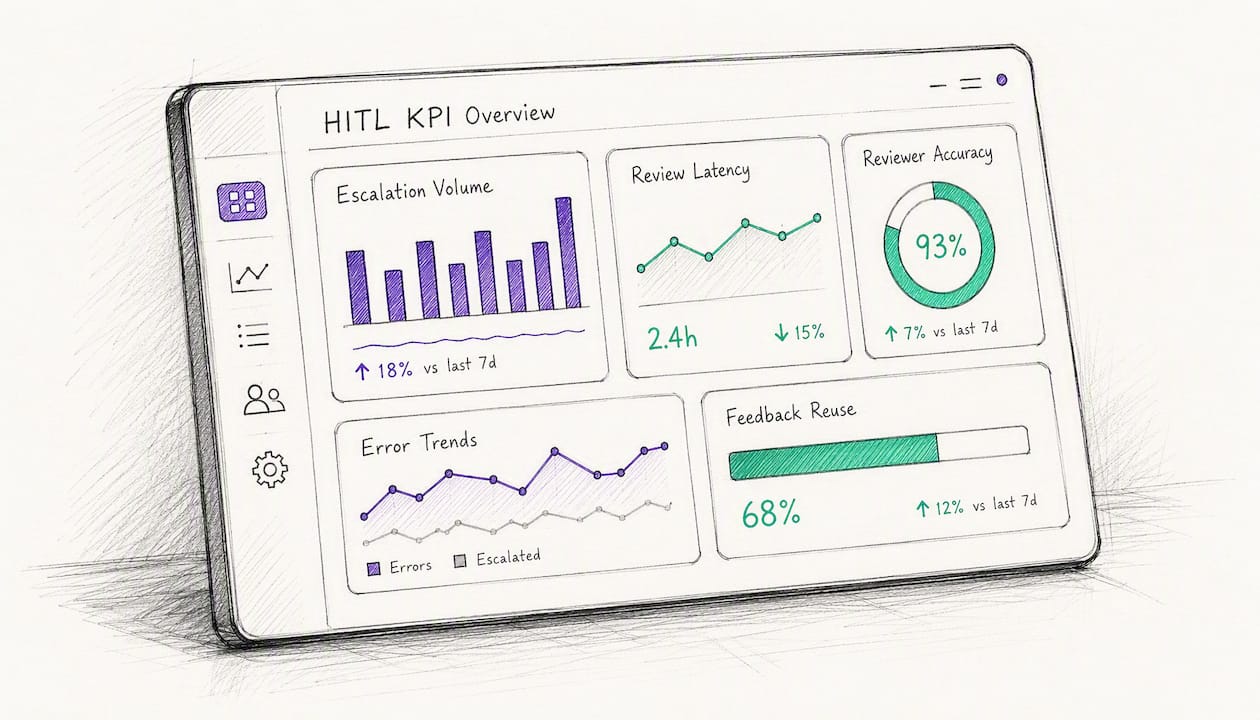
Quality controls to run continuously: periodic audit sampling (pull a random set of reviewed cases and re-score them against a gold standard), inter-rater agreement checks on a shared calibration set, and labeling-version control so you know which model version each training batch corresponds to.
Two measurement traps worth naming explicitly. First, selection bias in escalated sets: the cases humans review are not a random sample of all decisions. Accuracy metrics computed only on escalated cases will overstate or understate model performance on the full distribution. Second, metric drift: as the model improves and the escalation rate drops, the remaining escalated cases skew toward harder edge cases, making reviewer accuracy appear to decline even when nothing has changed in reviewer behavior.
How do you implement HITL in production? A step-by-step checklist
-
Define scope and goals. Identify which decisions need human oversight, the acceptable error rate, and the latency budget. Document this as a one-page decision policy.
-
Choose your design pattern. For most teams starting fresh, Selective Escalation is the right default. Match the pattern to your latency tolerance and staffing capacity.
-
Define the automation boundary. Specify exactly which inputs the model handles autonomously and which trigger human review. Write this as a routing rule, not a vague guideline.
-
Design the review UI and routing logic. Apply the minimal UI checklist above. Build routing rules into the queue system, not the model.
-
Staff and train reviewers. Write decision guidelines before training begins. Run an inter-rater agreement check before go-live. See the AI and tech talent strategy considerations for structuring reviewer roles alongside engineering teams.
-
Capture and pipe feedback. Every reviewed decision should write to a labeled dataset with reviewer ID, timestamp, original model output, and final decision. This is the raw material for the data flywheel.
-
Instrument monitoring and KPIs. Stand up the five-widget dashboard before launch. Set alerts on escalation rate and P95 latency.
-
Plan stage-gated automation increases. Schedule a quarterly review of confidence thresholds. Define the metric targets that justify raising the automation boundary. This is how pragmatic automation adoption compounds value over time.
Minimal tech stack by component: Annotation and labeling (Label Studio, Scale AI, or a lightweight custom UI); queue and routing (a task queue like Celery or a workflow engine like Temporal); audit logging (append-only event store, structured JSON); model training pipeline (MLflow, Kubeflow, or a managed service); monitoring and alerting (Prometheus plus Grafana, or a managed observability platform).
Compliance and security notes: Apply data minimization — reviewers should see only the fields required to make their decision. PII in review queues needs access control and a documented retention policy. Encrypt data at rest and in transit. For regulated industries, maintain an immutable audit log of every human decision with the reviewer’s identity and timestamp. These controls aren’t optional in healthcare, financial services, or government deployments.
In one production engagement, a team processing high-volume document classification routed all low-confidence cases to a two-tier review queue. After several months of feeding reviewed cases back into the training pipeline, the escalation rate dropped significantly and mean review latency improved notably. The model improved because the human work was treated as structured training data from day one, not as a manual correction step bolted on after the fact.
What are the most common HITL anti-patterns, and how do you fix them?
-
Late informal human workarounds. Engineers notice the model is wrong and quietly add a manual correction step outside the formal system. The fix: make human review a first-class workflow component from the start, with routing, logging, and SLAs. DistilledPatterns is explicit that human work should be a planned operating mode, not a patch.
-
Opaque systems that force rubber-stamp reviews. Reviewers approve everything because the interface gives them no context to disagree. The fix: surface the model’s reasoning, confidence score, and relevant evidence. UI research confirms that cognitive load and trust signals directly affect reviewer effectiveness.
-
Overloaded queues. Review latency climbs, SLAs break, and the human step becomes the bottleneck. The fix: monitor P95 latency daily, set capacity alerts before queues saturate, and raise the automation threshold temporarily when volume spikes.
-
Unclear decision guidelines. Reviewers make inconsistent decisions, the training data is noisy, and the model doesn’t improve. The fix: write explicit guidelines, run inter-rater agreement checks quarterly, and version-control the guidelines alongside the model.
-
Ignoring feedback reuse. Reviewed cases sit in a database and never reach the training pipeline. The fix: instrument feedback reuse rate as a first-class KPI and assign ownership of the pipeline to a named engineer.
When to retire human review: Track reviewer accuracy against the model’s autonomous accuracy on the same decision type. When the model’s error rate on previously escalated cases drops to within the margin of reviewer error, and the escalation rate is low enough that the operational cost outweighs the risk reduction, the human step has done its job. Retire it deliberately, document the decision, and keep the audit log.
Further reading and primary sources
These are the primary sources used for this guide. Each one covers a distinct dimension of HITL that is worth reading in full.
-
Stanford HAI — What Is Human-in-the-Loop? Authoritative definition and the “humans in charge” framing that distinguishes genuine oversight from passive presence.
-
Databricks — What Is Human-in-the-Loop (HITL)? Practical coverage of confidence thresholds, risk scoring, and how HITL appears across the AI lifecycle.
-
DistilledPatterns — Human-in-the-Loop Named design patterns, operational anti-patterns, and the case for treating human work as a planned production mode.
-
MDPI Entropy — Systematic Review of HITL Concepts, Methods, and Applications Academic taxonomy of HITL variants by loop placement, interaction granularity, and temporal characteristics; covers scalability and governance challenges.
-
NCBI — HITL in Clinical and High-Stakes Domains Evidence on risk reduction, labeled data generation, and operational cost management in healthcare deployments.
-
IJISAE — Human-in-the-Loop UI Design Research on cognitive load, semantic fidelity, and trust signals in review interfaces for generative AI co-creation.
Ridiculous Engineering builds HITL systems that work in production
Most teams that come to us have already tried to bolt human review onto an existing pipeline and found it doesn’t scale. The queue fills up, the guidelines are vague, the feedback never reaches the model, and the whole thing becomes a manual process with an AI logo on it.
Ridiculous Engineering designs custom AI-powered software where the human oversight layer is an engineered component, not an afterthought. That means a review UI built for the actual reviewer’s cognitive load, routing logic that keeps queues clear, audit logging that satisfies compliance requirements, and a feedback pipeline that makes the model measurably better over time. We work with product and engineering teams at startups, enterprises, and government organizations throughout Colorado and globally. If you’re ready to build a HITL system that holds up under production load, start a conversation with our team.
Sources
AI Development and Automation
Need a HITL system that holds up in production?
We design AI-powered software with the human oversight layer engineered in – review UI, routing logic, audit logging, and feedback pipelines included.
FAQ
What is the human-in-the-loop theory?
Human-in-the-loop theory holds that AI systems perform more reliably and safely when humans retain authority over decisions the model cannot own with sufficient confidence. Stanford HAI frames this as “humans in charge” rather than merely “humans present.”
What does it mean to keep the human in the loop?
Keeping the human in the loop means routing specific decisions to a human reviewer before the system acts, rather than letting the model decide autonomously. In practice, this involves confidence thresholds, review queues, and documented decision logging so every human action is traceable.
What is the human-in-the-loop problem?
The core challenge is operational: adding human review introduces latency, staffing cost, and inconsistency if guidelines are unclear. Systematic review research identifies scalability, trust calibration, and governance as the primary deployment challenges teams must solve.
What does “human out of the loop” mean?
Human-out-of-the-loop (HOOTL) describes a fully automated system where no human is involved in individual decisions. It maximizes throughput and minimizes cost, but removes the safety net and audit trail that regulated or high-stakes applications require.