Enterprise Design Systems: A 2026 Guide for Teams
Enterprise Design Systems: A 2026 Guide for Teams What is an enterprise design system? An enterprise design system (EDS) is a centralized, scalable framework that standardizes how large organizations design and build digital products.
What is an enterprise design system?
An enterprise design system (EDS) is a centralized, scalable framework that standardizes how large organizations design and build digital products. Think of it as the single source of truth that connects design intent to production code, across every team, platform, and product line simultaneously.
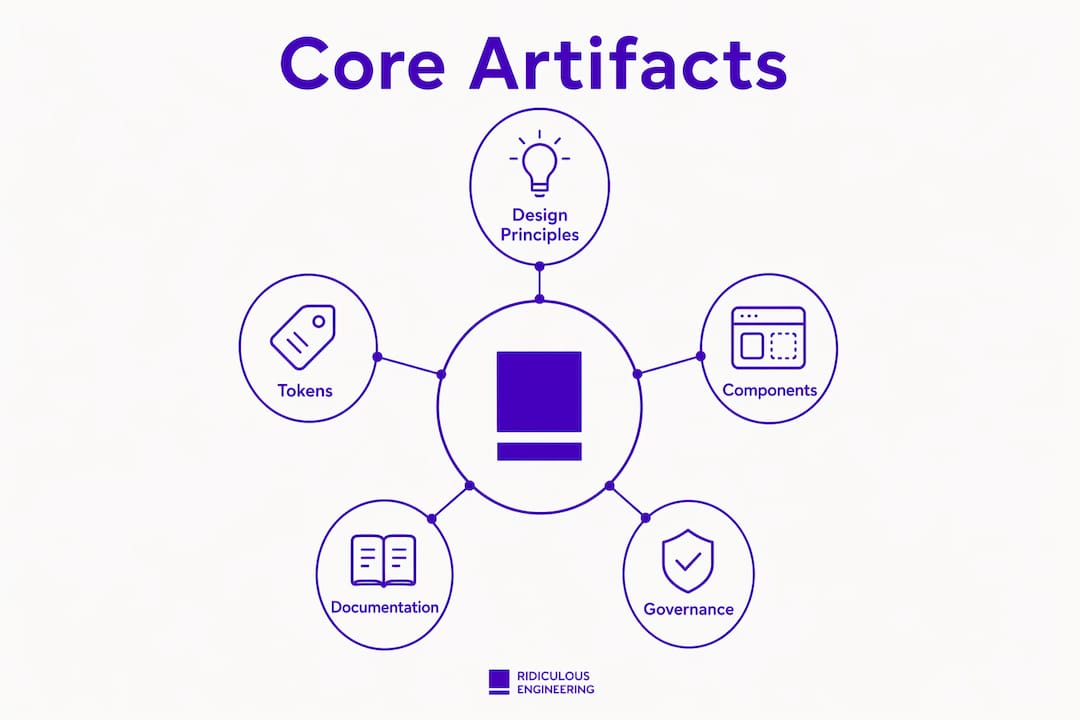
The core elements that make up a functioning EDS are:
- Design principles: The foundational rules that guide every visual and interaction decision, keeping the system coherent even when dozens of teams contribute independently.
- Design tokens: Tech-agnostic style variables covering color, typography, spacing, elevation, and motion. Tokens are the connective tissue between design files and code, and they exist in a three-tier taxonomy: primitive (raw values), semantic (contextual meaning), and component-level (scoped overrides).
- Reusable UI components: Pre-built, tested interface elements and patterns that teams assemble rather than rebuild from scratch.
- Documentation: Usage guidelines, do/don’t examples, accessibility requirements, and API references that make the system usable without a phone call to the core team.
- Governance processes: The workflows, decision rights, and contribution models that determine how the system evolves, who can change what, and how exceptions get handled.
These elements do not operate in isolation. Tokens feed components. Components follow principles. Documentation explains both. Governance keeps all of it from drifting apart over time. The technical artifacts are the entry cost; the governance and social infrastructure are what determine whether the system actually gets used.
Table of Contents
- Why do large organizations invest in design systems?
- What are the core artifacts inside a design system?
- How do you implement a design system that actually gets adopted?
- How governance and social infrastructure sustain a design system long-term
- How do enterprise design systems work in practice?
- Key Takeaways
- Ridiculousengineering builds design systems that ship to production
- FAQ
Why do large organizations invest in design systems?
The business case for a well-built design system is concrete. Teams stop rebuilding the same button for the fourth time. Designers stop arguing about which shade of blue is “the brand blue.” Engineers stop maintaining three slightly different modal implementations across three product lines.
The measurable benefits break down across several dimensions:
- Consistency at scale: A shared component library enforces visual and behavioral standards automatically, without requiring design review on every pull request.
- Faster delivery: When teams pull from a tested library instead of building from scratch, feature development accelerates. The design-to-development handoff shrinks because the vocabulary is already agreed upon.
- Reduced technical debt: Fragmented legacy systems accumulate duplicate components, inconsistent patterns, and undocumented workarounds. A design system gives teams a clear migration target and a deprecation path.
- Cross-team collaboration: A shared language between designers, engineers, and product managers reduces the friction that typically slows down multi-team projects.
- Scalability: As organizations add products, brands, or platforms, a well-structured system absorbs that growth without requiring a full redesign effort.
That kind of adoption shift matters because it directly reduces the maintenance burden on engineering teams and tightens the feedback loop between design changes and production output. The same case study found that integrating CI/CD automation into the token management pipeline cut token change turnaround from weeks to hours. That is not a marginal improvement; it changes how teams plan releases.
For organizations dealing with siloed teams and fragmented legacy systems, a design system also serves as an integration layer. It gives distributed teams a shared reference point without requiring them to coordinate every decision through a central bottleneck.
What are the core artifacts inside a design system?
Understanding what a design system contains is different from understanding how it works. The artifacts are the visible parts; the architecture is what makes them function at enterprise scale.
Design principles
Principles are not a brand manifesto. They are decision-making tools. A principle like “clarity over cleverness” gives a designer and an engineer a shared answer when they disagree about whether a complex animation adds value. Good principles are specific enough to resolve real disputes, not so abstract that they apply to everything.
Design tokens and their taxonomy
Design tokens are tech-agnostic, reusable style variables that carry values for color, typography, spacing, and more across every platform the organization ships to. The three-tier taxonomy matters in practice:
- Primitive tokens hold raw values:
color-blue-500: #0066CC. - Semantic tokens assign meaning:
color-action-primary: {color-blue-500}. - Component tokens scope overrides:
button-background-primary: {color-action-primary}.
This cascade is what makes theming possible. Swap a semantic token value and every component that references it updates automatically, across React, iOS, Android, and any other platform consuming the token set. The single most impactful technical decision in building a scalable design system is committing to a tokens-first architecture before writing a single component.
Reusable components and patterns
Components are the most visible artifact, but they are also the most commonly misunderstood. A component is not just a styled div. It carries accessibility semantics, interaction states, responsive behavior, and documented API contracts. Patterns sit one level above components: they describe how multiple components combine to solve a recurring UX problem, like an empty state, a data table with filters, or a multi-step form.
Documentation
Documentation is where most design systems quietly fail. A component that ships without usage guidance, accessibility notes, and clear do/don’t examples forces every consuming team to reverse-engineer the intent. Good documentation answers the question a developer has at 4 PM on a Friday without requiring them to file a ticket. Pairing documentation with software testing documentation practices helps teams maintain quality standards across the full component lifecycle.
The Hub-and-Spoke architecture
For organizations managing multiple brands or product lines, the Hub-and-Spoke model centralizes brand foundations in a global core while allowing localized token overrides in experience domains. A global retail brand, for example, might maintain a single core token set for typography and spacing while allowing regional teams to override color palettes for local market compliance. This balances consistency with the flexibility that large, distributed organizations actually need.
Pro Tip: Build your token taxonomy before you build your first component. Retrofitting a token layer onto an existing component library is significantly harder than designing the cascade from the start, and the rework cost compounds with every component you add.
How do you implement a design system that actually gets adopted?
Building a design system is the easier half of the problem. Getting teams to use it, trust it, and contribute back to it is where most enterprise efforts stall. The practices below address both the technical and organizational dimensions of adoption.
Start with naming conventions and token-first architecture
Naming is governance in disguise. A token named color-blue-500 is a primitive. A token named color-action-primary is a decision. The semantic layer is where the system’s intent lives, and consistent naming conventions make that intent legible to every team consuming the system. Establish naming standards before the first component ships and document the rationale, not just the rules.
Build cross-functional contribution models
A design system maintained by a single team is a bottleneck waiting to happen. Effective systems define clear contribution models: what any team can propose, what requires core team review, and what requires broader stakeholder sign-off. The contribution workflow should classify requests before debating solutions, splitting them into usage questions, local gaps, and shared system changes. That classification alone eliminates most unnecessary review cycles.

Choose the right governance structure
Governance models exist on a spectrum from centralized to federated to hybrid. Centralized ownership works when the product surface is unified and brand risk is high. Federated models work when multiple teams have legitimate variation needs and the core team cannot stay close to every product decision. Most mature organizations land on a hybrid: a small core team owns foundational tokens and primitives, while distributed product champions handle domain-specific patterns.
- Centralized: Core team owns all standards and approvals. Fast for consistency, slow for scale.
- Federated: Product teams contribute within a defined framework. Faster, but requires strong contribution guardrails.
- Hybrid: Core team sets direction and quality bar; product teams contribute within clear boundaries. The model that holds up in practice.
Track adoption metrics that matter
Production usage and design-to-code parity are the metrics that reveal true system health. Install counts and Storybook views tell you nothing about whether teams are actually shipping with the system. Instrument your components to report usage in production, and audit design files periodically to measure how closely they match the implemented components.
Integrate with CI/CD and automate quality gates
Governance that lives only in documentation gets ignored under deadline pressure. Incorporating automated quality gates into CI pipelines, pull requests, and design QA workflows enforces standards without requiring manual review on every change. Linting token usage, running accessibility checks, and validating component API contracts automatically keeps drift from accumulating silently.
Pro Tip: Treat deprecation as a first-class workflow, not an afterthought. Every component that enters the system should have a documented path out of it, including migration guidance and a timeline. Teams that discover a component is deprecated with no migration path will fork it instead of upgrading, and you will end up maintaining both.
How governance and social infrastructure sustain a design system long-term
The technical artifacts of a design system are table stakes. What separates a system that thrives from one that quietly gets abandoned is the operating model behind it. Design system governance defines how change enters the system, who is accountable for quality, how exceptions get handled, and how the system adapts when product needs outgrow current patterns.
Governance roles and decision rights
A functional governance model answers three questions quickly: what can a team decide on its own, what needs shared review, and how does a local exception either expire or become part of the system. Clarity on these questions prevents the core team from becoming a review queue and prevents product teams from making unilateral changes that create drift.
Effective governance typically defines three tiers of roles:
- Core team: Owns foundational tokens, primitives, system direction, and the quality bar. Manages releases and handles cross-team escalations.
- Product team contributors: Propose and implement domain-specific patterns within the contribution framework. Closest to the customer problem.
- Design system advocates: Embedded in product teams, these individuals champion adoption, surface friction points, and serve as the first line of support for their team’s design system questions.
The advocate role deserves more attention than it usually gets. Allocating 20% of an advocate’s time to design system work, rather than treating it as a side responsibility, is what makes the social infrastructure real rather than nominal. Without embedded advocates, adoption support falls entirely on the core team, which cannot scale.
Contribution and review workflows
A practical contribution flow classifies the request before anyone debates the solution. Usage questions, local gaps, and shared system changes each follow different review paths with different evidence requirements and turnaround expectations. Treating exceptions as time-boxed decisions, rather than permanent carve-outs, prevents the exception list from becoming a parallel system.
Drift detection and quality enforcement
Drift happens when teams make local overrides that never get reconciled with the system. Detecting it requires both automated tooling and periodic audits. Automated checks in CI catch token overrides and undocumented component variants before they merge. Quarterly audits of production UIs against the design system reveal patterns that have diverged over time and need either a system update or a migration.
Pro Tip: Run an RFC (Request for Comments) process for significant system changes. Publishing a proposed change with a comment period before implementation gives product teams advance notice, surfaces edge cases the core team missed, and builds the trust that makes teams willing to adopt changes rather than resist them.
The best governance models function like a flexible operating system, not a rulebook. When teams understand the reasoning behind a constraint, they can apply it correctly in edge cases without escalating every decision to the core team. That is the difference between governance that scales and governance that becomes a bottleneck.
How do enterprise design systems work in practice?
The scenarios below illustrate how the concepts above play out in real enterprise environments, where the challenges are rarely purely technical.
Multi-brand theming with Hub-and-Spoke
A financial services company managing three distinct brands under one engineering organization uses a Hub-and-Spoke token architecture. The global core defines typography scale, spacing system, and motion standards. Each brand’s experience domain overrides color palettes and border radius values through semantic token remapping. Product teams consume the brand-specific token set without needing to understand the global core, and a change to the global spacing scale propagates to all three brands automatically.
Integration across heterogeneous platforms
Enterprise environments rarely run on a single technology stack. A design system serving React web applications, a Tableau reporting layer, and a Power Platform internal tool suite needs token outputs in multiple formats: CSS custom properties for web, JSON for Tableau extensions, and XML for Power Platform themes. A well-structured token pipeline, often built with tools like Style Dictionary, generates all three from a single source of truth. The development-design alignment required to make this work across teams is significant, but the alternative is maintaining three separate style systems that drift apart immediately.
Migration from legacy systems
Migrating an existing product suite to a new design system is one of the harder practical challenges. Teams face:
- Adoption resistance: Engineers who have built muscle memory around existing patterns are reluctant to relearn them, especially under delivery pressure.
- Parallel maintenance burden: During migration, both the old and new systems need to be maintained, which doubles the support load temporarily.
- Incomplete coverage: The new system rarely covers every pattern the legacy system accumulated over years. Teams hit gaps and either wait for the core team or fork components.
Mitigation requires a phased migration plan with clear milestones, a coexistence strategy that lets teams migrate screen by screen rather than all at once, and a gap registry that makes missing patterns visible and prioritized. Connecting the design system to your broader legacy system integration strategy prevents the migration from becoming an isolated effort that competes with product delivery.
Design-to-development handoff in CI/CD workflows
When token pipelines are automated and components are published through a versioned package registry, the handoff between design and development becomes a version number rather than a Figma export. Designers update tokens in the design tool, a CI job generates updated token files, and a pull request lands in the component library repository for review. Engineers consume the updated package version. The automated pipeline removes the manual translation step that typically introduces inconsistencies between design intent and production output.
Key Takeaways
Enterprise design systems succeed when technical rigor and organizational infrastructure are built together, not sequentially.
| Point | Details |
|---|---|
| Tokens-first architecture | Committing to a token taxonomy before building components is the single most impactful technical decision for scalability. |
| Adoption metrics that matter | Track production usage and design-to-code parity, not install counts or Storybook views, to measure true system health. |
| Governance as operating system | Effective governance defines who decides what, how exceptions expire, and how contributions get reviewed, without becoming a bottleneck. |
| Social infrastructure | Embedding design system advocates with dedicated time allocation on product teams is what makes adoption sustainable at scale. |
| Ridiculousengineering’s approach | Ridiculousengineering builds and integrates design systems as part of end-to-end custom software engagements, connecting token architecture to production CI/CD workflows. |
Ridiculousengineering builds design systems that ship to production
Most design system projects stall between the Figma library and the codebase. Ridiculousengineering closes that gap. As a Colorado-based software engineering consultancy, we design and build custom software that includes the full stack: token architecture, component libraries, governance models, CI/CD integration, and the cross-functional alignment work that makes teams actually use what gets built. We work with enterprises that need a system connected to their real technology environment, whether that is React, a headless CMS, a data platform, or a legacy stack in mid-migration.
The difference between a design system that gets adopted and one that collects dust is usually not the quality of the components. It is whether the system was built with the engineering workflow, the governance model, and the product team’s delivery pressure in mind from day one. That is the kind of problem we are set up to solve. Reach out through our services page to talk through what your organization actually needs.
FAQ
What is an enterprise design system?
An enterprise design system is a centralized, scalable framework of design principles, tokens, reusable components, documentation, and governance processes that large organizations use to standardize design and development across multiple teams and platforms.
How is a design system different from a component library?
A component library is one artifact inside a design system. A full design system also includes design tokens, usage documentation, contribution workflows, governance models, and the social infrastructure that drives adoption across teams.
What governance model works best for large organizations?
Most mature organizations use a hybrid model: a small core team owns foundational tokens and system direction, while product teams contribute domain-specific patterns within a defined framework. Pure centralized control rarely scales, and pure federation risks drift without strong contribution guardrails.
How do you measure design system adoption effectively?
Production usage and design-to-code parity are the most reliable indicators of system health. Vanity metrics like download counts or Storybook views do not reflect whether teams are actually shipping with the system in production.
How long does it take to implement an enterprise design system?
There is no universal timeline, but many organizations see meaningful adoption within months when they start with a tokens-first architecture, a clear governance model, and embedded product team advocates from the beginning. The enterprise security resilience parallel is apt: both require sustained organizational commitment, not a one-time implementation effort.
Recommended
- Exploring Tech-Enabled DEI Solutions: A Comprehensive Guide | Ridiculous Engineering
- Bridging the Gap: Integrating Emerging Technologies with Legacy Systems | Ridiculous Engineering
- Product Engineering: Think Like Machines, But Create Like Humans | Ridiculous Engineering
- 7 Ways to Improve Development-Design Alignment in Product Design | Ridiculous Engineering