Multi-Tenant Architecture: A Practical Guide for Architects
Multi-Tenant Architecture: A Practical Guide for Architects Multi-tenant architecture is a software design approach where a single application instance serves multiple customers — called tenants — while keeping each tenant’s data and behavior isolated from every other.
Multi-tenant architecture is a software design approach where a single application instance serves multiple customers — called tenants — while keeping each tenant’s data and behavior isolated from every other. The practical verdict on model selection: treat tenancy as a tiered product decision. Start pooled for cost-sensitive, lower-risk customers; use a hybrid or bridge model when your customer mix is uneven; and provision dedicated silo infrastructure for enterprise or regulated tenants who require contractual isolation.
The three primary trade-offs every team navigates:
-
Isolation vs. cost: Stronger isolation means dedicated resources, which means higher per-tenant spend.
-
Complexity vs. flexibility: Shared models are cheaper to operate but require rigorous application-level enforcement to prevent data leakage.
-
Speed vs. compliance: Pooled architectures onboard tenants in seconds; silo models may take minutes to hours but satisfy auditors and enterprise procurement teams.
Table of Contents
-
How do you scale a multi-tenant platform without hurting performance?
-
How Ridiculous Engineering approaches multi-tenant architecture
-
Working with Ridiculous Engineering on your multi-tenant platform
What does “multi-tenant” actually mean?
A tenant is a distinct organization, account, or logical customer unit sharing the platform. A single enterprise might have thousands of users, but they all belong to one tenant. The tenant boundary is the logical or physical line that separates one tenant’s data, configuration, and behavior from another’s.
Contrast that with single-tenant architecture, where each customer gets a dedicated application instance and database. Single-tenant deployments are simpler to reason about but expensive to operate at scale. Multi-tenancy lets one application instance serve many customers, which is why most SaaS platforms adopt it to scale from tens to thousands of customers without rearchitecting the core system.
The business goals that push teams toward multi-tenancy are consistent: lower infrastructure cost per customer, a single deployment surface for updates and patches, and reduced operational overhead. The technical goals are equally consistent: data isolation between tenants, tenant-aware request routing, per-tenant monitoring, and the ability to enforce different configurations or feature sets per account.
What are the main tenancy models?
AWS guidance frames isolation as a continuum from Silo to Pool, with Bridge models in between. That framing is the most useful mental model for making architecture decisions.
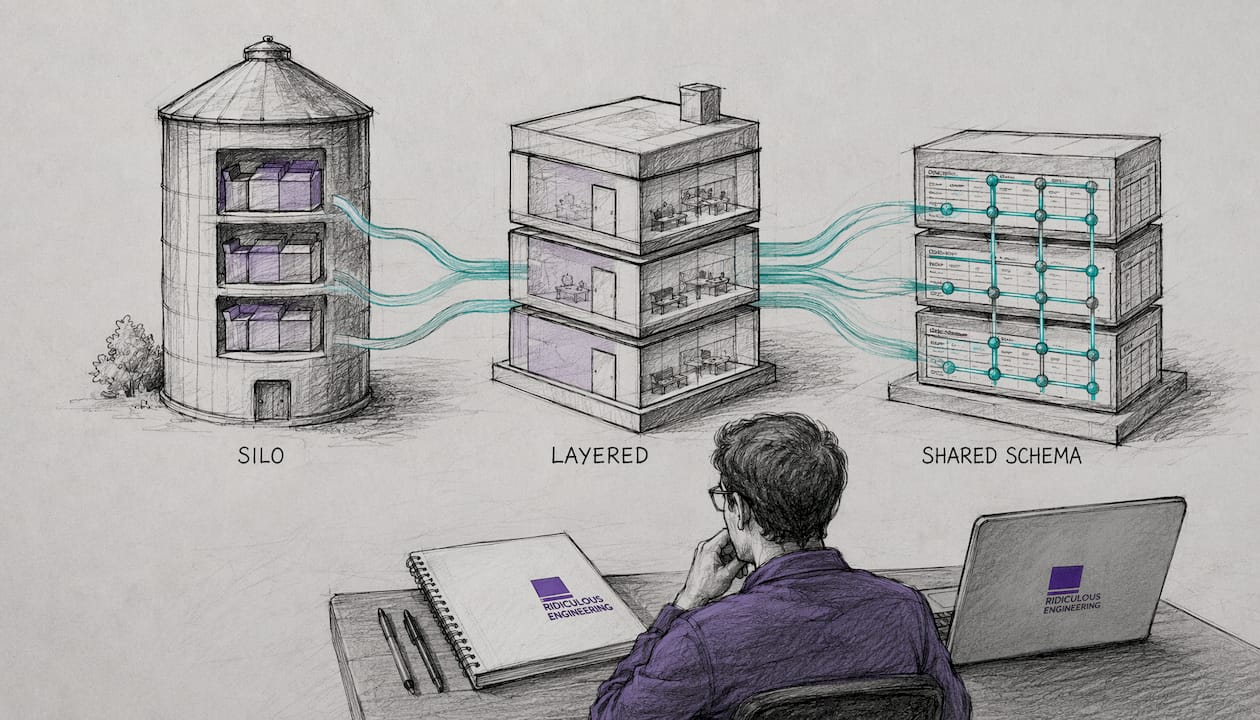
Silo (dedicated stack per tenant)
Each tenant gets its own application stack and database. Isolation is maximal: a bug, breach, or noisy workload in one tenant cannot affect another. Compliance auditors love it because data residency and access controls are straightforward to demonstrate. The cost is real, though. Infrastructure overhead scales linearly with tenant count, and operational complexity grows with every new deployment. Per-tenant restore is simple because each database is already scoped to one customer.
Schema-per-tenant (shared database, separate schemas)
All tenants share a database engine but each gets its own schema. This model sits between silo and fully pooled: you get meaningful logical separation without the cost of separate database instances. Schema-per-tenant works well when tenant count is in the hundreds rather than thousands, because schema proliferation eventually creates migration and connection-pooling headaches. Online schema migrations require careful versioning to avoid locking multiple tenants simultaneously.
Shared schema (row-level isolation)
One database, one schema, every tenant’s rows coexisting in the same tables. This is the lowest-cost model and the one that demands the most discipline. Row-level security requires a tenant_id filter on every read and write. Miss one query, and you have a data leak. PostgreSQL’s Row Level Security (RLS) policies or application-layer middleware can enforce this automatically, but the risk of a missing filter is real and the consequences are severe.
Bridge and hybrid models
A bridge model mixes pooled compute with varying degrees of storage isolation. A common pattern: shared application tier, but per-tenant databases for storage. Azure’s Deployment Stamps pattern takes this further by deploying dedicated infrastructure for a tenant or group of tenants, then scaling by adding stamps. Stamps can be single-tenant or multitenant, giving teams a clean upgrade path when a pooled tenant outgrows shared resources.
Tenancy model comparison
| Dimension | Silo | Schema-per-tenant | Shared schema | Bridge/Hybrid |
|---|---|---|---|---|
| Isolation level | Strong (physical) | Moderate (logical) | Weak (application-enforced) | Configurable |
| Cost per tenant | High | Medium | Low | Medium-High |
| Implementation complexity | High (ops overhead) | Medium | Low-Medium | High |
| Scalability | Linear cost growth | Hundreds of tenants | Thousands of tenants | Flexible |
| Compliance suitability | Excellent | Good | Requires evidence | Good-Excellent |
| Customization capability | Full | High | Limited | High |
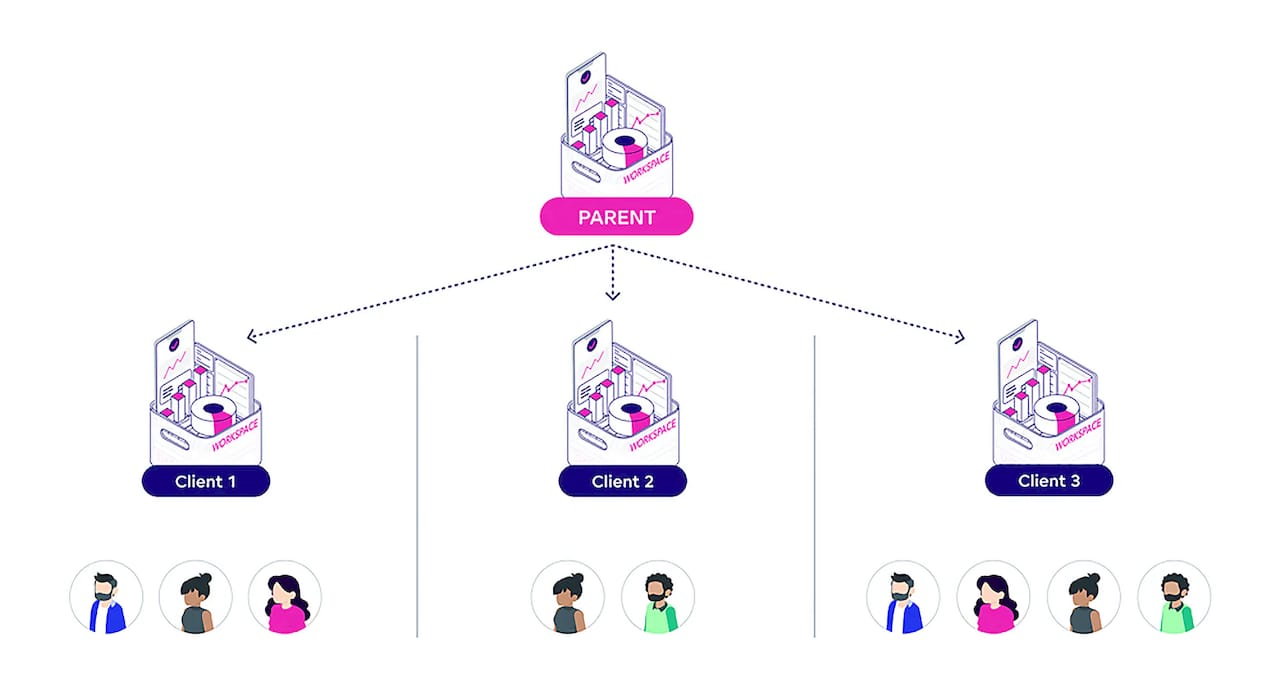
Pro Tip: Don’t treat this table as a final answer. Most production platforms end up using at least two models simultaneously: pooled for standard tiers, silo or stamp for enterprise contracts. Design your abstractions to support both from day one.
How do you choose the right tenancy model?
The decision is not purely technical. Treating tenancy as a product feature — something you price and package — is what separates platforms that capture enterprise revenue from those that leave it on the table.
Work through these criteria in order:
-
Regulatory and compliance requirements. If any tenant will be subject to HIPAA, PCI DSS, or SOC 2 Type II audits, start with silo or schema-per-tenant for those accounts. Shared-schema isolation is difficult to audit convincingly.
-
Contractual data residency. Enterprise customers increasingly require data to stay within specific geographic boundaries. Silo or stamp models make this straightforward; shared-schema models require careful database-level controls.
-
Enterprise SLA commitments. If you are promising 99.9%+ uptime with dedicated support windows, a noisy neighbor in a pooled model is an SLA liability.
-
Price sensitivity of your customer base. SMB and self-serve customers rarely pay enough to justify dedicated infrastructure. Start pooled for these segments.
-
Team maturity and automation level. Silo models require mature infrastructure automation. If your team cannot provision a new tenant stack in under five minutes with zero manual steps, the operational overhead will hurt you.
-
Workload variability. Highly variable or bursty workloads benefit from pooled resources because uncorrelated workloads flatten peak-to-average ratios. Predictable, high-volume tenants are better candidates for dedicated resources.
The practical decision flow: start pooled if your customer profile is unknown or SMB-dominated. Move to a hybrid model as soon as you sign your first enterprise customer with isolation requirements. Reserve full silo for regulated industries or customers with contractual data-residency obligations.
Pro Tip: Avoid the all-or-nothing trap. Platforms that commit to a single tenancy model across all customers either overspend on isolation for low-value accounts or lose enterprise deals because they cannot offer dedicated infrastructure. Build your tenancy tier into your pricing model from the start, even if you only have one tier today.
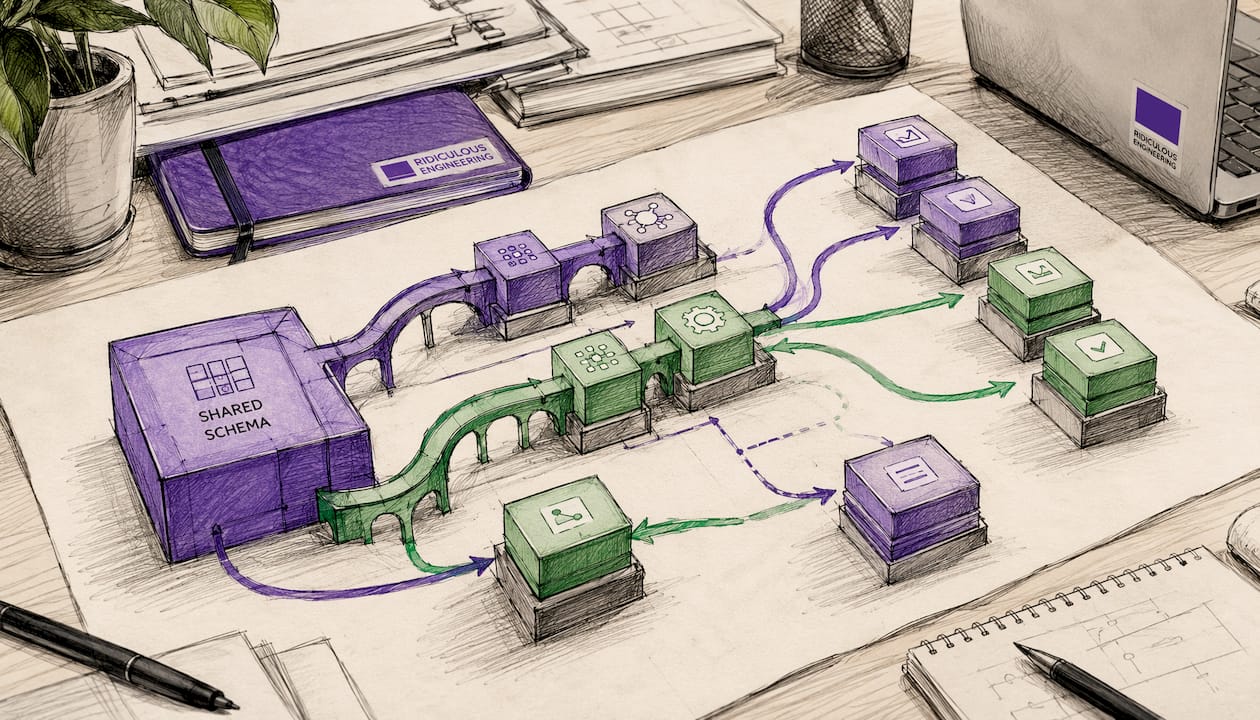
Teams that start fully pooled to save costs often face noisy-neighbor issues that are expensive to remediate later. Starting hybrid — pooled for lower tiers, isolated for enterprise — avoids that re-architecture cost. Aligning tenancy decisions with business objectives early is one of the highest-leverage decisions an architecture team makes.
Implementation checklist for multi-tenant systems
Getting the architecture model right is half the battle. The other half is the engineering discipline to implement it correctly. These are the building blocks that matter most.
Tenant identity and routing
-
Assign every tenant a stable, immutable
tenant_idat creation and treat it as a first-class citizen in every layer of the stack. -
Propagate tenant context through the request lifecycle: HTTP headers, middleware, database connections, and async job queues all need to carry it.
-
Use subdomain routing (
tenant.app.com), path-based routing (/api/tenant/{id}/), or JWT claims to resolve tenant identity at the edge before the request reaches application logic.
Data partitioning and connection pooling
-
For shared-schema models, enforce
tenant_idfilters at the data access layer automatically, not at the call site. Hard-coding tenant logic at the call site creates subtle security failures and maintenance debt. -
Use PgBouncer or a similar connection pooler to manage database connections efficiently across large tenant pools; per-tenant connection limits prevent one tenant from exhausting the pool.
-
For schema-per-tenant models, automate schema creation and destruction as part of the provisioning and offboarding lifecycle.
Authentication and authorization
-
Support per-tenant identity providers: enterprise customers will want to bring their own SAML or OIDC provider.
-
Enforce tenant-scoped roles and permissions so a user authenticated in Tenant A cannot access Tenant B’s resources, even with a valid token.
-
Use tools like Auth0, Okta, or AWS Cognito with tenant-aware claims to avoid building identity infrastructure from scratch.
Provisioning and migrations
-
Automate tenant provisioning completely. If provisioning requires manual schema writes or human steps, the system is effectively multi-instance, not multitenant.
-
Version all schema migrations and apply them in a backward-compatible way so you can roll out changes to thousands of tenants without downtime.
-
Maintain a tenant registry (a metadata store) that tracks each tenant’s tier, configuration, provisioning state, and assigned resources.
Backups, DR, and metering
-
Define per-tenant recovery SLAs and test restore procedures for individual tenants, not just full-database restores.
-
Collect per-tenant usage metrics (API calls, storage, compute) from day one and integrate them with your billing system. Platforms like Manaxo illustrate how SaaS products map usage data to billing tiers in practice.
-
Enforce quotas and rate limits per tenant to protect shared resources.
CI/CD and release strategy
-
Use feature flags to roll out changes to a subset of tenants before full deployment. This is the safest way to test tenant-specific customizations without risking the full fleet.
-
Automate CI/CD pipelines to deploy tenant-specific configuration alongside application code.
-
Anti-patterns to avoid: hard-coded tenant logic in application code, manual provisioning steps, and insufficient per-tenant observability.
Pro Tip: Instrument your system to emit tenant-tagged metrics and logs from the first day of development. Retrofitting observability into a running multitenant platform is painful and expensive. Tenant-aware logging is not optional — it is the only way to debug production issues without exposing one tenant’s data while investigating another’s.
Security and compliance in multi-tenant environments
Multi-tenant security is not a single control. It is a layered set of decisions that compound across the architecture.
-
Encryption at rest and in transit: Encrypt all tenant data at rest using AES-256 or equivalent, and enforce TLS 1.2+ for all data in transit. For highly regulated tenants, consider field-level encryption for sensitive columns so even database administrators cannot read raw values.
-
Tenant-scoped IAM: Apply least-privilege access controls at every layer. Cloud IAM policies, database roles, and application permissions should all be scoped to the tenant. No cross-tenant access should be possible through normal application paths.
-
Audit logging: Tag every log entry with
tenant_id, store logs in a tamper-evident system (AWS CloudTrail, Azure Monitor Logs), and retain them for the period required by applicable regulations. SOC 2 auditors will ask for this. -
Data residency: For U.S. data-residency requirements, use cloud region pinning and confirm that managed services (backups, replicas, analytics exports) also stay within the required region. Silo and stamp models make this easier to demonstrate.
-
PCI DSS: Cardholder data must be isolated. A shared-schema model is not a viable path for PCI scope without significant compensating controls. Silo or schema-per-tenant is the practical choice.
-
HIPAA: Protected health information requires a Business Associate Agreement with your cloud provider and demonstrable access controls. Per-tenant encryption keys and audit logs are baseline requirements.
-
Breach containment: Design tenant boundaries so a compromised application credential cannot traverse tenant lines. Per-tenant encryption keys mean a key compromise affects one tenant, not all of them.
-
Incident response: Maintain per-tenant runbooks so your on-call team can isolate, investigate, and restore a single tenant without affecting others. Operational resilience planning should include tenant-scoped incident scenarios.
This article is general technical guidance, not legal or compliance advice. Confirm your specific regulatory obligations with qualified legal counsel and your compliance team.
How do you scale a multi-tenant platform without hurting performance?
Scaling a multitenant platform is less about raw capacity and more about protecting tenants from each other while keeping costs predictable.
-
Group uncorrelated workloads. Clustering tenants with unrelated usage patterns flattens peak-to-average load ratios across pooled resources. A tenant whose peak is Monday morning paired with one whose peak is Friday afternoon is a better pool than two tenants with identical Monday morning spikes. This is one of the highest-leverage capacity planning decisions available to platform teams.
-
Per-tenant quotas and rate limiting. Enforce API rate limits, query time limits, and storage quotas per tenant. When a tenant hits a limit, throttle or queue their requests rather than letting them degrade the pool. This is the primary noisy-neighbor mitigation.
-
Topology escalation. When a tenant’s workload consistently exceeds what throttling can contain, move them to a dedicated resource tier. This is not a failure of the architecture; it is the upgrade path working as designed.
-
Autoscaling and serverless. Serverless compute (AWS Lambda, Azure Functions) handles variable workloads well for pooled tiers because you pay per invocation rather than per provisioned instance. For stamped deployments, autoscaling groups with pre-warmed capacity handle predictable growth. See infrastructure scaling patterns for practical guidance on high-traffic readiness.
-
Database scaling. Connection pooling is critical at scale. For shared-schema models, a single PgBouncer instance can manage thousands of tenant connections against a small number of actual database connections. For schema-per-tenant, Aurora Serverless or similar managed databases reduce the cost of idle schemas.
-
Per-tenant metrics and cost attribution. Instrument the platform to attribute compute, storage, and network costs to individual tenants. This data drives pricing decisions and identifies tenants whose usage does not cover their infrastructure cost.
How do you manage the full tenant lifecycle?
Tenancy is a product feature, not just a technical concern. The lifecycle from onboarding to offboarding needs to be as deliberate as any other product capability.
-
Zero-touch provisioning: Pooled tenants should be fully provisioned in seconds through an automated pipeline: create tenant record, assign
tenant_id, apply default configuration, send welcome credentials. No human steps. Automating onboarding is what separates a platform from a collection of manually managed instances. -
Provisioning artifacts: Each tenant provisioning event should produce a complete set of artifacts: schema or database creation, configuration blobs, secrets stored in a secrets manager (AWS Secrets Manager, HashiCorp Vault), API keys, and an entry in the tenant metadata registry.
-
Tier upgrades and migrations: Define a clear upgrade path for moving a tenant from pooled to schema-per-tenant to dedicated database to full silo. Each step should be automated and tested. The Azure tenancy models guidance describes how successful platforms use pooled tiers for standard users and isolated stamps for enterprise customers, and that pattern requires a tested migration path between tiers.
-
Customization management: Use feature flags (LaunchDarkly, Unleash, or a homegrown flag store) to manage tenant-specific feature availability. Store tenant configuration in a dedicated config store, not in application code. Extension points should be well-defined and sandboxed.
-
Billing and metering: Collect usage metrics continuously and map them to billing tiers. For regulated SaaS products, platforms like Intelligent Assessments demonstrate how tiered pricing maps to compliance-sensitive customer segments. Enforce hard quotas before billing cycles close to avoid surprise overages.
-
Offboarding: Define a tenant deletion process that removes or archives all tenant data, revokes credentials, releases resources, and produces a deletion audit record. GDPR and CCPA both require demonstrable data deletion on request.
What do reference architectures look like in practice?
AWS multi-tenant guidance
The AWS Guidance for Multi-Tenant Architectures organizes the design space around the Silo/Bridge/Pool continuum. In a pooled AWS architecture, tenants share ECS or Lambda compute, a single RDS or Aurora cluster, and a shared API Gateway with tenant-aware authorizers. In a silo architecture, each tenant gets its own VPC, RDS instance, and IAM role boundary. The bridge model typically shares compute (ECS tasks or Lambda) while isolating storage (per-tenant RDS instances or S3 prefixes with bucket policies).
AWS recommends using Amazon Cognito with custom attributes for tenant-aware identity, AWS IAM for resource-level isolation in silo models, and Amazon CloudWatch with tenant-tagged metrics for observability across all models.
Azure deployment stamps
Microsoft’s Azure Architecture Center describes the Deployment Stamps pattern as a way to scale multitenant platforms by deploying self-contained units of infrastructure. A stamp might serve one enterprise tenant (single-tenant stamp) or a group of pooled tenants (multitenant stamp). Adding capacity means adding stamps, not scaling a monolithic shared cluster. This approach gives teams strong isolation guarantees while retaining the ability to pool smaller tenants within a stamp.
Salesforce as a canonical example
Salesforce is the most widely cited example of large-scale multitenancy in enterprise SaaS. The platform serves hundreds of thousands of organizations on shared infrastructure using a combination of application-layer isolation, per-tenant metadata, and a proprietary query engine that enforces tenant boundaries at the data access layer. The key lesson from Salesforce’s architecture is not the specific technology but the principle: tenant isolation must be enforced at the data layer, not left to individual developers to remember at the call site.
SAP BTP and enterprise platforms
SAP’s reference architecture for multitenant SaaS on BTP follows similar principles: tenant isolation, automated onboarding and offboarding, resource sharing with governance controls, and tenant-level configuration for enterprise extensions. Enterprise platforms consistently converge on the same patterns regardless of the underlying technology stack.
How Ridiculous Engineering approaches multi-tenant architecture
Ridiculous Engineering is a Colorado-based software engineering consultancy that has designed and delivered production multitenant platforms for clients across regulated industries, SaaS startups, and enterprise software teams. Our process is deliberate and starts with discovery before any model is chosen.
Our typical engagement follows this sequence:
-
Discovery and constraint mapping: We document SLA targets, compliance requirements (HIPAA, PCI, SOC 2), expected tenant scale at 12 and 36 months, customization requirements, and team automation maturity. These inputs determine the starting tenancy model.
-
Tenancy decision and architecture design: We recommend a starting model and define the upgrade path. For most clients, that means pooled for initial launch with a defined migration path to schema-per-tenant or silo for enterprise accounts.
-
Automation and provisioning: We build zero-touch tenant provisioning pipelines before writing application features. Provisioning is a first-class engineering deliverable, not an afterthought.
-
Staged implementation: We implement tenancy controls at the data access layer, not the call site, and validate them with automated tests that simulate cross-tenant access attempts.
-
Runbook and ops handoff: We deliver documented runbooks for tenant onboarding, tier upgrades, incident response, and offboarding so your team can operate the platform independently.
Our work on the Consus CMS platform illustrates how platform-level thinking about tenant isolation and cloud architecture translates into production systems that scale without re-architecture. We evaluate the same constraints on every engagement: compliance controls, expected tenant scale, customization depth, and the team’s capacity to operate what we build.
Key Takeaways
Treat tenancy as a tiered product decision: start pooled for cost efficiency, add isolation tiers as compliance and enterprise requirements demand, and automate every step of the tenant lifecycle from day one.
| Point | Details |
|---|---|
| Start pooled, plan for isolation | Begin with a shared-schema or pooled model for SMB customers and define the upgrade path to silo before you need it. |
| Enforce tenant_id at the data layer | Apply tenant filters automatically at the data access layer, not at individual call sites, to prevent data leakage. |
| Automate provisioning completely | Manual provisioning steps mean you have multi-instance, not multitenant; push-button onboarding is a non-negotiable baseline. |
| Instrument per-tenant metrics early | Tag logs and metrics with tenant_id from day one; retrofitting observability into a live platform is expensive and error-prone. |
| Ridiculous Engineering designs for this | Ridiculous Engineering builds production multitenant platforms with automated provisioning, tiered isolation, and compliance-ready architecture. |
Useful sources and further reading
Architects looking to go deeper on implementation details have several authoritative references worth bookmarking:
-
AWS Guidance for Multi-Tenant Architectures: The primary AWS reference for the Silo/Bridge/Pool continuum, with sample architectures, CDK constructs, and guidance on tenant-aware identity using Amazon Cognito.
-
Azure Architecture Center: Multitenant Solutions: Microsoft’s comprehensive series covering architectural considerations, deployment stamps, service-specific guidance, and a practical implementation checklist for Azure-hosted multitenant platforms.
-
Azure Tenancy Models: Focused guidance on choosing between tenancy models, with trade-off analysis and upgrade path recommendations.
-
Shopify: Multi-Tenant Architecture Best Practices: A practitioner-oriented overview of how app developers scale from tens to thousands of merchants, with concrete implementation patterns.
-
SAP Architecture Center: Multitenant SaaS on BTP: Enterprise-focused reference architecture covering tenant isolation, onboarding, resource governance, and configuration management for SAP BTP extensions.
-
Ridiculous Engineering resources: For implementation help, case studies, and architecture engagements, see ridiculousengineering.com.
Working with Ridiculous Engineering on your multi-tenant platform
Building a multitenant platform correctly from the start costs less than fixing one that was built wrong. The most expensive architecture decision most teams make is committing to a single tenancy model without a migration path, then discovering two years later that their enterprise pipeline requires dedicated isolation they cannot deliver.
Ridiculous Engineering’s custom software development practice is built around exactly this kind of architecture work: discovery-first, constraint-driven, and delivered with the automation and documentation your team needs to operate it long-term. We work with SaaS startups, growing platforms, and established enterprises across Colorado and beyond. If you are designing a new multitenant system or modernizing an existing one, the right time to get architecture right is before the first enterprise customer asks for dedicated isolation. Reach out to start a conversation about your platform’s tenancy requirements.
FAQ
What is an example of a multi-tenant application?
Salesforce is the most widely cited example: hundreds of thousands of organizations share the same application infrastructure, with tenant isolation enforced at the data access layer. Shopify follows the same pattern for e-commerce merchants.
What are the main drawbacks of multi-tenant architecture?
The primary drawbacks are noisy-neighbor risk (one tenant’s workload degrading others), increased application complexity from tenant-aware filtering and routing, and the difficulty of demonstrating isolation to compliance auditors in shared-schema models.
What is the difference between single-tenant and multi-tenant architecture?
In a single-tenant architecture, each customer gets a dedicated application instance and database. In a multi-tenant architecture, one application instance serves multiple customers, with isolation enforced through application logic, schema separation, or physical resource boundaries depending on the model chosen.
What does multi-tenant architecture mean in Salesforce?
Salesforce uses a shared-infrastructure model where all customer organizations run on the same application platform. Tenant isolation is enforced through a proprietary metadata-driven query engine that automatically scopes every data operation to the requesting organization, making cross-tenant data access impossible through normal application paths.
When should you use a silo model instead of a pooled model?
Use a silo model when a tenant has regulatory requirements (HIPAA, PCI DSS), contractual data-residency obligations, or enterprise SLA commitments that shared infrastructure cannot reliably satisfy. For most SMB or self-serve customers, a pooled model is the cost-effective default.
Recommended
-
Composable Architecture Strategy 2026 | Ridiculous Engineering
-
Modernizing Digital Infrastructure for a Pacific Northwest Credit Union | Ridiculous Engineering
-
Transformative Growth with Cloud Computing | Ridiculous Engineering | Ridiculous Engineering
-
How Composable Architecture Enables Adaptability | Ridiculous Engineering