Replatforming in 2026: A Strategic Guide
Ecommerce Replatforming: A Strategic Guide for 2026 What is ecommerce replatforming and why does it matter?
Replatforming – moving your business to a new software platform – is one of the highest-stakes projects a company can take on. This guide uses ecommerce replatforming as its running example, because online stores show every replatforming challenge in its sharpest form: data migration, SEO preservation, zero-downtime cutover, and post-launch performance. Everything here applies to any platform migration.
What is ecommerce replatforming and why does it matter?
Ecommerce replatforming is the process of migrating your online store’s product data, customer records, order history, design, and integrations from one platform to another. It is not just a technical upgrade. It is a fundamental business decision that determines whether your commerce infrastructure accelerates growth or quietly throttles it.
Legacy platforms accumulate constraints over time: slow release cycles, brittle integrations, and mounting technical debt. When your team spends more energy working around the platform than building on it, that is the signal. Modern replatforming moves businesses toward composable architectures, AI readiness, and ecosystems that can evolve without another full migration in three years.
Key drivers that push businesses to replatform:
-
Inability to launch new features without significant custom development
-
Performance degradation under peak traffic loads
-
Integration failures with modern ERP, CRM, or fulfillment systems
-
Rising maintenance costs on aging, customized codebases
-
Competitive pressure from merchants running faster, more personalized experiences
Ridiculousengineering works with businesses at exactly this inflection point, designing and building custom ecommerce solutions that fit how each organization actually operates.
Table of Contents
-
Big bang vs. strangler pattern: which migration approach fits your business?
-
How to engage a custom software engineering consultancy for replatforming
-
How to evaluate platforms and technology stacks before you commit
-
Ridiculousengineering builds ecommerce platforms that don’t need replacing in three years
Big bang vs. strangler pattern: which migration approach fits your business?
Two primary strategies define most ecommerce platform migrations, and the choice between them carries real consequences.

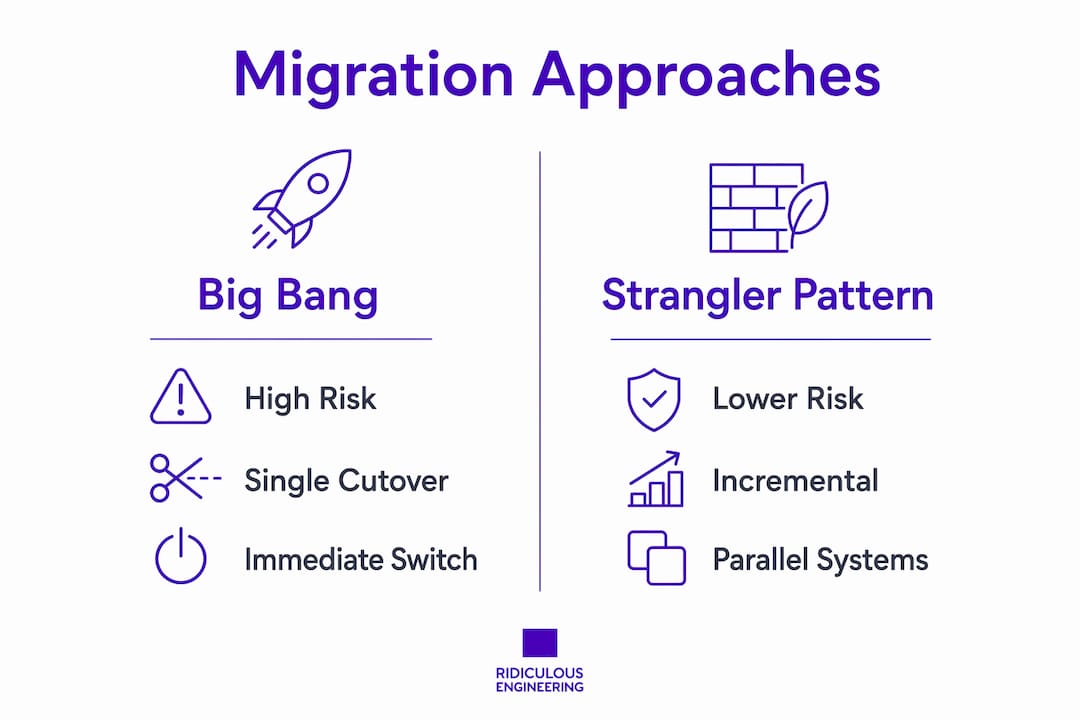
The big bang approach cuts over all at once. The old platform goes dark, the new one goes live, and every team deals with the transition simultaneously. It is faster to plan and simpler to coordinate, but the risk is concentrated at a single moment. Any data mapping error, integration failure, or performance issue hits your entire customer base at once.
The strangler pattern replaces functionality piece by piece while the legacy and new systems run in parallel. A business might migrate one product category, validate it, then move the next. Industry best practice has shifted decisively toward this phased approach for complex ecommerce environments, because it distributes risk across the timeline rather than concentrating it at a single cutover.
| Factor | Big Bang | Strangler Pattern |
|---|---|---|
| Risk profile | High, concentrated | Lower, distributed |
| Downtime exposure | Significant | Minimal |
| Validation opportunity | Post-launch only | Iterative, per phase |
| Complexity | Lower planning overhead | Higher coordination |
| Best fit | Smaller stores, simple catalogs | Mid-market to enterprise |
Practical considerations when choosing: catalog size, number of third-party integrations, subscription or loyalty program complexity, and how much revenue you can afford to put at risk during a cutover window.
The real benefits of moving to a modern ecommerce platform
Enterprises replatform to become AI-ready and unlock faster innovation, moving from rigid monolithic systems to composable ecosystems that improve continuously. The operational benefits are concrete:
-
Faster innovation velocity: Modular architectures let teams ship features independently without touching unrelated systems.
-
AI readiness: Modern platforms support data analytics pipelines, personalization engines, and automation that legacy stacks simply cannot accommodate.
-
Scalability: Composable commerce allows swapping or upgrading individual components without requiring another full migration, future-proofing your infrastructure.
-
Reduced technical debt: Clean architecture lowers the cost of every subsequent change.
-
Higher uptime: Modern cloud-native platforms are built for the traffic spikes that break older infrastructure.
Challenges and risk management you need to plan for
Data migration is where most replatforming projects lose value quietly. A substantial portion of key business assets like review content, loyalty points, and active subscription contracts can be lost if they are not migrated as distinct data entities outside the product catalog. Migrating only essential data — active products, recent orders, and current customer profiles — keeps the new system lean; historical data can remain archived separately.
SEO risk is the other major exposure. Every URL change without a proper 301 redirect strategy erodes link equity built over years. Metadata, canonical tags, and XML sitemaps all need explicit migration plans before launch day.
Pro Tip: Avoid the big bang cutover for any merchant where a few hours of degraded checkout performance would cause material revenue loss. The strangler pattern costs more to coordinate but pays for itself in risk reduction.
Other risks to plan for explicitly:
-
Integration failures with ERPs, payment gateways, and fulfillment providers
-
Organizational misalignment when teams have not agreed on scope and rollback criteria
-
Change management gaps when staff training lags behind the go-live date
Strong organizational alignment and defined roles across every team involved are not soft requirements. They are what separates migrations that land cleanly from ones that drag on for months past the original deadline.
How to engage a custom software engineering consultancy for replatforming
Choosing a consultancy is not primarily a technology decision. It is a judgment about whether a team can translate your business requirements into architecture decisions and then execute them without losing either thread.
Start by assessing your own priorities: Are you optimizing for speed to market, long-term flexibility, AI integration, or cost reduction? A consultancy worth engaging will push back on vague goals and help you define measurable outcomes before a line of code is written.
Evaluate expertise across the full stack: composable architecture, API design, data migration, UX, and post-launch support. A trusted partner ecosystem with fast integrations reduces time to market and total cost of ownership. Custom engineering makes sense when your business logic is genuinely differentiated and off-the-shelf platforms would require so much customization that you are effectively building custom software anyway.
Ridiculousengineering brings together software engineering, solution architecture, UX design, business analysis, and product management under one engagement model, which means the team that designs your architecture is the same team that builds and supports it.
What does a replatforming timeline actually look like?
A typical mid-market migration runs 8–16 weeks. Complex enterprise projects with deep customizations and many integrations can extend to several months. The phases are consistent regardless of platform:
-
Discovery and audit (weeks 1–2): Catalog all data entities, integrations, custom functionality, and SEO assets.
-
Architecture and platform selection (weeks 2–4): Define the target stack, data model, and integration architecture.
-
Build and data migration (weeks 4–10): Develop the new environment in parallel; migrate data in validated batches.
-
Integration and testing (weeks 8–14): Connect third-party systems; run end-to-end and load tests in staging.
-
Launch and stabilization (weeks 14–16+): Execute cutover or final phase; monitor closely for the first 30 days.
Post-launch, the first few weeks are a critical stabilization period. Keep engineering resources available, watch conversion rates and error logs daily, and treat any anomaly as urgent until the platform proves stable under real traffic.
What does ecommerce replatforming actually cost?
Costs vary widely based on catalog complexity, integration count, and whether you are building custom or configuring an existing platform. A realistic budget framework:
The biggest budget risk is scope creep on integrations and custom business logic. Define integration requirements explicitly before signing any contract, and build a contingency of at least 15–20% into your total project budget.
How to evaluate platforms and technology stacks before you commit
Platform selection should follow requirements, not the other way around. Build your evaluation framework around these criteria:
-
Composability: Can individual components be swapped without a full migration? Modular architectures reduce long-term lock-in.
-
API coverage: Does the platform expose the APIs your integrations require, or will you be working around gaps?
-
AI and analytics readiness: Can the platform feed clean data to personalization and forecasting tools?
-
Total cost of ownership: License fees are only one line item. Factor in developer time, integration maintenance, and upgrade costs.
-
Uptime and SLA: For revenue-critical commerce, anything below 99.9% historical uptime is a conversation-stopper.
-
Headless capability: Separating the frontend from commerce logic gives teams independent deployment cycles and ecommerce development flexibility.
Post-replatforming: keeping performance strong after launch
The migration is not the finish line. Performance optimization and scalability planning begin the day the new platform goes live.
Monitor Core Web Vitals, checkout conversion rates, and API response times weekly for the first quarter. Set up automated alerting so degradation surfaces before customers notice. Establish a regular cadence for dependency updates and security patches — the technical debt clock starts ticking again the moment you stop maintaining the codebase.
For scalability, design for the traffic you expect in 18–24 months, not just today. Horizontal scaling, CDN configuration, and database query optimization are the three levers that matter most under load. If you built on a composable architecture, you can upgrade individual services as demand grows without touching the rest of the platform.
What real replatforming outcomes look like
Real migrations produce measurable results when the strategy is sound. The Conran Shop moved from a heavily customized Adobe Commerce instance to a unified platform and saw a 50% reduction in total cost of ownership alongside a 54% increase in conversion rate. CarBahn consolidated three separate WooCommerce sites into one in 10 weeks, resulting in a faster site and cleaner architecture on a single domain.
The pattern across successful projects is consistent: clear scope, phased validation, strong data mapping, and a team that stays engaged through stabilization rather than handing off at go-live.
Ridiculousengineering builds ecommerce platforms that don’t need replacing in three years
Most replatforming projects fail not because of bad technology choices but because the engineering team and the business team never fully aligned on requirements. Ridiculousengineering’s custom software development practice is built around closing that gap. We handle architecture, data migration strategy, integration engineering, UX, and post-launch support as a single engagement, so nothing falls through the handoff cracks.
If your current platform is limiting what your team can ship, or if a previous replatforming project left you with a system that already feels dated, we can help you scope a path forward that fits your actual business, not a template. Contact Ridiculousengineering to start the conversation.
Key Takeaways
Phased ecommerce replatforming, grounded in clear data mapping and composable architecture, consistently delivers lower risk and better long-term outcomes than a single big bang cutover.
| Point | Details |
|---|---|
| Choose phased over big bang | The strangler pattern distributes risk and allows iterative validation before full cutover. |
| Protect non-product data | Reviews, loyalty points, and subscriptions need explicit migration plans or they disappear. |
| Budget for the full scope | Engineering, integrations, QA, and post-launch support all carry real costs beyond platform licensing. |
| Evaluate composability first | Platforms that allow component-level upgrades prevent another full migration in three years. |
| Ridiculousengineering | Provides end-to-end custom ecommerce replatforming from architecture through post-launch support. |
Replatforming & Migration
Planning a replatforming project?
We handle architecture, data migration, integrations, and post-launch support as a single engagement – so nothing falls through the handoff cracks.
FAQ
What is the difference between ecommerce replatforming and data migration?
Data migration moves your products, orders, and customer records to a new system. Replatforming includes data migration plus new integrations, updated operational processes, and often a redesigned storefront.
How long does an ecommerce replatforming project take?
A typical mid-market migration runs 8–16 weeks. Enterprise projects with complex integrations and deep customizations can take several months.
What is the strangler pattern in ecommerce migration?
The strangler pattern replaces platform functionality piece by piece while the legacy and new systems run in parallel, reducing risk by distributing it across the project timeline rather than concentrating it at a single cutover.
When should a business choose custom engineering over an off-the-shelf platform?
Custom engineering makes sense when your business logic is genuinely differentiated and configuring an existing platform would require so much custom development that you are effectively building custom software anyway.
How does Ridiculousengineering approach ecommerce replatforming?
Ridiculousengineering combines software engineering, solution architecture, UX design, and product management in a single engagement, covering everything from initial data mapping through post-launch stabilization and ongoing support.
Recommended
-
Unlocking eCommerce Success with Data Analytics | Ridiculous Engineering
-
Low-Code/No-Code: Transforming Ecommerce Development | Ridiculous Engineering
-
The Retail Evolution: Unifying Digital and Physical Frontiers | Ridiculous Engineering
-
Composable Architecture Strategy 2026 | Ridiculous Engineering